There are decades of mistrust, hatred, violence and lies to overcome. In fact, more than a century if one goes back to the Balfour Declaration and the Jewish settlements of the 1920s.
By Tom Arms | London
Peace in Gaza has hit a snag. Actually it has hit three but one is bigger than the others.
This is not surprising. No one but a total naiveté could have thought that total peace and harmony would have descended once Donald Trump had spoken.
There are decades of mistrust, hatred, violence and lies to overcome. In fact, more than a century if one goes back to the Balfour Declaration and the Jewish settlements of the 1920s.
But back to the present day when both sides have been accusing the other of bad faith and breaches of the ceasefire/peace agreement. Hamas has accused the Israeli Defense Forces (IDF) of continuing to fire on their fighters. They also complain that the promised aid has not arrived. The Israelis are angry that Hamas is slow in returning the bodies of dead hostages.
The IDF admits that since the ceasefire it has shot and killed Hamas fighters. Hamas claims that 24 have died. The Gaza Ministry of Health puts the death toll at four. The number, however, is less important than the fact that Palestinians who should be alive are dead.
Israel says that the Palestinians who died attacked Israeli soldiers and that they reserve the right to defend themselves. They probably did attack. How they attacked we do not know because journalists are now allowed inside Gaza. But we do know that the IDF has a reputation for shooting boys who throw stones. Hamas, however, has a reputation for ruthlessness and an inability to control its fighters.
Hamas’s other complaint is linked to a complaint from Israel—the supply of aid. There are three crossings from Israel into Gaza: Rafah, Erez and Kerem Shalom. All aid must go through these land crossings as Israel maintains a tight naval blockade. Two of the crossings are still closed by Israel. Therefore not enough aid is getting through and the Gazans are continuing to starve to death.
The Israeli government, however, is under pressure from the hostage families to withhold aid until all the bodies of the dead hostages are returned.
But the problem is that the Hamas leadership does not know where all the bodies are. Some are held by splinter groups who oppose the peace deal negotiated by Hamas. Many of them, however, are dead because they were killed by collapsing buildings and tunnels bombed by Israeli missiles and artillery shells. Hamas has asked for Turkish experts in earthquake rescue work to help in the recovery of bodies. But this will take time. In the meantime, Gazans continue to starve and Israeli hostage families grieve without the bodies of their loved ones.
The above are just some of the immediate problems facing the implementation of Donald Trump’s 20-point peace plan. The long-term ones involving governance, security and the rebuilding of Gaza appear insurmountable.
One of the key element of the plan is the International Stabilization Force (ISF) which will be responsible for building a police force without Hamas representation and providing overall security for Gaza until the Palestinians can assume full control. So far, Qatar, Indonesia, Azerbaijan and the United Arab Emirates, have offered help. But the establishment of ISF is still months away. Who acts as policemen in the interim? Is it Hamas who is supposed to be disbanding and disarming and at the moment is conducting public executions of opponents? It cannot be the IDF.
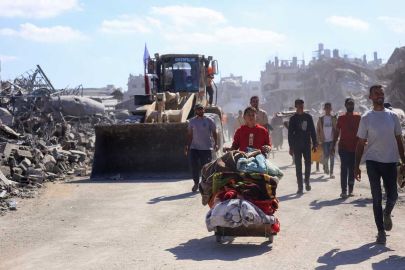
The UN estimates that it will take at least five years and cost $67 billion to rebuild Gaza. Eight-five to ninety percent of Gaza’s buildings have been reduced to rubble. Sixty million tons of debris has to be cleared. It cannot be done be quickly because the rubble contains unexploded bombs and human remains.
Clearing the debris is a recycling engineer’s dream. All 60 million tons will have to be sorted and separated. Plastic, steel, wood and household effects will need to be removed. When that is completed the remaining concrete can be ground up and re-used.
Once the ground has been cleared of debris, builders can start reconstructing infrastructure such as sewage pipes, water and electricity. More than 70 percent of Gaza’s essential infrastructure has been destroyed.
Moving the equipment and supplies needed for reconstruction is another major logistical headache. The land crossings from Israel are inadequate and, besides, the transitional government, will want to reduce dependence on the Jewish state. That means they need to build a deep water port so that supplies and equipment can be delivered by container ships.
The cost and organizational skills required, to say nothing of the goodwill requirement from Israel, is staggering. Next month, Egypt is expected to host a donor conference at which the world’s governments will pledge donations. Unfortunately, past such conferences in other parts of the world have been long on promises and short on delivery.
American diplomats are keen to stress that the peace plan is on track despite problems over hostage bodies, aid and occasional clashes. They are right to do so because it maintains momentum which—hopefully—will lead both sides, Palestinian and Israeli–to realize the benefits of peaceful coexistence.
Read: Observations of an Expat: Gaza
_____________________
 Tom Arms is foreign editor of Liberal Democrat Voice. He is also a regular contributor to “The New World” and is the author of “The Encyclopedia of the Cold War” and “America Made in Britain.”