From the rise and rise of the Ottoman Empire to the establishment of the Safavid Empire in Persia, from the emergence of Protestantism in Western Christendom to the explosion of Portuguese shipping into the Indian Ocean, there really was a great deal going on – events, moreover, with historic implications.
By Nazarul Islam | USA
Let me begin this article with my assessment that the great conquerors and Turkish Sultans who fought their wars in Europe did not try to build a modern civilization, but acted in haste to usurp the wealth of the vanquished kingdoms. The Ottomans’ lightning conquests have reshaped the geopolitical landscape of Europe and the Middle East, before the expense of governing a vast territorial empire began to take its toll. Little did the Ottoman Sultans foresee the need of their Jannisarees’ (loyal soldiers) long and continuous military engagements in Europe, could also lead the Ottomans to build a new civilization in the continent.
A quote from the historian Alan Palmer, describes the beginning of the end of Turkish conquests.
“Mahmoud, desperate to defend his capital, sought aid from the most formidable of his neighbors: three flotillas of Russian warships were invited to sail down the Bosphorus to moorings off the Golden Horn. They were followed by a Russian expeditionary force which established advanced headquarters on the Asiatic shore of the Bosphorus at Hünkar İskelesi, a bay some twelve miles up the straits from Constantinople and generally transliterated as Unkiar Skelessi. By early April nearly 30,000 Russians were deployed in defence of Mahmud’s capital, with a camp at Buyukdere on the European shore as well as at Unkiar Skelessi.” (Alan Warwick Palmer: The Decline and Fall of the Ottoman Empire)
An uncomfortable realization had dawned on me as I read Crescent Dawn. Despite being a student history relating to the central Middle Ages (10th-14th centuries), by this book’s ending I saw no alternative but to concede that the 15th and 16th centuries were truly very interesting times. So was the recorded history. Having staved off this conclusion for many years, I simply could not deny the sheer number of world-changing developments taking place at this time. Two years ago, I travelled to the historic, centuries-old small towns and hamlets to understand the landscape, geographical features and cultural responses of the people who are descendants from Portugal, France, Spain and Turkey.
From the rise and rise of the Ottoman Empire to the establishment of the Safavid Empire in Persia, from the emergence of Protestantism in Western Christendom to the explosion of Portuguese shipping into the Indian Ocean, there really was a great deal going on – events, moreover, with historic implications.
All these developments receive attention in this remarkable piece of scholarship by Si Sheppard. In essence, Crescent Dawn provides a detailed military-political history of the Ottoman Empire and its neighbors/adversaries during these crucial centuries. Moving briskly through the empire’s origins in the 13th century as a group of displaced refugees seeking refuge from the Mongols and its early rise to prominence in Western Anatolia during the following century, this history enters its stride as the empire established itself as a major power during the 15th.
Providing detailed discussion on events such as the conquest of Constantinople in 1453, the Ottomans’ persistent wars of expansion into the Balkans, rebellions in Anatolia, and naval battles in the Aegean, the well-known historian Sheppard offers an almost blow-by-blow account of the empire’s many campaigns.
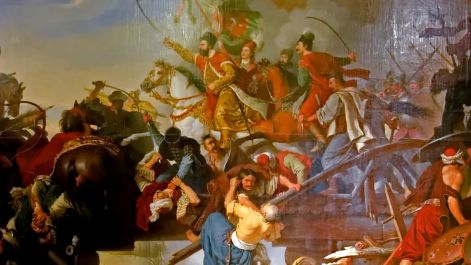
Moving into the 16th century, the discussion turns to the Ottomans’ epic struggle with the Safavids, their defeat of the kingdom of Hungary at the Battle of Mohács (1526), and their bitter duel with the Habsburg Empire. Sheppard also elaborates the Ottomans’ actions on other frontiers, considering, for example, their reactions as the Portuguese reached the Indian Ocean, setting up a network of naval bases and seeking to cut the Ottomans off from the Spice routes.
A key word underpinning Crescent Dawn’s core argument is ‘containment’. Sheppard does not simply provide a history of the Ottoman Empire’s rise; rather this account shows how the empire reached its culmination point – its high-water mark (or thereabouts). In their early years, the sultans carried all before them, but their wars of conquest began to stall as conquest piled on conquest and the sheer bulk and expense of the empire’s vast territorial mass began to take its toll.
Over time, the Ottoman military encountered forces they could not subdue, whether on their European frontiers (the Habsburgs), in the Mediterranean (Italian city states, Habsburgs and Knights Hospitallers), North-west Africa (Saadian Morocco), East Africa (Ethiopia), Persia (Safavids), or in the Indian Ocean (Portuguese). In time, these powers formed a quasi-perimeter around the Ottoman Empire that it was unable to breach and, by the end of the 16th century, the time of sweeping advances was all but over.
Crucially, this is not a history describing a ‘clash of civilizations’ between Christianity and Islam. True, the campaigns of this era included many instances of holy war and brutal acts of religious violence, but the armies blocking the Ottoman advance included both Muslim and Christian protagonists, complicating any simplistic portrayal of these events as solely an inter-faith war. Likewise, Christian Europe confronted the Ottoman advance while in the throes of the Reformation.
Again, Sheppard has made it clear, the doctrinal disunity of Christendom affected its leaders’ efforts to unite against a common adversary. The ongoing struggle between the Holy Roman Empire and the Kingdom of France also diverted attention away from the Ottomans, while the French frequently aligned themselves with Turkish, rather than papal, interests. In other words, this was a complex and messy set of conflicts that defies easy interpretation along religious lines.
This narrative itself is superbly explained and Sheppard is an expert guide. He has the remarkable ability to vividly and succinctly sketch out complex military encounters, whether sieges, naval battles or raids, capturing a real sense of tempo and pace, without any loss of scholarly authority. I frequently found myself catching my breath and – even though I know this history reasonably well – a palpable sense of suspense hovered in the air across the drumbeat of events. More importantly, the bigger global picture comes across very clearly.
The confused and evolving tangle of rivalries and international alliances that ensnared so many different societies during this era – from South East Asia to the Atlantic seaboard – is extremely well explained and you can see how the world (or this chunk of it) took shape as these centuries developed. This is a crucial strength for two reasons: first – and most obviously – because this wide panorama helps to explain the book’s main subject, the rise of the Ottoman Empire; second, because it serves to remind us of the straightforward importance of a really solid work of political-military history.
Too frequently, phrases such as military-political history prompt an instant and yawn-inducing dismissal as indicating something that’s a bit geeky, niche, or tedious. All these assessments are problematic. Even for those with no interest in the cut-and-thrust of early modern warfare, a really thorough and well-researched piece of military-political history can prove invaluable. It can provide a sense of framing that, in turn, can help those interested in other themes – whether economics, theology, gender, architecture etc. – to better grasp the background to the events with which they are concerned.
History is largely situational; once you understand the broader panorama of events, contextualizing an individual or community’s life, then their actions and choices come into sharper focus.
In an era where conflict and war tore apart so many different societies, acquiring a strong understanding of the developing fortunes of war – coupled with all the terrors, hopes, aspirations, and tragedies this entailed – brings so many other dimensions of history into relief. In other words, books of this kind have implications extending far beyond the borders of military-political history – and Crescent Dawn is a case in point.
Among the many battles and sieges that punctuate this work, there are also many fascinating points of detail. Did you know, for example, that the Ottomans seriously discussed the idea of building a channel between the Red Sea and the Mediterranean (i.e. the Suez Canal)? Did you know that some Portuguese commanders considered diverting the Nile so as to weaken the Ottoman Egypt? These are just a couple of examples of such moments among many found across the book.
The final chapter also covers Europe’s ongoing conviction that somewhere in the wider world lay a Christian kingdom ruled by an emperor called Prester John who one day would march to their aid. This particular myth can be traced back to the 12th century and played a centuries-long role in shaping Christendom’s conception of the wider world; in this era, the myth coalesced around the ongoing diplomacy between European powers and the kingdom of Ethiopia.
This is an exciting and thought-provoking book with a great deal to offer. Towards the end, it provides a brief summary of the Ottoman Empire’s history after the 16th century, but I couldn’t help wondering whether Sheppard can be persuaded to offer up a sequel? It would certainly be welcome.
Read: Resurgence of the Ottoman Power
____________________
 The Bengal-born writer Nazarul Islam is a senior educationist based in USA. He writes for Sindh Courier and the newspapers of Bangladesh, India and America. He is author of a recently published book ‘Chasing Hope’ – a compilation of his articles.