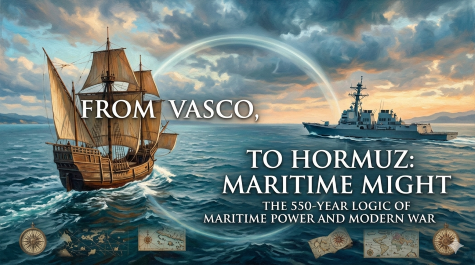
The story that began in 1494 is far from over. What started as a maritime rupture has evolved into a global system where power is exercised through control of movement, of ships, goods, and resources.
By Mohammad Ehsan Leghari
History does not always move in straight lines, but its patterns are often too consistent to ignore. The unfolding crises in West Asia, particularly the intensifying confrontation around Iran and the Strait of Hormuz in 2026, are not isolated geopolitical events. Rather, they represent the continuation of a much older strategic logic, one that began over five centuries ago with the arrival of European naval power in the Indian Ocean. This long arc of history suggests that what we witness today is not merely a modern conflict, but the latest chapter in a 550-year-old struggle for global dominance.
The Lost Order of the Indian Ocean
Before the arrival of European fleets at the close of the 15th century, the Indian Ocean was not a battlefield; it was a shared commercial space. Known in Sanskrit as Ratnakara, or the “mine of gems,” it functioned as a decentralized yet remarkably stable network of trade and cultural exchange. This system was governed less by coercive naval dominance and more by environmental rhythms and ethical norms. The monsoon winds dictated the pace of commerce, compelling merchants from Arabia, East Africa, South Asia, and Southeast Asia to coexist, cooperate, and often reside temporarily in foreign ports. These interactions cultivated a cosmopolitan maritime culture grounded in trust and mutual benefit.
Islam played a particularly important role in shaping this order. The Prophet Muhammad (peace be upon him), himself a merchant, provided a moral and commercial framework that emphasized honesty, contractual integrity, and cross-cultural engagement. Trade was not merely economic; it was civilizational. Equally significant was the existence of indigenous maritime legal systems, such as the Undang-Undang Laut Melaka, which regulated shipping, hierarchy, dispute resolution, and safety. These codes demonstrate that the seas were far from lawless; they were governed spaces with their own constitutional logic.
1494: The Beginning of Maritime Violence
This equilibrium was shattered at the end of the 15th century. The Treaty of Tordesillas in 1494 symbolically divided the non-European world between Spain and Portugal, while Vasco da Gama’s arrival in 1498 physically inaugurated a new era defined by militarized trade. European ships were fundamentally different from the merchant vessels of the Indian Ocean; they were not merely carriers of goods, but floating artillery platforms. The integration of heavy bronze cannons into naval design transformed maritime interaction from negotiation to coercion.
Vasco da Gama’s second voyage in year 1502 demonstrated this shift with brutal clarity. His actions, burning a ship full of pilgrims, bombarding Calicut, and mutilating captives, were not aberrations. They were calculated strategies designed to impose a new order through terror. Under this new paradigm, trade was no longer a shared enterprise; it became a monopoly enforced at gunpoint.
The Cartaz System: From Commerce to Control
The Portuguese institutionalized this violence through the Cartaz system, a naval licensing regime that required all ships to obtain permission and pay fees to operate in the Indian Ocean. This system effectively transformed the ocean into a controlled economic space where ships without permits were seized and crews were often killed. What had once been a free-flowing commercial network was converted into a “toll-gated” maritime empire. This logic of controlling trade by controlling movement did not disappear with the Portuguese; it evolved. Later European empires, and eventually modern global powers, adopted similar strategies, replacing cannons with sanctions, blockades, and surveillance.
Global Expansion and Human Catastrophe
The maritime revolution did not remain confined to the Indian Ocean; it expanded outward, producing one of the most devastating demographic collapses in human history. In the Americas, indigenous populations declined by up to 90% within a century and a half of European contact. Disease, mass killing, forced labor, and ecological disruption combined to dismantle entire civilizations. This was not merely conquest; it was systemic transformation. Ecosystems were reshaped, economies reoriented, and societies restructured to serve external interests. The so-called “discovery” of new lands was, in reality, the beginning of their reconfiguration.
Chokepoints: The Geography of Power
At the heart of this transformation lay a simple but enduring idea: control key maritime chokepoints, and you control global trade. In the 16th century, this meant places like the Strait of Hormuz and the Strait of Malacca. Portuguese strategist Afonso de Albuquerque recognized that dominating a few strategic locations could yield disproportionate power over vast trade networks. By the 20th century, the commodity had changed from spices to oil, but the geography remained almost identical. Hormuz, once vital for spice routes, became indispensable for global energy flows. Pipelines, naval bases, and military alliances were all designed around this enduring reality: whoever controls the chokepoints shapes the global economy.
The Geopolitics of Oil and Intervention
Iran’s modern history reflects this long arc of geopolitical contestation. Its strategic location at the Strait of Hormuz and its vast energy resources have made it a focal point of external intervention. The 1953 coup against Prime Minister Mohammad Mossadegh, triggered by his attempt to nationalize oil, set a precedent for regime change as a tool of economic control. Subsequent decades saw cycles of conflict, including the “Tanker War” of the 1980s, where maritime routes themselves became battlegrounds. These episodes reinforced a consistent pattern: ensuring that no regional power could independently control critical trade corridors.
2026: A Modern Echo of an Old Strategy
The recent military strikes against Iran in 2026, framed in terms of countering nuclear threats and ensuring regional stability, mirror earlier strategies in both form and intent. Technologies have changed; precision-guided missiles have replaced bronze cannons, but the underlying logic remains strikingly similar. The objective is not merely military victory, but strategic reordering: securing chokepoints, ensuring compliant regimes, and maintaining control over global flows of energy and trade.
Conclusion: An Unfinished Historical Project
The story that began in 1494 is far from over. What started as a maritime rupture has evolved into a global system where power is exercised through control of movement, of ships, goods, and resources. The Indian Ocean was once a shared space governed by cooperation and legal pluralism. Its transformation into a contested arena of military and economic dominance marked the beginning of a new world order that continues to shape contemporary conflicts. Understanding today’s crises, particularly in regions like the Strait of Hormuz, requires looking beyond immediate events. It demands recognizing the deeper historical structures that continue to guide global politics. Until the logic of chokepoint control and coercive dominance is replaced by a more equitable framework, the cycle initiated over five centuries ago is likely to persist, adapting in form, but not in essence.
References
Boxer, C.R. (1969) The Portuguese Seaborne Empire, 1415-1825. London: Hutchinson.
Chaudhuri, K.N. (1985) Trade and Civilization in the Indian Ocean: An Economic History from the Rise of Islam to 1750. Cambridge: Cambridge University Press.
Kinzer, S. (2003) All the Shah’s Men: An American Coup and the Roots of Middle East Terror. Hoboken: John Wiley & Sons.
Mahan, A.T. (1890) The Influence of Sea Power upon History, 1660-1783. Boston: Little, Brown and Company.
Yergin, D. (1991) The Prize: The Epic Quest for Oil, Money & Power. New York: Simon & Schuster.
Read: The War, Trade, and Transit
_______________
 Mohammad Ehsan Leghari is a water expert, former Member (Sindh), Indus River System Authority (IRSA), and former Managing Director, SIDA.