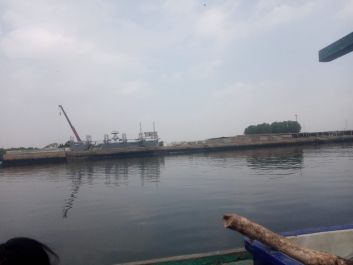
Port Qasim Authority is gradually capturing more islands and creeks, displacing small fishermen’s huts and eroding their historic routes to the deep sea
Farooq Sargani
Port Qasim Authority (PQA) is gradually capturing more islands and creeks, displacing small fishermen’s huts and eroding their historic routes to the deep sea. Dense mangrove forests are being cleared, a trend that has become disturbingly common.
I learnt this during a recent visit near the Indus Delta, where I spoke with fishermen, and boatmen who live in the region’s challenging conditions. Despite adversity, these communities preserve the long-standing traditional culture of Sindh.
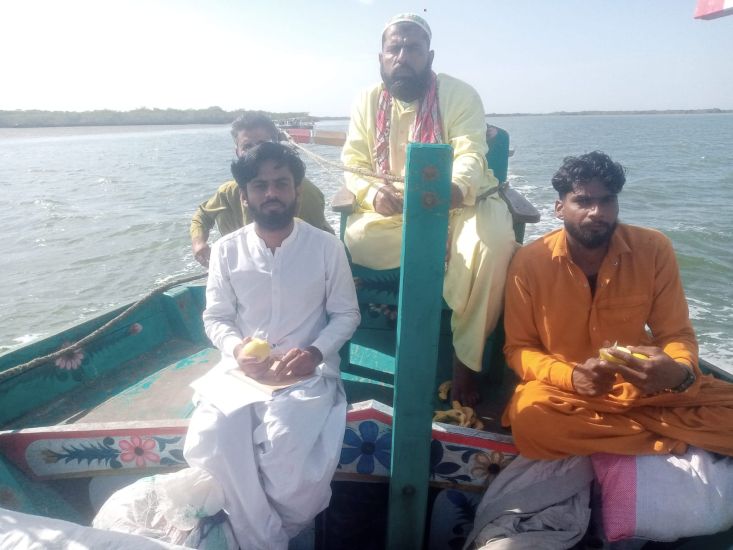 The creeks and islands are not empty spaces to be exploited; each creek has a name and a history spanning centuries. For example, Dhol Channel is believed to have earned its name from the drumming sounds (dhol) heard by locals during nocturnal journeys. The people who lived here relied on fishing for their livelihoods, and their villages were situated on these very islands.
During my visit, I also spoke with Khuda Dino Shah, a notable of fisherman, and president of the Sindh Indigenous Rights Alliance, at Razakabad, Malir. He recalled past celebrations and gatherings that brought fishermen and boatmen together because the season’s earnings allowed for vibrant community events. But that beautiful past has vanished.
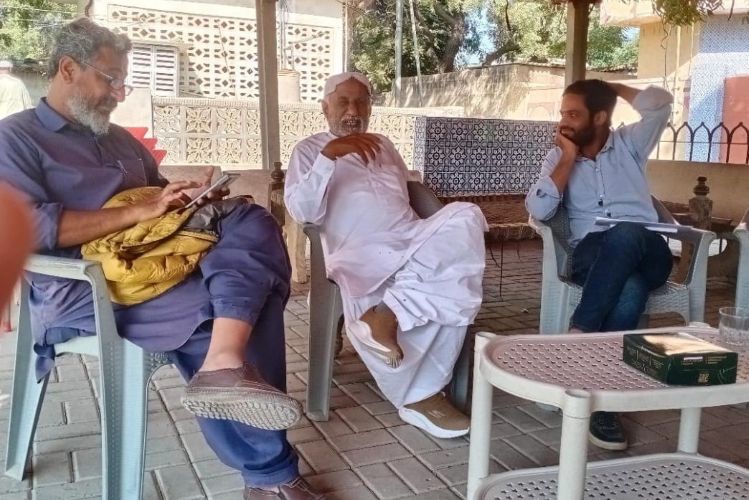 “A drastic future has emerged, marked by the displacement of approximately 31 villages by the Port Qasim Authority,” Shah lamented the promises made by the government —housing and basic necessities—but found the reality stark: there was no pure drinking water, and factories were erected on ancestral lands. He added that indigenous people were offered only second- or third-class jobs.
After speaking with Khuda Dino and Comrade Hafeez Baloch, it became clear to me that the area where Port Qasim is now situated is known as Kuttay Darh. Indigenous researcher and historian Gul Hassan Kalmatti notes in his book Coastal Islands: Charna to Jaki of Sindh that locals refer to the area as Kuttay Darh. Two twin sandy hills once stood along the old Karachi–Gharo road, near where a water tank named Kuttay Darh Bhit was situated before the steel mills’ main entrance toward Gharo.
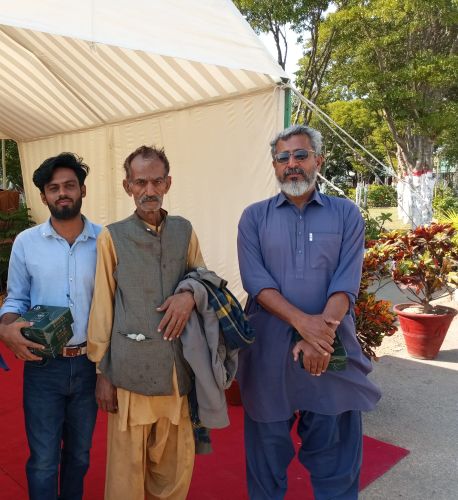 I also spoke with Younis Khaskhaili, a fisherman who possesses deep knowledge of the coastal belt and the Indus delta’s creeks. He estimates there are around 300 islands in the delta, and claims that PQA has annexed more than 100 of them. Khaskhaili denounces PQA’s policies for disregarding indigenous wisdom and knowledge, which has contributed to widespread destruction across creeks. He notes the decline of rear species such as Suoo and Balaster due to illegal dredging by PQA, and he highlights damage to dense mangrove forests. He explains that soil dredged from between creeks is dumped near islands rather than into the deeper sea, contributing to the mangroves’ death within just a couple of months. Mangroves, which support wildlife and species like Jheenga fish (Prawn) and play a crucial role in cyclone protection, are being cleared in ways that favor capitalist interests.
As PQA’s activities expand, Phitti Creek, Chan Creek, and the small islands they encompass are being affected by what is framed as development. Indigenous people and their historical routes are disappearing, and environmental crises are mounting. The region faces threats to various species that rely on the marine environment, raising urgent questions about the future of this coastline.
In summary, Port Qasim’s ongoing dredging, island annexations, and industrial expansion are displacing indigenous communities, erasing centuries-old cultural and economic practices, and degrading crucial ecosystems. The result is not just a loss of homes and livelihoods, but an environmental crisis that endangers the region’s biodiversity, resilience, and cultural heritage.
Read: The Hidden Crisis of Jhimpir
_______________
The author is freelance writer. He has graduated from Karachi University