The encounter between poetry and visual art is not merely an aesthetic luxury, but an artistic necessity that opens doors to deeper understanding and multifaceted appreciation
Souad Khalil | Libya
Art, in all its forms, has long been a means of expressing the deepest human emotions and ideas. Poetry and painting, in particular, have played a distinctive role in conveying these sensations indirectly, where thought takes shape through words and through colors. Despite the difference in mediums, the bond between them remains strong: poetry embodies words to create mental images and emotional meanings, while painting employs colors and lines to materialize these feelings in visual compositions.
The shared language between poetry and painting lies in their ability to express emotions and sensations that cannot be confined to words or colors alone. They go beyond mere representation to interpret reality and inner feelings in ways that allow each viewer or reader to perceive them according to their own sensibility. Both attempt to capture a moment and reshape it artistically, granting the recipient freedom of contemplation and interaction with meaning.
 Hence, the relationship between painting and poetry is not merely one of proximity between two arts, but rather a relationship that emanates from the human spirit and intellect. It contributes to building a bridge of understanding between words and colors, between mind and body, and between consciousness and emotion.
In this article, we seek to explore the points of similarity and intersection between the poem and the painting, the hidden language they share, and how a poem can transform into a painting, and a painting into a silent poem that speaks through color and shadow.
Salah Hassan Rashid states that the ancient East recognized communication between the arts and the world of the word. At first glance, the relationship between the visual arts and poetry may appear ambiguous to the ordinary reader, yet it is crystal clear to the cultivated reader and specialists alike. There are countless ties and close connections between the worlds of image and word, between painting and poem, between painter and poet. What unites the arts is the unbridled imagination, the visionary outlook, and the capacity for astonishment and wonder.
Many poems gained widespread recognition due to being read through a visual and aesthetic lens, clearly influenced by Cubist and Surrealist artistic movements. Likewise, numerous artworks and exhibitions have captivated audiences by drawing upon the influence of poetry and language. In the Arab world, interest in this relationship began not long ago. In the early twentieth century, the great Egyptian painter Salah Taher expressed intellectual and philosophical poems by the genius Abbas Mahmoud Al-Aqqad through visual works that astonished Al-Aqqad himself, as well as the visitors of his salon and lovers of literature, art, and culture during the 1940s.
In his book *Surrealism in the Eyes of Mirrors*, the writer and translator Amin Saleh—recently published by the General Egyptian Authority for Cultural Palaces—affirms this cultural truth, one that the West preceded us in exploring when its writers, painters, and critics discussed the extent of fusion between poetry and painting, the interpenetration of image in verse and idea in visual taste, and the mutual influence between the two. As a result of our contact with the West in the modern era, the Surrealist movement reached us with its intellectual, philosophical, and artistic tributaries, revealing the relationship between poetry and visual art, and between the beautiful word and dazzling images.
Amin Saleh notes that at the beginning of the twentieth century, young poets were influenced by oil painting, while the generation following World War I sought their direction among visual artists, moving toward a more visual form of poetry. These poets established intimate relationships with painters such as Picasso, Braque, and Derain. André Breton placed words and visual images on the same footing as tools of Surrealist exploration. Thus, painters, poets, and writers collectively contributed to probing the Surreal reality beyond appearances. The relationship between painting and poetry became profoundly close, as painting represented the most fertile field of suggestion for poetry.
Amin Saleh further explains that painting ceased to be merely a tool for representation, illustration, or decoration of literary books. When painters undertook the task of illustrating poets’ works, they did not attempt to describe poetic images, but rather created new images that expanded the meaning of verbal imagery. This is evident in Picasso’s illustrations of Max Jacob’s poems, Max Ernst’s drawings for Breton’s *The Castle of the Stars*, Tanguy’s illustrations for Péret’s Sleep, Sleep in the Stones*, and Dalí’s images for Lautréamont. Painting, therefore, is not indebted to literary forms, but to the poetic spirit that breathes life into all artistic forms.
André Breton stated that poetry seems to have discovered in painting its widest field for exercising influence, enabling painting to reveal to consciousness the power of spiritual life. At the present time, there is no fundamental difference in artistic ambition between a poem by Paul Éluard or Péret and a painting by Max Ernst, Miró, or Tanguy. André Lhote asserted that the poem and the painting are complementary, and that Surrealist poetry and painting do not tolerate objective representation of a rational subject; rather, they expand it beyond logic.
Amin Saleh also emphasizes that Dadaism, followed by Surrealism, witnessed an exceptional collaboration between poets, painters, and musicians. Never before had poetry and visual art interacted so intensely. Poets painted, painters wrote poetry. When reviewing the names of visual artists, whether within the Surrealist movement or beyond it, we find that many practiced painting alongside poetry, such as William Blake, Hugo Ball, Tristan Tzara, El Greco—whom Élie Faure considered a painter of the metaphysical spirituality of the world—Jean Arp, Max Jacob, Francis Picabia, Mayakovsky, Paul Éluard, André Breton, Picasso, Jean Cocteau, Jacques Prévert, Marcel Duchamp, and others. Moreover, a poetic aura envelops the works of many painters, a quality praised by Éluard himself.
Regarding Baudelaire’s view of Eugène Delacroix, he described him as having elevated his art to the heights of great poetry. Éluard, who regarded painting as a constant source of inspiration for his poetic practice, discovered visual poetry in the works of René Magritte, Joan Miró, and others. He wrote numerous poems about painters or dedicated poems to them, in addition to forming deep friendships with many of them.
The Special Language of Poetry
Joan Miró once remarked that rich and dynamic material is necessary to deliver a blow to the viewer between the eyes at first glance—one that strikes before other ideas have time to intervene. In this way, poetry expressed visually speaks its own language. In *The Rope and the Mice*, André Malraux stated that the subjects of Chardin and Vermeer are not poetic in themselves, nor are the atmospheres of their paintings; rather, it is their act of painting that acquires poetry.
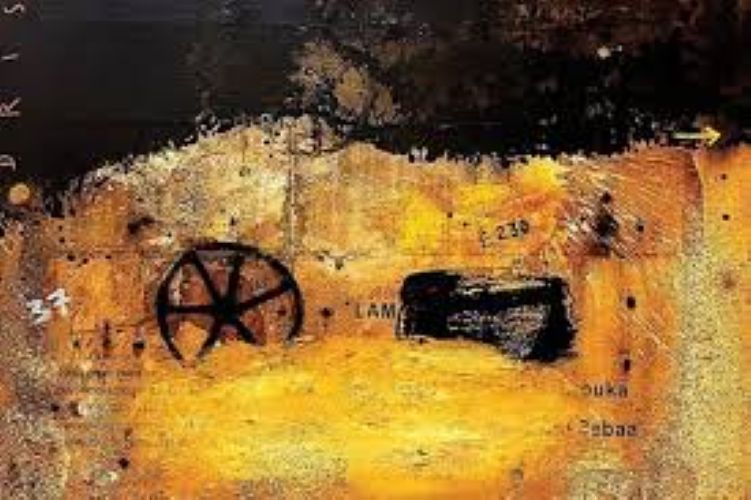 The painter Marc Chagall declared his pursuit of an inseparable unity between poetry and painting, while the poet-painter Adrian Huthier sought to create a shared language between them. Max Ernst also produced visual poems using fragments from old newspapers and books, engraved onto metal plates. Amin Saleh argues that the dialectical relationship between visual art and poetry is evident in poets’ adoption of new and unconventional typographic forms. Instead of horizontal, linear writing, poets turned to visual and structural printing techniques, organizing the poem on the page as a painting in space.
The aim was to shock the sense of sight, not merely the intellect, through visual arrangements of poetic elements on the page, much like a painter filling the canvas. This visual technique allows for the simultaneous presentation of elements to the reader rather than a sequential one. Words, phrases, and spaces coexist, overlap, and unite cohesively, just as shapes, masses, and color patches do in a painting. This approach is partly derived from Cubist painters’ vision of dismantling reality’s elements and reassembling them into a new system.
Eastern Writing Rich in Imagery
Mallarmé employed a typographic style in his poem *A Throw of the Dice*, marking a shift from musical values to geometric ones. Amin Saleh notes that interest in typographic techniques is ancient, as the visual and geometric aspects of writing were given great importance by scribes and poets. Some pages are filled with lines, symbols, images, or even ambiguous marks devoid of explicit meaning, or with vast white spaces. There are also poems whose words are arranged in the shape of bottles or other forms.
 Eastern writing is particularly rich in visual imagery and symbolic forms. Attention to typographic art can also be observed among the Italian Futurists. This method of constructing images from words is part of an ancient tradition found among the Chinese, Greeks, and Byzantines. Amin Saleh affirms that a dominant unity characterizes Surrealist art, one not dismantled by artists’ shifts from one method to another. The Surrealist stamp was not tied to a particular mood, psychological state, or technical approach, but rather to a metaphysical proximity to reality, translatable in countless ways and capable of penetrating the deepest layers of the mind.
The Fusion of the Poetic and the Visual
The Spanish artist Joan Miró showed profound appreciation for the Surrealists’ insistence on achieving fusion between the poetic and the visual, and for their belief in the necessity of expanding the human sensory field through every possible means. This involves exploring worlds that are difficult to comprehend and have yet to be fully examined—those of the subconscious. Amin Saleh notes that in poems inspired by Picasso’s drawings, Paul Éluard paid tribute to Picasso, praising his grand vision and elevating the act of seeing itself above the visible object.
Thus, we discover that poetry and painting are separate only in form; in essence, they are complementary and speak a single language—the language of sensation, contemplation, and emotional response. Both strive to seize a fleeting human moment and transform it into a lasting imprint on the soul. While poetry weaves images through words, painting draws emotions with colors. Together, they reshape the inner and outer worlds through a language that requires no translation, only sincere feeling and refined aesthetic perception.
The encounter between poetry and visual art is not merely an aesthetic luxury, but an artistic necessity that opens doors to deeper understanding and multifaceted appreciation. It grants the recipient a unique opportunity to read the world with two eyes: the eye of the word, and the eye of color.
Read: Heritage as the National Culture
_________________
 Souad Khalil, hailing from Libya, is a writer, poet, and translator. She has been writing on culture, literature and other general topics.