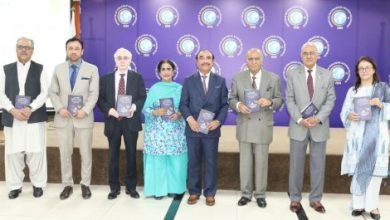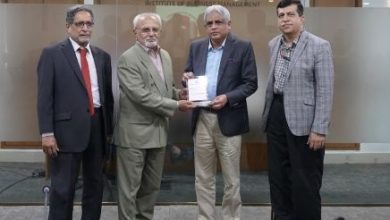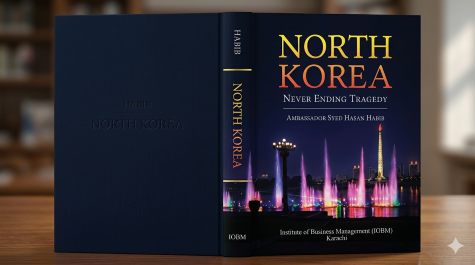
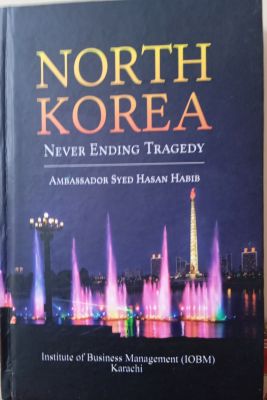
Review of the book “North Korea – Never Ending Tragedy”, authored by Ambassador Syed Hassan Habib
- The book deals with the history of Koreas, the Korean War of 1950-53, and the rise of the Kim dynasty beginning with Comrade Kim-il-sung, nuclear weapons, UN sanctions, life under the shadow of hacking, control, and espionage
Ambassador M. Alam Brohi
In the Foreign Service of Pakistan, two stations – Sudan and North Korea – are known as very hard places not because of any security problem but due to lack of education and health facilities, rest and recreation, entertainment, attractions and distractions. While filling any vacancy in our Missions in Khartoum and Pyongyang, the administration surveys the list of Sindhi, Baloch, and Pashtun officers serving at the Headquarter or in our Missions abroad who are due for posting. This practice is faithfully followed.
 Since 1980, seven Sindhi speaking Ambassadors have served in Khartoum. I was one of these lucky gentlemen. I know at least three Sindhi and Baloch Officers assigned as Ambassador to Pyongyang including Syed Hassan Habib. I enjoyed my stay in Khartoum interacting extensively with our troops stationed as peacekeepers in Sudan. Unbelievably, Khartoum was a crime free capital during the long rule of President Al-Bashir.
Late Ambassador S.M. Korejo had two consecutive postings in Khartoum, and completed the manuscripts of his two landmark biographies of Khan Abdul Ghafar Khan and G. M. Syed which were later published by the Oxford University Press. Ambassador Zafarullah Shaikh is an admirer of Sudan. Khalid Ahmed Yousfani volunteered as Ambassador to Sudan. I was posted on the untenable ground that I had served at two A-stations.
Many friends believe that Pyongyang is harder than Khartoum because local population is forbidden to interact with foreigners, especially the foreign diplomats who are the most watched, most pursued and most monitored community, and cannot move out of their residences without being stalked by spooks. Many officers returned from Pyongyang with impaired mental health.
While shedding sporadic light on the North Korean society, Syed Hassan Habib, in his book “North Korea – Never Ending Tragedy”, writes that about 10 percent of the population lives in some sort of prison; 16 percent are in the compulsory service of the armed forces, and the rest work, directly or indirectly, for the state. The regime not only tightly controls all systems of communication, it has enacted severe punishments for unauthorized interaction with foreigners or irrelevant elements within the country.
Ambassador Syed Hassan Habib, as I know him, is a man of pleasant, affable and highly balanced disposition, who remains undaunted even under challenging circumstances. He faced the rigours of Pyongyang by his strong will, steely nerves and wise and rational approach to life, and returned home with a sound mind and sharp intellect to take the challenging job of teaching in this august Institution in 2016.
Syed Hassan is known for his simple and honest disposition, hard-work, intellectual strength, analytical prowess, and deep understanding of the complex International Affairs. This book sticks another feather in his cap as being a skilful writer. Syed Habib deserves all laurels for rendering invaluable services to the country, and to our children in the Institute of Business Management.
This is a small book of over 200 pages – divided into 14 small chapters dealing with the history of Koreas, the Korean War of 1950-53, and the rise of the Kim dynasty beginning with Comrade Kim-il-sung, nuclear weapons, UN sanctions, life under the shadow of hacking, control, and espionage. There are chapters on the North Korea and USA, and the author’s observations.
The author has appropriately called North Korea as “Hermit Kingdom” probably referring to the period of the Joseon dynasty from 1392 to 1910 in which Korea had intentionally restricted contacts with foreigner to save the purity of its culture.
The term applies perfectly to North Korea because of its extremely enigmatic political and economic governance and social isolation – highly restricted contacts with foreigners, travel, spread of knowledge, and minimum diplomatic representation of foreign states.
The Korean rulers claim that they follow a self-reliance ideology. I call it an Enigma where the population lives under siege yearning for the dawn of free, independent, and dignified living. Without socialization, a human society cannot remain healthy, stable and vibrant.
The country has an outmoded and broken system of public transport, public health, public education, and public utility services. There is no private sector to provide such public facilities. No inter-city transport is allowed. The supply of commodities of daily use, mostly imported, is erratic, and highly irritating. Diplomats may travel to China to buy food stuff and toiletries.
The diplomatic community is very small. There were 25 diplomatic missions, and international agencies when the author was posted there. This must be closely knit community socializing with each other more frequently.
As contrasted with North Korea, the then Sudan was a comfortable station. Khartoum was welcoming, bustling with hotels, restaurants, and shopping malls and good meat shops owned by Turkish men. The country was abundantly provided with food, local and imported fruits, and reasonably good public utility services. Alcoholic drinks were prohibited.
I used to take solace from my evening walks along the paved bank of Blue Nile which converges with the White Nile on the other side of the city near Omdurman. The British era Bridges on Nile River used to soften my nostalgic longing for Sindh reminding me of the Lansdowne Bridge of Sukkur designed by Sir Alexander Meadow Rendel and erected by Engineer Robertson in 1889.
The River Indus and River Nile were tamed and controlled by British Engineers constructing bridges, barrages, and water head-works on them. On River Indus, they constructed Bridges at Attock (1880), Sukkur (1889) Kotri (1900) Kotri-Hyderabad Railway Bridge (1900).
The book is interesting in the sense that it tries to give readers some information about this Hermit Kingdom or the Enigma. Only an author of the caliber and courage of Syed Hassan Habib can pick up his pen to write on an enigmatically complex subject such as North Korea. My salutations to him.
Praise be to Allah.
_______________
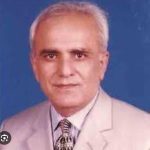 Based in Karachi, the author is a former member of the Foreign Service of Pakistan and has served as Ambassador for seven years.