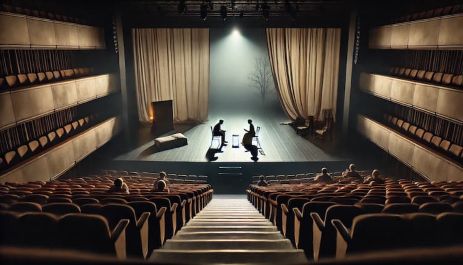
The emergence of theatre throughout the world was purely poetic in the sense that it began as religious rituals during particular occasions not directly linked to everyday life.
Souad Khalil | Libya
The discussion of the relationship between theatre and poetry is considered one of the critical issues that has occupied both researchers and creative writers alike, due to the intersection it presents between dramatic language and its aesthetic dimension on the one hand, and poeticity as a vision and sensibility that transcend the limits of reality on the other. In this context, poetic theatre presents a fundamental problem concerning the validity of attributing the quality of “poetry” to a dramatic work, and whether the mere use of verse or rhetorical imagery is sufficient to grant it such a designation. Through the discussion of the views of a number of critics and scholars, foremost among them Oscar Mandel and Nehad Selaiha, the distinctions between “verse,” “poetry,” and “poeticity” become clear as interrelated yet non-identical concepts, thereby opening the way toward a deeper understanding of the nature of poetic theatre and its artistic and aesthetic boundaries.
 In the book of the well-known American writer Oscar Mandel, which includes a collection of lectures on poetic theatre delivered at New York University’s Graduate School, Mandel—who wrote poetry, drama, and short stories in addition to his work as a lecturer in drama at the University of California—presents a serious attempt to establish a clear and precise concept of the quality of poetry when applied to a dramatic work. Critics frequently resort to using this term in their analyses of certain theatrical works as a form of praise, either because those works are generally characterized by delicacy and sweetness, or because their authors employ poetic devices such as imagery, symbolism, rhythm, and suggestion in expressing and embodying their vision.
Applying the quality of poetry in these two cases is incorrect because the concept of poetic theatre has suffered from many misconceptions caused by critics as a result of confusing verse, poetry, and poeticity.
Regarding verse, Nehad Selaiha states that the prevailing view today is that arranging words into familiar metrical forms is not sufficient to create a poetic dramatic work. Verse in itself does not create poetry; indeed, there are many versified works that have nothing to do with poetry and may even lack poeticity altogether.
If we cannot describe a dramatic work as poetry merely because it is written in verse, then it is even more appropriate not to apply this description to a theatrical work praised for other reasons, since doing so would constitute a grave injustice to prose drama, especially realistic drama in its finest forms as seen in the works of Chekhov and Ibsen. Any good realistic drama must contain emotionally intense moments that sometimes require the playwright to resort to poetic devices such as imagery, rhythm, and suggestion in order to express them. Nehad Selaiha explains in this article that such moments do not constitute sufficient justification for granting the entire work the quality of poetry. Rather, it is more accurate here to use the term “poeticity.” Poeticity, therefore, is the quality characterizing dramatic works distinguished by emotional intensity or by delicacy and refinement of feeling and expression, while not essentially being poetic theatre.
True poetic drama, in Mandel’s view, is that drama which lifts us noticeably above the level of ordinary reality and daily life that we ourselves experience and read about in newspapers, so that we feel as though we have taken a vacation from reality. This does not mean that drama must completely detach itself from human reality in order to become poetic drama. Rather, it means a temporary elevation above reality into a distinct new world possessing a comprehensive human vision and differing in a perceptible and tangible way from the real world upon which it partly comments. The world of poetic theatre is marked by distance and strangeness, yet it does not separate itself entirely from the spectator’s world to the point where no connection between the two worlds can be established. Such complete separation, if caused by excessive alienation or obscurity, for example, removes the quality of poetry entirely from the artistic work. It is necessary for poetic drama to embody this indirect metaphorical relationship between the world of reality and the world of the play. Aristotelian imitation here does not occur, as in prose or realistic theatre, through comparison and condensation, but rather indirectly through elevation, so that the poetic play becomes a comprehensive artistic metaphor vividly perceived by the spectator.
The emergence of theatre throughout the world was purely poetic in the sense that it began as religious rituals during particular occasions not directly linked to everyday life. Theatre then evolved into celebratory performances revolving around well-known myths, and it was easy for the playwright at that time to achieve, without effort, that temporary separation between the world of poetry on stage and the world of reality, despite the close and indirect connection between the two through metaphor.
With the development of drama, the shrinking influence of myth, and the increasing connection of theatre with society, as well as the emergence of currents of realistic drama, satirical and critical drama, theatre of social and human types, and dramas of ideas and issues, in addition to naturalistic drama, theatre came to imitate reality not through comprehensive metaphor as in poetic theatre, but through intensifying reality and commenting upon it.
Thereafter, while drama in its poetic phase drew inspiration from myth to explore humanity’s relationship with knowledge and the universe, in its prose phase it came to focus on the individual’s relationship with his or her reality, society, people, and events.
In the modern era, writers of true poetic theatre often seek to achieve distance from reality through inspiration drawn from history and myth, or through dreams and fantasy. At other times, the writer succeeds in achieving that distance or elevation through intensifying certain human qualities to the extent that they become inhuman qualities or qualities beyond the level of reality. Mandel cites Faust’s love of knowledge as an example.
In light of this concept of poetic drama, we can consider the works of Ionesco and Beckett poetic plays regardless of their affiliation with the Theatre of the Absurd. On the other hand, we cannot apply the quality of poetry to the theatre of Arthur Miller, for example, whom Mandel considers primarily a naturalistic playwright despite Miller’s insistence on using unrealistic stage settings filled with multiple levels constantly reminding the spectator that what is seen on stage differs from reality, despite the expressionist label often associated with his theatre. Likewise, according to this concept, we cannot describe all the plays of the poet T. S. Eliot as poetic drama, despite the fact that they are written in verse. Verse, although it creates a form of alienation and a false sense of distance from daily reality, is not in itself sufficient to establish the necessary distance between the signifier and the signified so that dramatic metaphor may be realized with sufficient coherence and distinction. While Murder in the Cathedral fulfills the characteristics of poetic drama completely, one cannot consider The Cocktail Party a poetic play according to this concept.
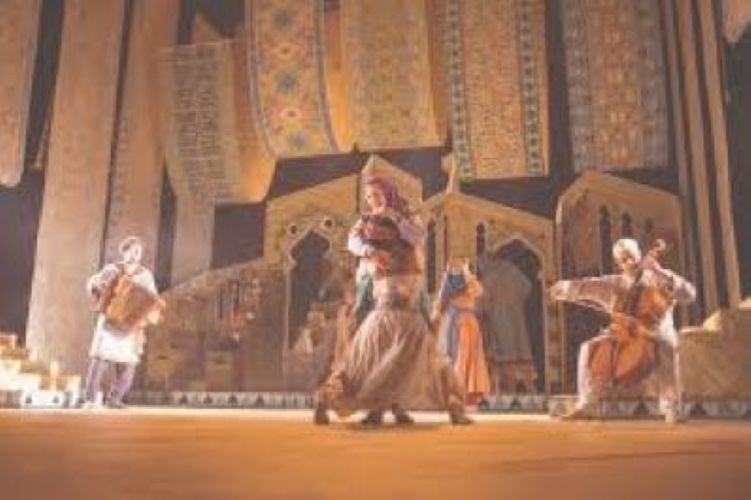 The real difference between prose theatres—whether written in verse or prose, or what may more accurately be called realistic theatre—and poetic theatre is the difference between simile and metaphor. If prose theatre resembles reality through what occurs on stage and enriches the spectator’s awareness of reality through condensation and comparison, true poetic theatre aims to deepen and enrich the spectator’s emotions and life through the creation of a new world that serves as a metaphor for reality without entirely separating from it, extending into other regions of emotion and consciousness that may not be closely linked to the immediate concerns and pressing issues of daily life.
In light of this argument, it becomes evident that poetic theatre cannot be reduced to being merely a versified text or one saturated with poetic imagery. Rather, it is an artistic vision based on elevating reality rather than reproducing it, and on creating a dramatic world that transcends the ordinary and familiar without severing itself completely from them. Poeticity in theatre is not so much a linguistic quality as it is an aesthetic state embodied in emotional intensity and the ability to transform human experience into a grand metaphor that reshapes reality from a broader and deeper perspective. Hence, the distinction between prose theatre and poetic theatre lies in the difference between simile and metaphor, between imitating reality and recreating it anew. This grants poetic drama its uniqueness as an art form balancing truth and imagination, consciousness and emotional transcendence.
Read: Superstition and Magic: Ancient Cultures
___________________________
 Souad Khalil, hailing from Benghazi Libya, is a writer, poet, and translator. She has been writing on culture, literature and other general topics.