Perhaps time has changed many things, but memories remain alive in their original colors. Sometimes, simply remembering old days becomes one of life’s most beautiful joys.
By Abdullah Usman Morai | Sweden
Sometimes, the most beautiful memories of life are not connected to grand palaces or expensive journeys, but to the narrow streets of small towns where people lived simply, worked honestly, and shared happiness. Some of those vibrant memories are tied to the famous Shahi Bazaar of Moro, where, in one era, the making of “currency note garlands” was an important part of local culture, craftsmanship, and livelihood.
Perhaps the tradition still exists to some extent today, but it is no longer the same as it once was. The love, artistry, and dedication with which those garlands were created remain fresh in memory.
Centers of Craftsmanship and Skill

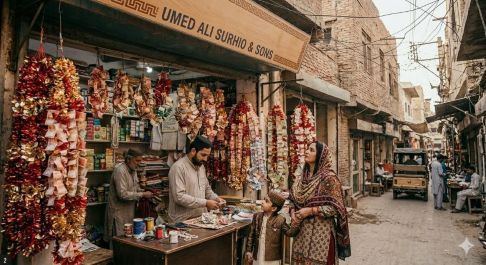
Even today, one remembers the shops in Moro’s Shahi Bazaar where certain shopkeepers would create garlands from currency notes with extraordinary skill and elegance. These craftsmen were so talented that they could fold and shape crisp new notes into flower-like patterns and carefully join them together with staplers. Some designs were circular, some elongated, while others were arranged in such creative ways that they left the viewer amazed. It was not merely a business; it was an art form, a creative expression.
One memorable personality among them was Chacha Umeed Ali Surhio. He was not only a remarkable craftsman but also an exceptionally cheerful and warm-hearted man. Always smiling, joking, and speaking lovingly with people, simply passing by his shop was a pleasant experience. He constantly joked with people walking through the market. I remember that he would always call me “Igloo,” the name of a popular ice cream from that time. He had amusing nicknames for everyone, calling some “ Barki ja putr means goat’s children” and others “Bhotaar.” Looking back now, I realize that some people are remembered not only for their work but also for the kindness and warmth of their personalities.
Crisp New Notes and the Business behind Them
The Surhio community of Moro was especially associated with this craft, though some Memon families were also involved in the trade. During childhood, we often wondered where they managed to get so many fresh, crisp, clean, and shiny currency notes, because the market mostly circulated old, torn, and worn-out notes.
Later, we learned that some people would bring fresh notes from Karachi, Sukkur, Hyderabad, or Quetta through the State Bank and then sell them at a profit to these shopkeepers. Even the fragrance of those new notes was strangely delightful.
In those days, currency note garlands were an essential part of wedding ceremonies. Just as flower garlands looked beautiful, these garlands of notes had their own unique charm because of their shine and artistic arrangement. Even before the notes were attached, the glittering decorative sheets and colorful paper used in the garlands looked attractive.
When wedding season arrived, those shops would become crowded with excitement and festivity. Shopkeepers worked late into the night. Customers would arrive, examine different designs, choose their favorites, and the shopkeepers would carefully wrap the garlands in old newspapers, seal them neatly with staplers, and hand them over to the buyers. Later, these garlands would adorn wedding ceremonies or celebrations for young boys’ circumcision events, where they became symbols of joy and festivity around someone’s neck.
 The Vibrancy of the Shops
These shops were not limited to currency note garlands alone. They sold many other essential items as well, almost like tiny worlds of their own. One could find soaps, pearl necklaces, beauty products, creams, oils, bangles, handkerchiefs, makeup items, and colorful traditional Sindhi and Arabic-style scarves that men often wore over their shoulders or heads. Many other household and decorative items were also sold there.
Each shop had its own fragrance, its own atmosphere, and its own distinct style.
An Era of Simplicity and Peace
There was simplicity in the lives of those people, and there was peace. The blessings and inner contentment that come from earning an honest livelihood were visible on their faces. There was no jealousy, no unnecessary competition, and no mental stress so common today. People were satisfied with their work, treated their customers with affection, and lived among neighbors with warmth, humor, and familiarity.
In todays fast-paced, competitive world, where everyone seems trapped in some endless race, such memories bring a strange sense of comfort to the heart. They remind us that happiness does not always lie in great wealth. Sometimes, the true beauty of life is hidden in a tiny shop, a garland wrapped in old newspaper, the jokes of Chacha Umeed Ali, or the lively noise of Shahi Bazaar.
Perhaps time has changed many things, but memories remain alive in their original colors. Sometimes, simply remembering old days becomes one of life’s most beautiful joys.
Even today, whenever these memories return to mind, one can almost feel the fragrance of those streets of Moro. Those people and those simple joys remain a priceless treasure in our lives.
Read: Bullets of joy become cries of grief
__________________

Abdullah Soomro, penname Abdullah Usman Morai, hailing from Moro town of Sindh, province of Pakistan, is based in Stockholm Sweden. Currently he is working as Groundwater Engineer in Stockholm Sweden. He did BE (Agriculture) from Sindh Agriculture University Tando Jam and MSc water systems technology from KTH Stockholm Sweden as well as MSc Management from Stockholm University. Beside this he also did masters in journalism and economics from Shah Abdul Latif University Khairpur Mirs, Sindh. He is author of a travelogue book named ‘Musafatoon’. His second book is in process. He writes articles from time to time. A frequent traveler, he also does podcast on YouTube with channel name: VASJE Podcast.