When Camels Walked through Moro Town of Sindh and a Darwesh called Malook Walked with Them
By Abdullah Usman Morai | Sweden
There was a time, a quiet, ordinary time of life, when camels regularly walked through the streets of Moro.
I was a child then.
Villagers from nearby areas used to bring firewood on camels for selling in the town. That firewood, which we called kathyoon, was meant for fireplaces to cook. We already had gas cylinders at home, but Baba would still buy that wood, just in case the gas supply ran short. In those days, shortages were common, and people learned to prepare for uncertainty.
 After unloading the wood at our house, the villagers would sometimes tie their camels in our street. The camels usually sat down to rest, folding their long legs beneath their heavy bodies. Sometimes, though, they remained standing, tall, silent, towering over everything around them.
I was afraid of them.
Whenever I saw a camel tied in our street, I would change my route to school. Even on my way back home, I preferred to take the longer path rather than pass close to those massive creatures. Their size overwhelmed me. Their eyes felt ancient. Their presence made the narrow street seem smaller.
Back then, camels were also used to transport wheat bags from villages to town. They were part of everyday life, slow-moving bridges between rural fields and urban markets. Yet for me, they were something more: symbols of strength, patience, and quiet power.
And then there was Malook Bhutto.
Everyone in Moro knew him.
He lived near one of the villages on the outskirts of town. People said he was not in his right senses. We, who called ourselves “normal,” labeled him mad. But in truth, Malook was something else entirely, a darwesh, a wandering soul detached from worldly rules.
He never wore clothes.
People used to call him “Alif,” as if he represented the first letter of existence itself.
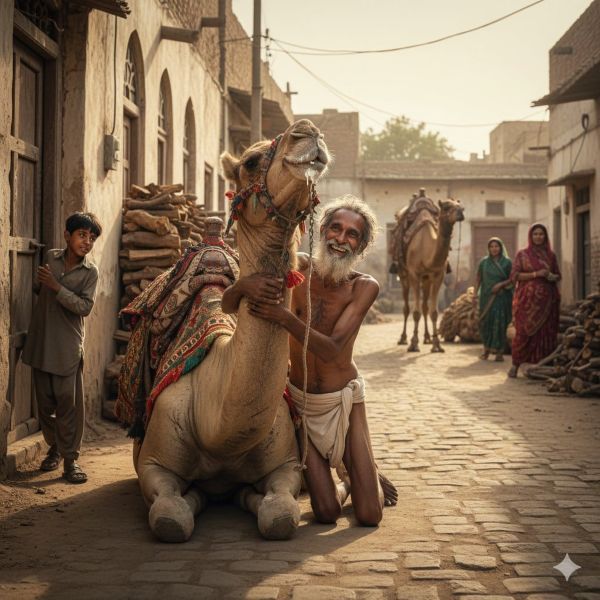
Malook had a strange habit: he would walk up to people, slap them on their backs, and burst into laughter. Yet he was harmless. He never hurt anyone. His laughter carried no cruelty, only a wild, innocent freedom that most of us had forgotten.
Over time, people began to believe that a slap from Malook was not just one of his strange habits, but a kind of blessing. Many said it brought good luck, as if it were a silent dua from him. Some even walked closer to him on purpose, hoping to receive that gentle strike on their backs, believing that the touch of a darwesh carried unseen prayers.
But what Malook truly loved were camels.
He would go to the outskirts of Moro and wait for the caravans arriving from villages. As soon as the camels appeared, he would grab their harnesses and take control, guiding them proudly into town like a king returning with his army.
Sometimes, he tied his arms around a camel’s neck and hung there, swaying with its movements, laughing loudly, enjoying the ride as if it were the greatest joy life could offer.
I watched him in disbelief.
I was scared to walk near camels, yet Malook embraced them.
Even when the camels released balloons of white foam or saliva from their mouths, moments that made us children step back in fear, Malook stayed close. At that age, many of us believed that when camels did that, they were showing their strength and power.
And Malook was never afraid of power.
He was part of Moro’s identity for years. A living landmark. A moving story. Every child had a memory of him. Every street carried an echo of his laughter.
He belonged to our childhood.
Then one day, quietly, without announcement, he disappeared.
First, a day passed.
Then another.
Weeks turned into months. Months into years.
 No one knew where he went. Even his family had no answers. He simply vanished, as if he had dissolved back into the dust of the roads he once walked.
We never saw Malook again.
And slowly, the camels stopped coming too.
Today, Moro feels different. The streets are louder, faster, more crowded, but somehow emptier. The camels are gone. The wood caravans are gone. Malook is gone.
Only memories remain.
His photograph and a small story about him now live inside a book titled Moro Nahe Thoro. But for those of us who grew up there, Malook is not just a character in a book.
He is a fragment of our past.
Sometimes, when I think about him, I realize how unfair our definitions of “normal” are. Perhaps Malook was freer than all of us. While we chased routines and respectability, he followed camels and laughter.
And maybe that is what childhood teaches us best, that some souls arrive only to remind us how simple joy can be, and how easily it disappears.
Just like Malook.
Just like the camels.
Just like that quiet Moro of long ago.
Read: Sindhis Elevating Beyond Comfort
__________________
 Abdullah Soomro, penname Abdullah Usman Morai, hailing from Moro town of Sindh, province of Pakistan, is based in Stockholm Sweden. Currently he is working as Groundwater Engineer in Stockholm Sweden. He did BE (Agriculture) from Sindh Agriculture University Tando Jam and MSc water systems technology from KTH Stockholm Sweden as well as MSc Management from Stockholm University. Beside this he also did masters in journalism and economics from Shah Abdul Latif University Khairpur Mirs, Sindh. He is author of a travelogue book named ‘Musafatoon’. His second book is in process. He writes articles from time to time. A frequent traveler, he also does podcast on YouTube with channel name: VASJE Podcast.