The Pearl of East Africa and the Charm of Traveling to Uganda
By Abdullah Usman Morai | Sweden
I have before me the travelogue “Uganda Yatra” by Mr. Baloch Sohbat Ali, which describes his journey to Uganda, a country located on the Equator. Truly, even before beginning to read it, a sense of joy, curiosity, and excitement has already arisen within me, because through this travelogue, I too will virtually explore that country known as the Pearl of East Africa.
 Although I had heard quite a bit about Uganda before, my interest deepened when I had a Ugandan friend named Kenge at an international organization, the Global Water Partnership. He later moved from Stockholm to Kathmandu, Nepal, to work with UNICEF. According to him, since Uganda lies on the Equator, its weather remains almost the same throughout the year, and people there rarely even discuss the weather.
Traveling, for me, is more than a hobby; it is a passion. And once someone falls in love with this passion, they can never truly detach from it, nor should they. In my view, this love keeps a person forever young.
As Baloch Sohbat Ali beautifully puts it, we have surrendered ourselves to wandering as if we were leaves floating freely on flowing water. In Pakistan, one often sees a delightful Punjabi phrase written on trucks: “Rul tay gaye haan, par chass aa gayi ae” (We may have wandered aimlessly, but we’ve come to enjoy it). Indeed, there is immense joy and pleasure in such wandering, no matter which corner of the world it takes place in. Imagine bidding farewell to the monotony of daily life and setting out from places like Dadu, Larkana, Ghotki, Mirpurkhas, Thar, Kohistan, Karachi, or Moro, and arriving at Lake Victoria in Uganda; surely, it would bring deep inner peace.
 Dr. Muhammad Laiq Zardari once said, “Wherever you travel, document it and make it a part of history.”
Whenever travelogues are mentioned, it would be unfair not to mention Altaf Sheikh. He made a remarkable point: we should read travelogues written by our own people because their experiences are more relevant to us than those written by outsiders. For instance, an Englishman, an Arab, or a French traveler may receive a different kind of response from locals compared to us. While their accounts can certainly be enjoyable, the experiences of people like us are more practical and relatable when we plan to visit those places ourselves. Understanding how locals treat people like us is far more useful. Credit goes to Baloch Sohbat Ali for documenting his journey to Uganda and turning it into a part of history, while also providing a kind of travel guide for future visitors.
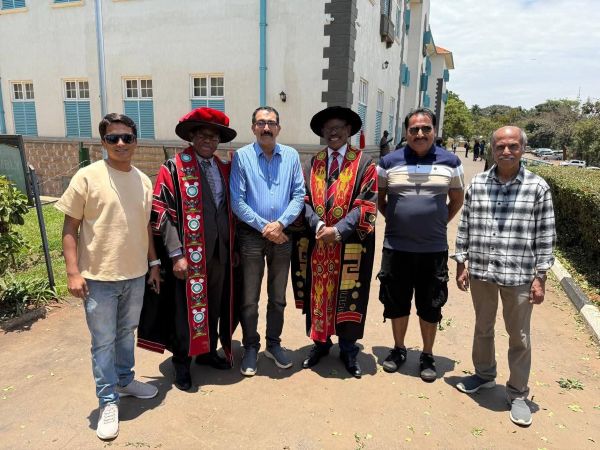 Contributors like Mukhtiar Samo sahib, Junaid Dahar, Partab Shivani, Mahmood Patojo, and the author himself suggest in this travelogue that although Ugandan visas can be obtained on arrival with a Pakistani passport, it is better to apply online in advance to avoid unnecessary complications. Another important recommendation is to get vaccinated against Yellow Fever, which is essential.
 The joy of travel begins the moment we start preparing for it. On the day of departure, calling friends, coordinating locations, “Where are you?” “We’ve crossed Mehar, reach the Dadu bypass and we’ll pick you up” the journey to Karachi airport, dealing with immigration officers, exercising patience, facing challenges, observing fellow travelers’ behavior, their snoring or sleep-talking, the cheerful hospitality of Salma, her playful request in a shopping mall for Junaid Dahar to hug her in front of everyone, all these moments are lively, humorous, enriching, and full of learning.
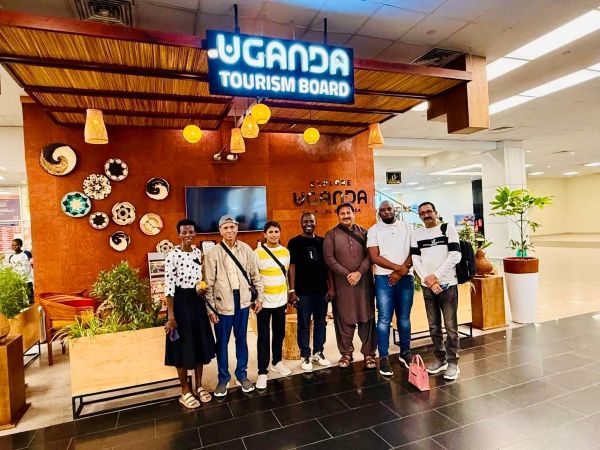 This travelogue offers extensive insights into Uganda’s long journeys, geography, history, economy, tourism, politics, agriculture, lakes, religions, fruits, animals and wildlife, rulers, immigration system, languages, intergroup conflicts, precautions against thieves and criminals, local foods, motorcycle taxis, electrical switches, buildings such as State Life, the Supreme Court, High Court, temples, mosques, churches, museums, libraries, art and craft markets, Victoria Mall, the King’s Palace, wildlife education centers, dense forests, the source of the Nile River, botanical gardens, national parks, Independence Square, African cannibals, the howling of wolves and dogs, mosquito bites, and much more.
 One valuable lesson highlighted is that if you need something, you should ask without hesitation. For example, the travelers asked permission to enter a Bahá’í temple—there is no harm in asking. Similarly, having the courage to express a desire to meet a university’s Vice Chancellor is also commendable. At various points, the poetry of Shah Abdul Latif Bhittai and Ustad Bukhari is beautifully referenced, adding depth and cultural resonance.
Interestingly, the travelogue also reveals that, like in Europe, many shops there are run by women. Another notable difference is that the weekly holiday is Friday instead of Sunday. Indians have also been living there for a long time.
 After reading this travelogue, I also realized that, compared to Europe, people in Uganda may be more open to asking and answering personal questions during first meetings. They also do not seem to mind if photos of children are taken without prior permission. Additionally, the book provides excellent information about local foods and restaurants, which will undoubtedly be very useful for future travelers.
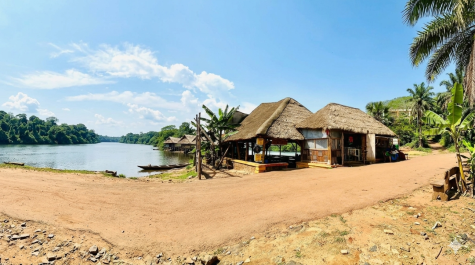
This travelogue, dedicated to the beloved Ayaz Latif Palijo of Sindh, is written in simple and clear language, making the reader feel as if they are physically present in Uganda. While reading, I strongly felt that it would have been wonderful if I had been part of that journey. The descriptions of the beautiful villages and rural life stir the heart deeply and create an urge to travel there immediately.
Keep traveling, keep documenting your experiences; this is, in a way, a service to your language and your people. As the recurring phrase suggests: Yes, indeed, the story is pleasing; this travelogue truly delights the heart.
Read: Where Forest Meets the Sea
_______________
 Abdullah Soomro, penname Abdullah Usman Morai, hailing from Moro town of Sindh, province of Pakistan, is based in Stockholm Sweden. Currently he is working as Groundwater Engineer in Stockholm Sweden. He did BE (Agriculture) from Sindh Agriculture University Tando Jam and MSc water systems technology from KTH Stockholm Sweden as well as MSc Management from Stockholm University. Beside this he also did masters in journalism and economics from Shah Abdul Latif University Khairpur Mirs, Sindh. He is author of a travelogue book named ‘Musafatoon’. His second book is in process. He writes articles from time to time. A frequent traveler, he also does podcast on YouTube with channel name: VASJE Podcast.