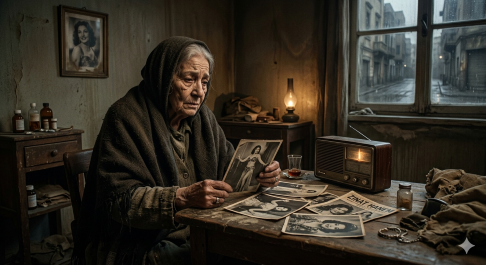
On a harsh, wintry night, Zinat took her last breath. She died alone, surrounded by nothing but old black-and-white photographs of her laughing at life
By Abdel latif Moubarak | Egypt
Zinat was born in a narrow alley where the air was choked with poverty and humidity. The daughter of a washerwoman, she never knew a father except as a blurred image in her imagination. In that alley, the only music was the shouting of neighbors or a distant radio wailing Oum Kulthum’s songs. Amidst this chaos, Zinat danced barefoot on the dirt, swaying like a willow branch that refused to break. Her eyes held a spark that outshone the gold she had never touched.
At sixteen, Zinat fled her fate as a domestic servant. She found her way to a third-rate nightclub on Emad El-Din Street. There, she learned to turn her body into a language understood by hungry eyes. Her dancing wasn’t just movement; it was a scream of protest against hunger. Wearing a tattered costume sewn from scraps of old fabric, she began to draw attention with a waist that moved like a small hurricane and eyes that shot arrows of defiance.
Zinat’s stay in the lower depths didn’t last long. A glance from a wealthy “Pasha” was enough to catapult her to the grand stages. Her photos began to fill posters, and “Zinat” became “Zinat Hanem.” She learned how to walk, how to speak, and how to smile with half her lips to drive men mad. In this phase, Zinat was no longer the washerwoman’s daughter; she had invented a new history for herself, burying her past under mounds of makeup.
Zinat reached the pinnacle when she became the favorite dancer at the palaces. She performed for kings and princes during nights of revelry where contracts were signed and fates decided to the rhythm of her anklets. She established a political and cultural “salon” frequented by ministers and top commanders. A word from her could promote an official; a frown could topple another. She owned wealth and prestige, and her home became a palace buzzing with life and noise.
At the height of her glory, Zinat believed time had stopped for her. She bought jewelry by the thousands and surrounded herself with a wall of hypocrites who swore by her life every morning. She thought her beauty was a “certificate of grace” that would protect her from the treachery of days. She saved nothing for a rainy day and never opened her heart to true love; instead, she collected men like she collected antiques—for display, not for companionship.
Time eventually demanded its due. The first fine lines appeared around her eyes, and she spiraled into a frenzy. She spent fortunes on plastic surgeons in Paris, trying to plead with the youth that was migrating away from her body. But the stage is merciless; the lights began to dim, and promoters started looking for a “new Zinat”—younger and more vibrant. She felt the danger, but she remained stubborn, dancing even as she felt a weakness in her bones.
Friends began to vanish one by one. The ministers who used to kiss her hand now apologized for being “too busy” to see her. The palace that once teemed with people became a haunting shell, visited only by echoes. She was forced to sell her jewelry to pay off mounting debts. She was no longer the dancer for whom the palace shook; she had become a “memory” people discussed in gossip sessions.
She sold the palace and moved to a small apartment in a modest neighborhood. Her fortune eroded through failed attempts to make a comeback and on medications for a heart that was starting to fail. No one remained with her except an old, loyal maid who stayed out of pity. Zinat, who once ruled kings, now sat in front of the radio waiting to hear her old songs, weeping over the ruins of a body that no longer obeyed her even to walk.
Zinat fell gravely ill. In that cold room, the chill gnawed at her bones, and loneliness gnawed at her soul. There was no money left to buy a single injection to ease her pain. The maid knocked on the doors of old “friends,” but everyone denied knowing her. “Zinat? She died a long time ago!” was the common response. She would look at her hands, seeing the marks where rings used to be, grieving for a time when those hands were the ones giving out bounties.
On a harsh, wintry night, Zinat took her last breath. She died alone, surrounded by nothing but old black-and-white photographs of her laughing at life. They didn’t find enough money in her home for a funeral befitting a “Queen of Dance.” She was buried in a charity grave, with no mourners, no kings, and no music. Zinat departed, leaving behind a story that serves as a lesson in the treachery of time, told in the very alleys she came from—as if the circle had closed exactly where it began, but with a much bitterer taste.
Read: Waiting for What Never Comes
______________________
 The author was born in Suez and writes poetry using classical Arabic and Egyptian vernacular. He received a Bachelor of Law from Ain Shams University. He was one of the most important poets of the 1980s and his poems were published in several literary magazines in Egypt and the Arab world, including the Arab magazine, Kuwait magazine, News Literature, Republic newspaper, Al-Ahram, the new publishing culture (magazine).[1] Received the Excellence and Creativity Shield from the Arab Media Union in 2014 and Won the shield of excellence and creativity from the East Academy 2021.He won the Sergio Camellini International Award in Italy in 2025. He won first place in the “Divinamente Donna” competition in Italy 2026.