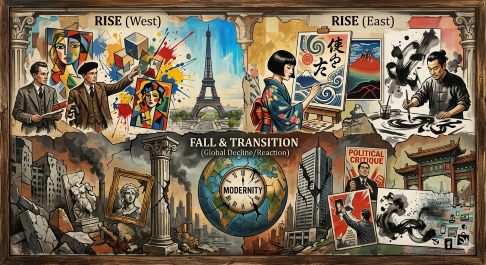
Modernity’s artistic dawn and dusk between the East and West
Souad Khalil | Libya
This article presents a critical reading of the trajectory of artistic modernity and its transformations between East and West, through the example of the Weimar art exhibition and the extensive controversy it generated within European critical circles. It reopens the debate on the concept of “postmodernism” not merely as an artistic movement, but as a contested space where ideology intersects with aesthetics, and history with cultural politics.
It also highlights the perspective of the critic Edward Beaucamp, who defended the exhibition of East German art, revealing the underlying tensions between Western and Eastern conceptions of art, and between modernity as a liberating project and its use as an ideological instrument of classification. Through this approach, the article re-examines the relationship between art and power, as well as between creativity and freedom of expression within shifting historical contexts.
 Postmodern art is a set of artistic movements that sought to challenge certain aspects of modernism or developments that emerged in its aftermath. In general, movements such as installation art, conceptual art, and multimedia art—especially those involving video—are described as postmodern. This is the scholarly definition of postmodern art. However, in previous years, the Weimar exhibition of East German art was subjected to harsh criticism, which led the art critic Edward Beaucamp to defend the exhibition.
Although the article is old, what this critic wrote and the important points he clarified prompted me to republish it in Arabic.
Art critic Edward Beaucamp, in defense of the Weimar exhibition of East German art as part of a three-part exhibition that was at one point heavily criticized, expresses his commitment to East German art, which is not highly appreciated in the West. Here he explains his view on why the exhibition was considered a failure.
He says: We have been overwhelmed in every way by talk of the millennium, its evaluations, and the pursuit of gains at the expense of modernity. The beginning came from Weimar, which celebrated and mourned itself at the same time. But this exaggerated attempt at self-exploration suffers from lack of clarity and distortion, and reflects a flamboyant, masculine, and ostentatious mentality.
“Rise and Fall of Modernity” is a comprehensive overview of more than one thousand works divided into three chapters. It is presented through a striking contrast between modernity and non-modernity, between the refined idea of abstraction held by the pioneers of art and a vulgar conservative vision, both of which were strongly criticized by both sides.
 The noble first idea—and at the same time the largest part of the exhibition—was devoted to the emergence of modernity from the rural, bourgeois, and feudal system of cultured Weimar. Figures such as Count Kessler, some artists around him, and Henry van de Velde sought to transfer it, in a spirit of refinement and elitism after the turn of the century, to the center of the Belle Époque art world, through international efforts. The result is well known: the rapid acceleration of new beginnings and flights of artistic imagination was followed by defeats and setbacks. In the rural palace burdened with taxes and under an unenlightened duchess, there were urgent conflicts, revolutionary turmoil, and resignations of leading figures.
The exhibition in the Schloss Museum forms the first chapter and presents three hundred paintings by pioneers of Weimar art, including everything that was seen in the city—or rather everything that was produced there. This is thanks to the flourishing exhibitions during three periods full of hope. In this opening section, there is even a small structure that brings together works by Manet, Monet, Cézanne, Gauguin, Rodin, and others. While these artists were celebrated in Weimar, their reputation was being undermined in Berlin.
The exhibition was a living representation of the Schloss Museum’s collections and a reflection of earlier exhibitions. The atmosphere and setting reveal contrasts between different roles, particularly the arcade decorated with arches used for works by Rodin, Maillol, and others.
In a small hall, fourteen striking nude watercolor paintings by Rodin were assembled, dedicated to Weimar. Their exhibitions in cities and provinces caused scandal, which led to Kessler’s resignation.
However, the reform carried out by van de Velde at the School of Arts and Crafts was comprehensive, and the new artistic breakthroughs were largely reformative. After 1918, the most important cultural project and the most future-oriented plan in Weimar was the founding of the Bauhaus. In fact, this was the only project that imposed itself in Weimar until 1925, affirming the city’s place in art history.
Van de Velde’s Bauhaus House was fundamentally divided between rationalists, romantics, engineers, and poets. In the Schloss Museum, the attractive exhibitions of the 1920s reappeared through Impressionists from Munich such as Kandinsky and others, as well as Weimar artists such as Molzahn, Robert Michael, Ila Bergmann, Walter Dexel, and members of the “Vereinigung” group, Klee and Kandinsky.
There are also reminders of Weimar as a base for donors and constructivists who gathered in the city for the 1922 conference. Karl Peter Taemid considered the Bauhaus House the first artistic deviation and opportunistic movement.
At the beginning of the 1930s, it turned toward traditionalism, then returned again to its progressive roots in 1946.
Weimar’s artistic leadership was shaped by the reactions of progressive forces. By 1929, the National Socialists had come to power, and Interior Minister Frick—who came from Weimar—was one of the first advocates against “black culture” and in favor of German national tradition. Paul Schultze-Naumburg, director of the United Art School, promoted modern tendencies in art before later expelling its pioneers.
This introduction leads us to the second part of Weimar’s studies within the century: an epic selection of National Socialist art.
What is presented in the exhibition is nothing but derivatives of Weimar.
There are 120 paintings out of 700 purchased by Hitler himself or through his personal photographer Heinrich Hoffmann for the Government Art Exhibition in Munich. These heroic landscapes, mythological scenes, nude studies, and local paintings were all linked to the academies of Munich and Vienna. They were traditional and mediocre works, but they appealed to Hitler’s taste, expressing a hostile and provocative vision. He preferred ornate and exaggerated styles to pacify and mesmerize the educated public. Thus, the regime turned to traditionalists and conservatives who had been defeated and pushed aside by modernism.
This second part of the exhibition—and the third as well—was dedicated to East German art. It had been temporarily moved to the National Assembly Hall in the Nazi Koforam section, a massive space once used to hold twelve thousand people and still in use since 1968 as a multipurpose hall.
 This scandalous arrangement brought together Nazi art and East German art, aiming to link both through hostility toward modernism. Yet the artworks clearly show that both systems are engaged in a struggle similar to that of fire and water. Nazi painting appears empty and devoid of feeling, while East German art reflects anxiety, hysteria, deviation, and fragmentation—ultimately stripped of meaning.
This confrontation serves a populist purpose. The contrast between the refined treatment of Nazi paintings on the ground floor and the rough handling of East German works—where five hundred paintings were crammed into a circular hall and left to “find their way to the trash of history”—is evident. The massive quantity was intended to provoke disgust and ridicule, recalling Nazi techniques used in exhibitions of “degenerate art.”
In this context, the “trash” becomes more than propaganda. High-quality works, commercial works, museum pieces, creative works, and even ideological productions were all mixed into a chaotic mass, rendered useless.
The rhythm and composition of this display symbolize a need for freedom and individuality, yet they also lead conflicting perspectives into a void. Nothing constructive emerges from Weimar in this regard. On the contrary, the Schloss Museum carefully selected the quality of East German works acquired.
A preparatory section under Hermann Henselmann documented Weimar’s post-1945 reality, including attempts to revive Bauhaus traditions. Later, abstract East German art was inserted into the circular hall, though it had little effect compared to the many outstanding works.
The issue is not about victims of East German cultural policy being judged in Weimar; rather, the exhibition was organized by West Germans, many of whom held academic and museum positions in the East.
Their treatment of modernism—derived from Cold War binaries of abstraction versus realism—was biased. Under such conditions, both Beckmann and Dix, as well as Medner or Kruse, were also discarded.
While the East developed its art within this type of modernity, the West preferred to examine authoritarian links to Soviet constructivism and the Bauhaus.
Similarly, a vast number of Western works from avant-garde artists and commercial galleries could easily be presented. However, the goal of this controversial exhibition was not dialogue but downfall.
If modernity is merely a fading spark requiring artificial support, then it is on the wrong path. Independent art should not be subject to social systems or regimes. What matters is the rejection of censorship and manipulation, and allowing fair comparison between East and West. The East does not fear competition; for example, in Berlin, historical folk songs often surpass Western contributions in strength.
Source: German magazine KULTURCHRONIK
Article by Edward Beaucamp, translated by Khaled Abu Al-Ruz
Issue 5, 1999
Read: Between the Ambiguity and Clarity
_________________
 Souad Khalil, hailing from Benghazi Libya, is a writer, poet, and translator. She has been writing on culture, literature and other general topics.