It is essential that writing be distinguished in its presentation, treatment, and formulation, leading the reader into distant realms rich with discovery, illuminated with insights, and abundant in meanings.
Souad Khalil | Libya
Part Two of the article: This section continues the exploration of textual theory, focusing on style, clarity, and the communicative function of writing.
Thus, the importance of the text is affirmed through the historical value embedded within it, as it stands as a testimony to a certain stage, theory, or methodology, given that it expresses an intellectual agitation. This agitation may extend or continue for a period of time, or it may reach broader horizons, depending on what it represents or signifies to a group of people or to larger segments of humanity.
The possibility of hierarchical attraction, with regard to living ideas, is an inferential one. It does not fall within the realm of instinct, spontaneity, or immediacy. Ideas that we may describe as “alive” possess an individual capacity for profound, deep, and extended influence upon the human being. These ideas have their methodological, daily, and future-oriented discourse, as they adhere to human life and become an active, dynamic, and evolving part of existence as a whole.
The text is the broader model for such ideas. From here emerges the importance of transferring the vitality of thought into the horizons of anticipation, and into the dynamism of the dialectic between the present and the future. The ability to express corresponds precisely to the inner capacity of ideas themselves; they are components teeming with internal elements—moving and being moved, pushing and being pushed, adding and being added to. From this, the centrality of stillness collapses, and the human being, as an active force at the starting line, becomes a link between influence and being influenced.
Since the text represents the practical direction of the writer, this direction manifests itself through the value of the content that the text embodies.
Thus, the theorization of the text and its incorporation into philosophical logic has endowed the text with its essential nature. The creative process has moved beyond spontaneity, the ready-made, and the self-evident, driven by the transformations of reality—transformations that often surpass imagination itself. What the mind conceives is exceeded by comprehensive and extraordinary human achievements that have transcended expected levels and perceptions. Moreover, the influence of the world extends into all fields of creativity, as these fields penetrate the details, subtleties, and even the concrete and abstract realities of human life.
From this perspective, writing becomes a process of formation, encompassing all that this state implies: structure, organization, planning, and a defined objective. Writing must be elevated and exemplary, capable of raising the reader toward ascending expressive horizons. It must also possess the capacity for deep communication, surpassing superficial reading and transforming the reader into an essential counterpart—one who engages, participates, and interacts.
It is essential that writing be distinguished in its presentation, treatment, and formulation, leading the reader into distant realms rich with discovery, illuminated with insights, and abundant in meanings.
When we examine the relationship between language and writing, we find this inquiry both appropriate and significant. Language is no longer viewed merely as a tool; it has surpassed this traditional role. Its function has evolved, revealing its inherent capacity to achieve a form or linguistic structure characterized by specific and influential features.
Within this context, the text constitutes a theoretical insight that does not require immersion in tedious historical details. Rather, it expresses a historical phase, even when framed through the life of an individual—what surrounds them, what they experience, and how they act. The modern text is an act that expresses its time and stage, reflecting the horizons of its human extension, capable of establishing a continuous bridge of communication and understanding. It remains a source of illumination, carrying human concerns and shedding light on obscured corners.
Some believe that complexity or ambiguity in style forms the foundation of the text. This is based on the assumption that the text is a detailed expression concerned with theoretical insights, containing clear and defined tools that, in their totality, construct a dialectical structure embodying idea, content, analysis, reproduction, and persuasion.
These elements reveal their importance in achieving effective and convincing communication—one that is stable and clear. Here, a technical dilemma emerges: the primary objective is to achieve communication, then continuity, and finally stability. Therefore, lack of understanding cannot simply be attributed to the reader’s inability to comprehend, even when we consider different qualitative and quantitative levels. Rather, we address the intelligent, specialized reader—the exceptional one, broadly cultured, capable of penetrating the most subtle and densely layered ideas.
Returning to theoretical insight, it serves as the applied entry point to theories, offering precision in defining direction. Ideas, in general, represent an existential form of theoretical reality itself. They are transferred from the level of imagination to a structural level that reorganizes, reconstructs, integrates, and engineers all elements within the totality of the text.
Insight, therefore, precedes theory—or rather completes it in an acceptable form. No theory or idea can achieve universal consensus, not because such agreement is impossible or irrational, but because the richness of civilizational identities lies in intellectual plurality, with its diverse manifestations, inheritances, and extensions.
The reader needs an acceptable text whose parts form an integrated unity—one that embodies every detail, every element, and every harmony. The text must appear as a clear and comprehensible embodiment. Ambiguity, therefore, does not benefit the writer; it becomes a burden, hindering the movement, freedom, vitality, and effectiveness of the text.
What is the value of a discourse that finds no one to receive, understand, sympathize with, debate, interpret, or analyze it? If the text is placed within the labyrinth of abstract imagination—under the illusion that obscurity or conceptual fog might rescue the writer from falling into nothingness—then the writer effectively pronounces their own intellectual demise.
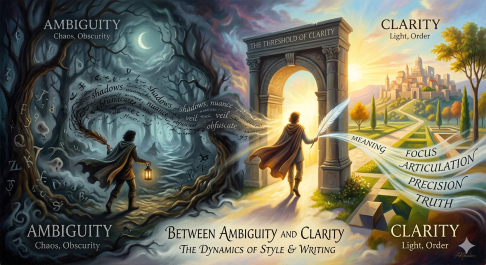
The difference between ambiguity and clarity is like that between a closed road and an open one.
Clarity in style aims to convey thought to the reader and draw them into the depths of meaning. Understanding is achieved through linguistic context—not before or after it. Thus, clarity in expression and the avoidance of unnecessary lexical heaviness are essential for maintaining coherence.
Style is the outcome of a pragmatic arrangement—not in the narrow sense of pragmatism—but as a set of dynamic points characterized by high flexibility and logical coherence. This allows the writer greater control over expressive tools.
It has been said: “The writer is the style.” This statement belongs to formalist theory. Each writer differs from others in the formulation of ideas through style itself. Style represents the dialectical essence of the writer’s thought; thus, the text becomes a fusion of ideas, forms, and language.
As the writer confronts themselves, they require a reflective mirror to reorganize their tools and refine the structural fabric of the text. This “mirror” consists of foundational elements such as intuition, instinct, intellectual activity, and mental transcendence. These elements function both independently and collectively, contributing significantly to the creation of ideas and the shaping of their final form, while simultaneously supporting both the form and content of the text in a unified artistic process.
The selection and refinement of the text remove impurities, enriching it with deep clarity, communicative simplicity, and rhetorical language. This holistic subjectivity fulfills the writer’s intention and defines their method of expression.
The writer’s capabilities are not confined, as they establish a dynamic state reflecting a position or pursuit. Writers do not remain within a single, stagnant intellectual framework, except in the case of philosophers or theorists who continuously defend and develop their ideas through intellectual justification and historical grounding.
In addition, the nature of discourse, the rhythm of directness, and the breadth of inherited intellectual frameworks all interact and harmonize, forming clear responses to complex questions.
Ultimately, the task of the text—and the writer—is one: to convey an idea to the mind, intellect, and emotions of the reader, and to influence them through persuasion. If the text fails to achieve this, it signifies a failure in its overall essence. Conversely, success affirms its value, as there is no benefit in a rigid text upon which no ideas can grow.
The text, in its strangeness, remains an open field for wonder and discovery. It does not merely present meaning but draws the reader into an interpretive adventure where readings multiply as perspectives expand. It is a living entity that transcends its apparent limits, creating a parallel world in which language intersects with thought, and imagination merges with reality—forming an infinite creative space.
Read Part-1: The Strangeness of the Text
________________
 Souad Khalil, hailing from Benghazi Libya, is a writer, poet, and translator. She has been writing on culture, literature and other general topics.