From the World Atlas of Moro to the Heart of the Balkans: A Journey of Peace and Memory
- There are certain childhood memories that never truly fade; they simply wait for the right moment to come alive again.
By Abdullah Usman Morai | Sweden
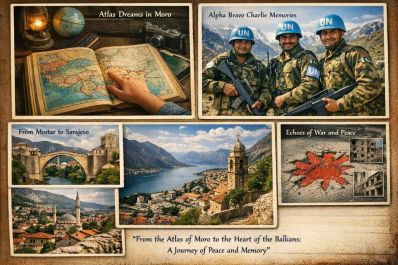
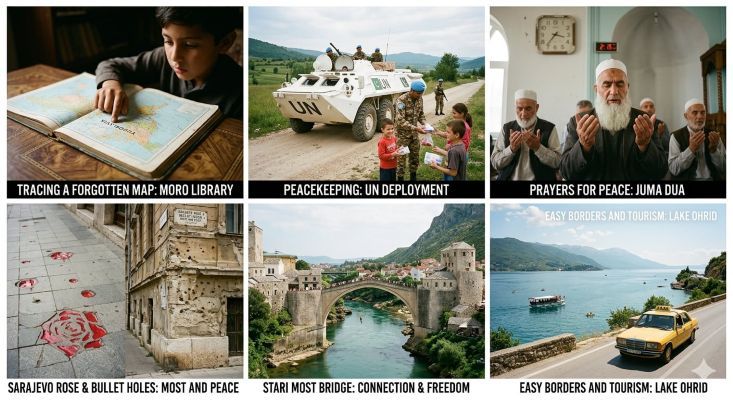
For many of us who grew up in Pakistan during the 1990s, one such memory is the iconic and legendary drama Alpha Bravo Charlie, aired on Pakistan Television. It was more than just a television series; it was a window into a distant world that captured our imagination, one filled with discipline, camaraderie, sacrifice, and above all, a mission for peace, showing Pakistani forces deployed as UN Peacekeepers in the war-torn mountains of Bosnia.
Outside of the drama, the reality was stark. Every Friday, the Imam at the local mosque would lead heartfelt duas asking for peace and protection for the people suffering in those distant lands of the Balkans. The pain of the Balkans somehow reached our homes, echoing in our prayers and conversations.
 We often hear names like Serbia, Macedonia, Bosnia and Herzegovina, Kosovo, and Montenegro in the news, always followed by reports of pain and displacement.
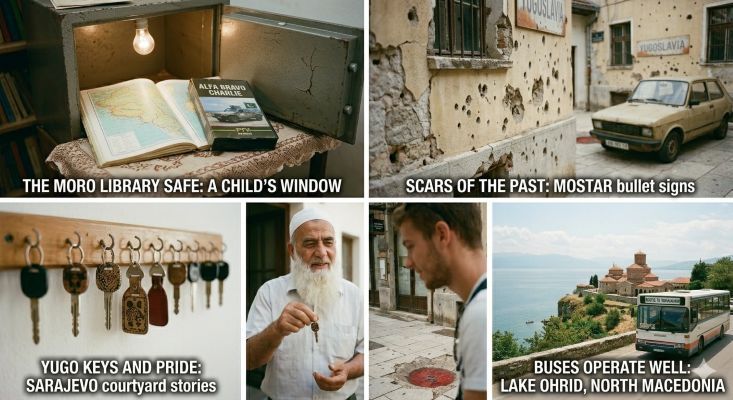
In the quiet, dusty corners of my home, in my hometown, Moro, there is a small room that serves as our family library. Tucked away on those shelves is a world atlas book from my childhood, an old, slightly worn book that still rests, a book that was once my window to the world. In the early 1990s, I would lay that atlas flat and trace and stare at the map and borders of a massive, singular country labeled Yugoslavia. A unified country stretching across a significant part of Europe. To a young mind, it was just one place. Borders were invisible, histories unknown, and the future unimaginable.
These places seemed like a distant, dark mystery. I remember looking at my atlas and thinking, “Will there ever be peace here? Will I ever see what lies behind those headlines?”
In those days, the Balkans were not a tourist destination, and images of vacations or scenery; in our imagination, they were a region of conflict, fear, war, and uncertainty. News bulletins frequently mentioned war-torn places like Bosnia and Herzegovina, Serbia, Kosovo, Croatia, and North Macedonia. Names such as Sarajevo, Srebrenica, and Pristina carried a weight that even a child could feel, though not fully understood.
Yet something stirred within me. After watching Alpha Bravo Charlie and hearing countless stories of war and peacekeeping, a quiet thought took root: Perhaps one day, when peace returns, I will visit these lands.
Years passed. The guns finally fell silent. The wars ended. The maps were redrawn and changed.
 What was once a single block on my map fractured into independent nations. Yugoslavia was no longer a single entity. It had dissolved into several independent nations and vibrant countries, i.e., Slovenia, Croatia, Bosnia and Herzegovina, Serbia, Montenegro, North Macedonia, and Kosovo, each with its own identity, flag, and story.
And then, finally, life fulfilled that childhood promise and vow, I traveled to the heart of the Balkans. I found myself walking in Bosnia and Herzegovina, I stood on and beneath the iconic Stari Most bridge in Mostar, and walked the historic streets of Sarajevo, where East meets West. In Croatia, the “Pearl of the Adriatic,” Dubrovnik, looked like a fairy tale carved from limestone, and I witnessed the Adriatic Sea shimmer against ancient walls.
I traveled to the grand city of Belgrade and the cultural hub of Novi Sad in Serbia, both of which revealed a blend of resilience and revival. I gazed at the fjord-like beauty of Kotor and Perast, towns nestled between mountains and sea in Montenegro.
I found serenity by the ancient waters of Ohrid in North Macedonia, where history meets tranquility beside a crystal-clear lake, and I felt the pulse of a young, hopeful nation shaping its future in Pristina and Prizren in Kosovo.
Beyond the former Yugoslavia, my travels extended into the broader Balkans. I also ventured into Albania, Bulgaria, and Romania, nations that, lands equally rich in culture, history, and natural beauty, while not all part of the former Yugoslavia, share the rugged, beautiful spirit of the Balkan soul.
What struck me most was not just the beauty, but the contrast.
Walking through these lands, I was struck by a profound realization: the news reports of my childhood had failed to mention how breathtakingly beautiful this region is.
As a child, the Balkans meant war. As an adult, they revealed themselves as breathtaking landscapes of mountains, rivers, lakes, and centuries-old architecture. The same places that once echoed with gunfire now resonate with laughter, tourism, and life.
The most moving part of the journey was the ease of travel. Traveling across borders felt almost effortless. Today, buses move effortlessly across borders and connect cities with ease. In many places, you can even take a taxi from one country to another. People moved freely, shared stories, and welcomed visitors with warmth. Peace had not only returned, but it had rebuilt bridges, both physical and emotional. A concept that would have seemed impossible during the shelling of the 90s.
And yet, the memory of war remains, and the past is not forgotten.
In Sarajevo, I saw “Sarajevo Roses”, indentations in the pavement caused by mortar shells, filled with red resin. I saw buildings with bullet holes still visible on the walls in Mostar, preserved as a testament to what was lost and a silent reminder of what once was.
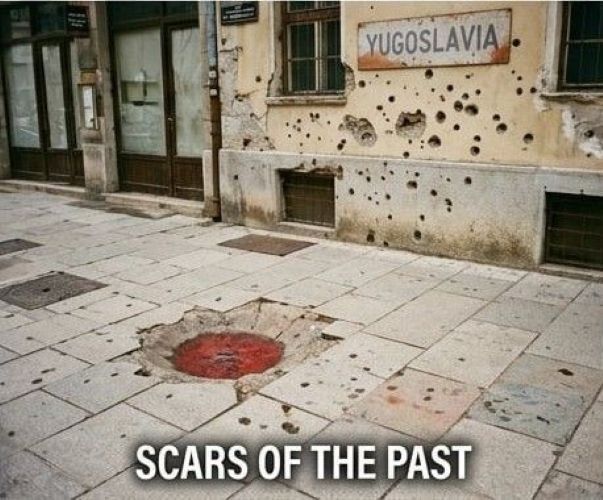 Museums and memorials preserve the memory of lives lost. As I walked through these places, I often paused, reflecting on those who never lived to see this peace. Their absence is deeply felt in the presence of calm.
Amidst modern cars and bustling streets, one might still spot the humble Yugo. The locals still speak with a bittersweet pride about the Yugo, the small, boxy car that became a symbol of the former unified state and a symbol of nostalgia and resilience. It stands as a reminder that even in simplicity, there is pride.
Wandering through these mesmerizing landscapes, the green mountains of the Balkans, I couldn’t help but think of the thousands who lost their lives before this peace was achieved.
This journey was not just about travel; it was about closure, about connecting the dots between childhood imagination and adult reality. The Balkans are living proof that no matter how deep the divide or how bitter the conflict, peace is the only sustainable destination. It was about witnessing how regions once divided by war can heal through dialogue, cooperation, and time.
The infrastructure can be rebuilt, and the borders can be opened, but the loss of innocent lives is a debt that can never be repaid.
Looking back at the boy in Moro with his atlas, I realize that the world shouldn’t wait for decades of suffering to end a war. Whether it is the Balkans of the 90s or the conflicts of” today”, the solution remains the same: dialogue, empathy, and the courage to choose peace. As the sun sets over the Adriatic, the message is clear: sooner is always better. Peace is not just the end of war; it is the beginning of life.
In the end, one truth becomes undeniable: wars leave behind ruins, grief, and lost generations. But peace, however delayed, builds, heals, and endures.
The Balkans taught me that borders may change, nations may divide, but humanity’s longing for peace remains constant. The sooner we choose dialogue over destruction, the more lives we save, and the more beautiful this world becomes.
Because ultimately, it is not war that defines us, it is the peace we strive to create.
Read: How Sindh’s Railways Fell Into Silence
________________________
 Abdullah Soomro, penname Abdullah Usman Morai, hailing from Moro town of Sindh, province of Pakistan, is based in Stockholm Sweden. Currently he is working as Groundwater Engineer in Stockholm Sweden. He did BE (Agriculture) from Sindh Agriculture University Tando Jam and MSc water systems technology from KTH Stockholm Sweden as well as MSc Management from Stockholm University. Beside this he also did masters in journalism and economics from Shah Abdul Latif University Khairpur Mirs, Sindh. He is author of a travelogue book named ‘Musafatoon’. His second book is in process. He writes articles from time to time. A frequent traveler, he also does podcast on YouTube with channel name: VASJE Podcast.