The modern world looks globalized and open, but behind this openness there is silent competition between states
Noor Muhammad Marri Advocate | Islamabad
People usually think states only fight through armies, tanks, missiles and open diplomacy. But history tells another story. Every powerful state, kingdom or empire always tried to know what was happening inside other societies. For this purpose they used spies, traders, migrants, laborers, scholars, travelers, religious men and even educational institutions. Espionage is not something new. It is as old as human civilization itself.
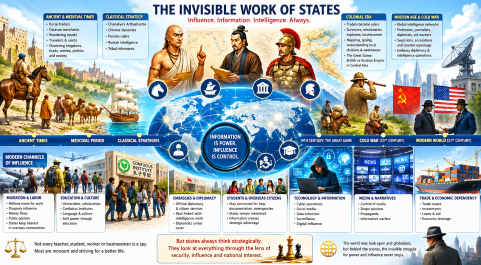
In old times kings used horse traders, caravan merchants and wandering monks as sources of information. A horse trader could travel from one kingdom to another without creating suspicion. He could observe roads, military camps, food supply, local politics and social tensions. Merchants travelling through Silk Route were not only carrying goods but also information. The same happened in Arab trade routes, Central Asia and the Indian subcontinent.
Chanakya in his famous work Arthashastra openly discussed the role of spies in governance. He mentioned spies in shape of students, saints, businessmen and travelers. Ancient Chinese dynasties, Persian rulers and Romans also had intelligence systems. Even tribal chiefs depended on informants to know movements of rival tribes.
Later European colonial powers made espionage more organized. The British East India Company came to India as traders but slowly became rulers. Trade and intelligence worked together. Surveyors, missionaries, explorers and businessmen all collected information. The British understood local divisions, tribes, geography and political weaknesses better than local rulers themselves.
During the nineteenth century the rivalry between the British Empire and the Russian Empire in Central Asia became famous as the Great Game. Explorers moved in shape of travelers, researchers and pilgrims. Their real purpose was to map mountains, roads and strategic areas. Intelligence became part of imperial survival.
In the modern age the shape changed again. During the Cold War the United States and the Soviet Union spread intelligence networks across the world. Professors, journalists, businessmen, diplomats and aid workers were often suspected of intelligence links. Some accusations were false, some were true. But the reality is that all powerful states use soft channels to increase influence.
Today migration and labor are also important parts of global politics. Millions of laborers move from poor countries to rich countries. Most are innocent hardworking people trying to feed families. But states always observe migrant communities carefully. Diaspora communities can influence politics, money flows and public opinion. Governments remain interested in overseas citizens because these communities can become economic and political assets.
Educational institutions also entered this competition. One important example is the Confucius Institute established by China in many countries. Officially these institutes promoted Chinese language and culture. But many in the United States believed they could also increase Chinese political influence inside universities. Due to these fears several American universities closed partnerships with Confucius Institutes. China denied such allegations and said these centers were only educational and cultural. But this controversy itself shows how suspicious modern geopolitics has become.
Embassies also play an important role in this invisible world. Officially embassies exist for diplomacy, visas and protection of citizens abroad. But throughout history embassies were also linked with intelligence work. Almost every major country suspects foreign embassies of gathering political and strategic information. During the Cold War many diplomats were actually intelligence officers working under diplomatic cover.
Even today states remain connected with their students and citizens abroad. For example students from Pakistan studying in foreign countries remain in touch with Pakistani embassies for documentation, emergencies, scholarships and legal help. This is normal. But states also keep interest in overseas communities because information itself is power. The same happens with almost all countries including China, Russia, United Kingdom and the United States.
Modern espionage is no longer only about secret agents wearing black coats. Today information comes through technology, social media, universities, NGOs, trade companies, cyber systems and financial networks. Some states use media influence, some use economic dependency, some use education and some use migration patterns.
However one thing should also be understood carefully. Not every professor, migrant, laborer, student or businessman is a spy. Most people are ordinary human beings struggling for education and survival. But states themselves always think strategically. They look at everything from security and influence perspective. That is why powerful states rarely separate trade, education, migration and diplomacy completely from intelligence interests.
The modern world looks globalized and open, but behind this openness there is silent competition between states. Every major power wants influence beyond its borders. Sometimes through trade, sometimes through education, sometimes through culture and sometimes through intelligence networks hidden inside ordinary structures of life.
This invisible struggle never stopped in history. Only its shape changes with time.
Read: America: The Age of Invisible Transformation
_____________________
 Noor Muhammad Marri Advocate & Mediator is based in Islamabad