

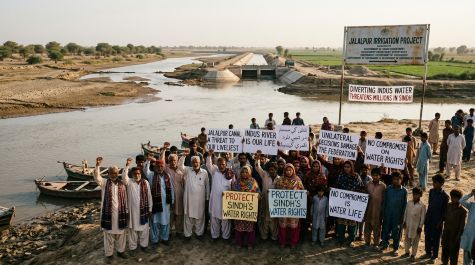
Depriving Sindh of its legitimate right to the river, again and again, risks shattering the very foundations of the state.
- No government has the authority to compromise Sindh’s water rights through unilateral decisions. Any attempt to proceed with projects that threaten the livelihoods of millions in Sindh will only deepen the constitutional crisis and further erode confidence in the federation.
Azhar Azad Mughal, Shikarpur
The Indus River, long considered the jugular vein of the people of Sindh, is under assault. The construction of the Jalalpur irrigation canal — and its trial commencement — has gone ahead despite Sindh’s stiff opposition last year, voiced through a peaceful protest movement that carried the province’s strong resentment and anger to the federation.
Sindh’s political forces have raised serious concerns and reservations over Punjab’s decision to commence trial operations of the Jalalpur canal, even as the constitutional dispute over new canal projects and Sindh’s water rights remains unresolved. Sindh is already grappling with acute water shortages, the destruction of the Indus Delta, and the collapse of its agricultural economy. To proceed with new upstream canal projects under these conditions is unacceptable to the people of Sindh and amounts to an assault on the rights of the lower riparian province.
There is no denying that agriculture is the livelihood of the majority of Sindh’s people, and that this agriculture depends entirely on river water — the Indus being its only source. The crops, fruits, vegetables, and sweet drinking water that sustain Sindh all owe their existence to this one river. Without the Indus, there would have been neither Sindh nor its thousands-year-old civilization.
The Sindh government must record its protest before the federal government and urge it to immediately convene a meeting of the Council of Common Interests, taking every constitutional measure available to halt the project.
Sadly, we have learnt nothing from our past mistakes and blunders. Why do we remain wedded to narrow-mindedness and shortsighted thinking bound to destroy our very existence? Will this policy bring us success and standing in the comity of nations? Why are our so-called champions of democracy and constitutional supremacy more inclined toward injustice than fair treatment? Will this serve the cause of our unity?
The constitution obliges the federal government to convene a meeting of the Council of Common Interests at least once every three years. Yet the federation seems more preoccupied with resolving international conflicts than with addressing the issues confronting the country and defusing tensions between its federating units — even though the latter bear more directly on national stability.
Our government strongly condemns India’s aggressive weaponisation of water under Modi. Yet it shows no equal readiness to ensure the judicious and fair distribution of water among its own federating units, as mandated by the Indus River System Authority (IRSA). The construction of the Jalalpur canal in Punjab, in flagrant breach of the decisions taken at last year’s CCI meeting — decisions reached only after massive protests and a strong outcry across Sindh — amounts to diverting Sindh’s water to irrigate the barren lands of its “big brother,” at Sindh’s expense.
Unless decisions reached by consensus are implemented in letter and spirit, for the good of the country as a whole, the differences between the federation and the provinces will only widen rather than ease.
The Indus, the very source of survival for the people of Sindh, should never be pushed to the wall. Depriving Sindh of its legitimate right to the river, again and again, risks shattering the very foundations of the state. No government has the authority to compromise Sindh’s water rights through unilateral decisions. Any attempt to proceed with projects that threaten the livelihoods of millions in Sindh will only deepen the constitutional crisis and further erode confidence in the federation.
Read: Indus River: It’s more than just water
_____________________



Infact Abaseen River is called Indus River when it enters Attock. Hence the right of water from Abaseen every province where it flows. Hence Punjab, Baltistan and KPK can take advantage. Sindh gets it’s share as per ISRA Agreement. Sindh opposed Kalabagh Dam which was in the benefit of Sindh Province.