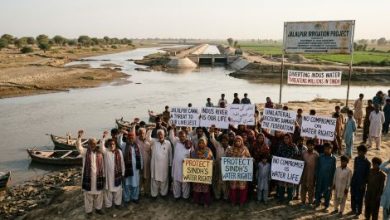
Development at Environmental, Social Cost
Industrialization Threatens Malir’s Generations-Old Lands


Malir is not merely a piece of land. It is home to communities with generations of history, culture, livelihoods, and a deep connection with the natural environment.
By Noor Zaheer
At a site in Malir where a mosque was demolished in the presence of a heavy police contingent only a few days ago, and a large boundary wall was also brought down, serious questions remain unanswered for the local community. The mosque served as a place of worship for the people living in the area.
Standing at the same site today and looking around, one can still see Malir’s natural landscape — its greenery, agricultural fields, and long-established villages. The area is home to several settlements and thousands of acres of land where local families have lived for generations, depending on their land for their homes and livelihoods.
The question is: for what purpose is this fertile and largely green part of Malir being transformed? If large buildings, industrial projects, lithium battery and tyre manufacturing units, and other industries are established here, what will be the social and environmental cost of this development — and who will bear it?
Local residents say they are unwilling to leave their land. For them, these lands are not simply pieces of property; they are their homes, their source of livelihood, and part of a history passed down through generations.
There is also a fundamental legal question. Articles 23 and 24 of Pakistan’s Constitution protect the right to own property and establish safeguards against the deprivation of property except in accordance with the law. In Sindh, the Goth-Abad (Housing Scheme) Act, 1987 provides a legal framework for housing facilities and the regularization of rural settlements, including the rights of eligible occupants.
Therefore, if local residents are being asked to vacate their land, the legal basis for such action should be made clear. What legal procedure has been followed for acquiring the land? What notices have been issued to the affected people? And what arrangements have been made regarding compensation and, where necessary, resettlement?
The demand that local residents vacate their land within only two days raises particularly serious concerns. For families that have lived in an area for generations, being asked to leave their homes, land, and livelihoods within a matter of days is not merely an administrative decision; it can fundamentally disrupt their lives.
If the government or relevant authorities have the legal power to acquire the land, they should make public the relevant notifications, the legal basis for the acquisition, the procedure being followed, and details of the rights and compensation available to the affected people. Transparency is essential if public concerns and doubts are to be addressed.
Another important question concerns the use of the police. Who is directing the police to take action on the land of local residents? Under what legal authority are such directions being issued? Where land disputes exist, are all affected parties being given a fair opportunity to present their case and seek legal remedies?
The role of elected representatives also deserves scrutiny. Local residents have, in the past, received assurances regarding their land and settlements, yet disputes over land and displacement have continued. Residents have also alleged that they have faced pressure in matters concerning their land. In such circumstances, elected representatives and relevant authorities have a responsibility to provide the public with clear and verifiable information.
We are not against development. Malir should certainly develop, but development should not mean that the land, homes, places of worship, livelihoods, environment, and settlements of local communities become its price.
Development can only be sustainable when local communities are included in decision-making, their legal rights are respected, the environment is protected, and every process involving the acquisition of land is carried out transparently and in accordance with the law.
Malir is not merely a piece of land. It is home to communities with generations of history, culture, livelihoods, and a deep connection with the natural environment. If all of this is sacrificed in the name of development, we must ask a simple question: development for whom, and at whose cost?
Read: Malir – Farmlands, Heritage at risk
____________
 Noor Zaheer