The WB, ADB, UNDP and other development agencies should focus on ecotourism venues with a view to compensate the climate change vulnerabilities suffered by the people of our country.
Mohammad Zafar Wassan
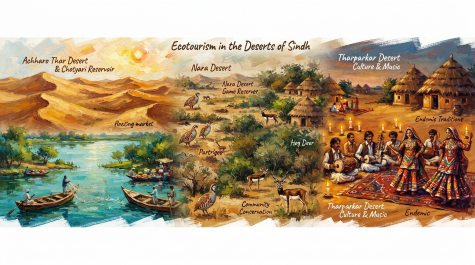
Our country is endowed with large swatches of Desert lands. As per statics more than 60 percent of country’s area is Rangeland. Commonly these lands are known as Desert. In past, these areas has not got attention for their poor Agriculture potential in terms of food and Cash Crops. Now, with new scientific concepts of sustainable development the rangelands are classified as main area to address issues related to Biological Systems stability in addition to livelihoods improvement of the people. These rangelands has a significant potential to develop tourism with broader vision of Sustainability in terms of nature conservation. At the first instance, the Range lands located on southeastern Deserts of country are good avenues to cast tourism services. The south eastern part of Sindh is hub of a unique indigenous culture on sandy grounds of Achharo Thar, Tharparkar and Nara deserts. Achharo Thar is at interface of a historical lake encompassing an area of more than 28000 acres. In recent past, it was complex of many wetlands. All these wetlands located at the interface of Achharo Desert, now converted into Chotyari Reservoir. On the western side of these wetlands, there are swatches of Riparian Forests.
This complex of Eco Systems developed an unforgettable picturesque to see the contrasts of nature. The vast are of sand grounds will be ideal for Desert Safari. Likewise, the lake is a nice place to enjoy the Wetland tourisms. The Chotyari Lake is known for its local and endemic Fish cuisines prepared by different procedures. The local fishermen has special skill to make many dishes from the local fish catch. In these wetlands, the avenues of floating markets may be developed like Thailand and Vietnam. These floating markets are main feature of Thailand and Vietnam tourism. It provides fun to visitors by shopping in a unique style while boarded on the boats. It will provide employment and income generating source to local inhabitants. In addition, the endemic Deserts mushrooms are food with a good content of proteins. In a traditional style, these desert mushrooms are cooked with a special spices and local recipes. This nexus of Freshwater and Deserts Ecosystem will be an ideal place for Nature lovers who want to enjoy the glimpses of nature in Wild.
In the west southern side of this lake, Nara desert is located. Nara desert is a mosaic of Forests and the desert grounds are constituting the complex diversity of Desert and Forest life. It presents a best model of anthropogenic and community based model of Resource Conservation. These Forests are Game reserves protected by the communities.
These forests are Game reserves which are abounded with partridges, Black Buck and Hog Deer. These wild fauna are protected by local communities, who are disciples of Pir Pagaro. These reserved area are maintained with a view to host their spiritual leader for a hunting game. The live glimpses of partridges in thousands are roaming around these grounds of vegetated desert.
The Tharparkar is place of unique culture in terms of thatched architecture. The residential places are made with the branches, stems, logs, thorns and leaves of local vegetation. No brick and mortar is used in these houses. It creates a nature based insulation in these thatched infrastructure. All this make Tharparkar desert to visit and see the endemic culture, nature and indigenous communities inhabited in the areas since thousand years.
Tharparkar deserts are known for unique cultural characteristic of endemic and peculiar music of this area. These deserts has a unique musical culture to touch the heights of musical performance in consonance with special rhythms of desert. The musicians and vocalist of Thar has specialty to sing on high pitch of sound. They are used to sing on open grounds so they sing loudly on high pitches of their sound. Historically, Tansen, the great guru of Indian Classical music in times of Great Akbar Mughal earned laurels by performance. He was inhabitant of a Thar Desert of Rajhastan.
Furthermore, group dances by local artists in candle light on desert carpets of sands presents a unique picturesque in night time. It deserve to be stored in recalled memories for infinite times. In these performances the cultural strengths are coupled with ecological endemics.
In view of above ecological description and cultural peculiarities it is suggested as under:
1) These complexes of diverse ecosystems need the attention of international and local tourist to earn and express the love for nature.
2) The Electronic, Print and Social media should divert their attention to these ecosystems which are required private investments for nature’s revival. This revival is Climate Change Resilience with anthropogenic interaction to recover the nature and its ingredients on sustainable basis.
3) The development donors like World Bank, Asian Development Bank UNDP and other development agencies should focus on ecotourism venues with a view to compensate the climate change vulnerabilities suffered by the people of our country.
4) The development leadership who is specifically working on different models of Climate Change Resilience should focus their attention in these Deserts to restore and recover diverse life in addition to reduce the poverty and arrange the livelihood for local communities by means Ecotourism.
5) The local and International financial institutions like Banks, mutual funds and corporate sector should come forward to invest from Climate Change Adaptation funds in these nature based business ventures meant to save the nature. These investments will pay higher and compensate the losses incurred for Carbon Emissions.
Read: Tribal Clashes Ravage the Indus Eco-Zone
___________
 Hailing from Sanghar district of Sindh, the author is a freelance writer. He writes for different newspapers on the subjects of Governance, Climate Change, Current Affairs and Natural Resources Management.