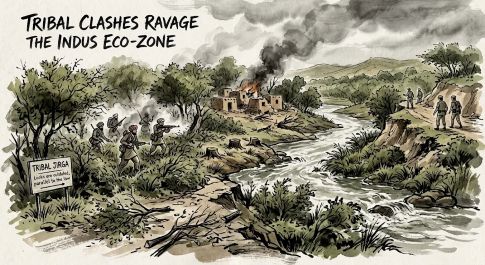
Tribal enmities and criminal hideouts along the Indus River are severely damaging vital ecological covers.
Strengthening governance, banning parallel justice systems, and enforcing conservation laws are urgent steps to save nature.
Mohammad Zafar Wassan
It is a dilemma that nature’s conservation is not given the due importance required by the general populace. The ecological assets meant to perpetuate sustainability are not owned by the people for their conservation and protection. Tribal clashes are a curse that destroys peace, and against the backdrop of these enmities, tribal warriors turn into criminals, committing murders, dacoities, robberies, and kidnapping for ransom. Thousands of people are killed, and billions in property is lost in the name of these tribal enmities, with culprits finding refuge under dense forest covers after committing crimes.
The ecological systems along the Indus bear the brunt of all these societal evils. Criminals who are absconders and wanted in heinous crimes avail themselves of refuge in the forest covers of the River Indus. From the very beginning, forests have provided good cover to hide the visibility of dacoits, and their landscape features facilitate criminals and outlaws in maintaining their stay within these thorny covers. Likewise, the river’s deep waters serve as a shield to protect them from chasing law enforcers, and these criminals are generally good swimmers capable of escaping easily. In addition, the biological lines, equipped with xerophyte modifications of thorns, obstruct law enforcers.
The locals’ acquaintance with the zigzag ways and intricacies of the location is the primary strength used by these criminals to dither law enforcers. Tragically, this biological strength protecting criminals also causes the removal of tree cover, as law enforcers require clear paths to move their logistics and forces through these dense covers, clearing passing lines by cutting down trees. Similarly, trees are a valuable commodity in monetary terms; when criminals take over the ground on forest landscapes, they start cutting trees for financial gains.
Under service delivery systems, the forest department is obliged to manage these forests, possessing a duty description with certain delegated powers to enforce the law and deter forest-related offenses. However, it is a lacuna in our governance systems that the forestry sector has not been given importance in conformity with its job ambit and duty description. To date, the forest department has not been declared an armed force and is not equipped with the required paraphernalia to deter ecological crimes. In view of these systematic inabilities, the local population seizes the opportunity to sell woody trees, as there is no forceful check to restrict them from wood theft.
Furthermore, the parallel justice system originating from obsolete feudalistic norms is a curse to the conservation of ecological life along the Indus. The tribal jirga settles societal crimes in its own style under feudalistic jurisprudence; murder crimes are settled by imposing fines and inhuman honor exchanges, granting remission to murderers who ought to be hanged or imprisoned for life. In this jirga system, there is no room to secure and compensate public properties, and feudalistic jurisprudence rejects collective ownership and intrusive welfare, with public properties taken over as tribal properties and treated as the exclusive ownership of the Tribal Chief—or endowed by tribal leaders to cronies, relatives, and friends.
It is quite strange that the government favors these curses, impairing modernity while modern societies lead toward development. Public institutions established to uphold the law and constitution are letting these anomalies in governance systems slide. The parliament, from which the government stems, remains silent, and nothing is legislated to curb and withhold these societal irregularities in a fruitful way. Consequently, there is no accountability mechanism to deter ecological losses and environmental crimes; thousands of carbon sinks have been removed without punitive action, and crimes against the global climate are systematically allowed on public lands while society remains silent due to its subjective mentality.
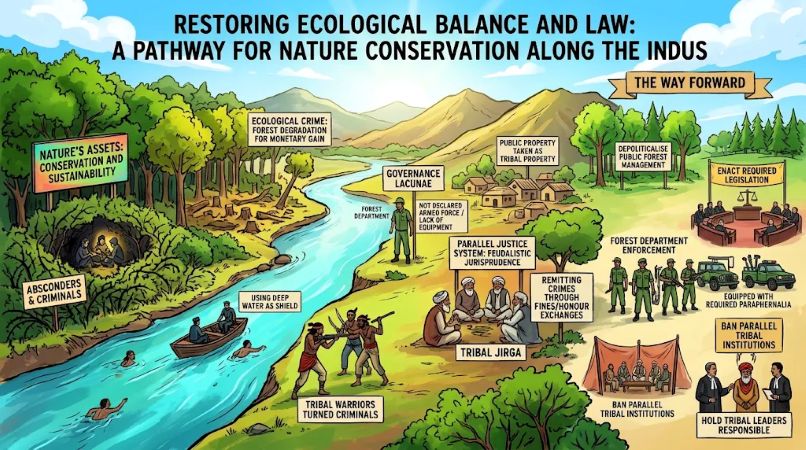
In view of the governance lacunae and societal indifference to conservation and nature described above, it is suggested that the state cognize ecological crimes and bring ecological criminals to justice for a logical end as admissible under the book of law. The state should step forward with a conservation agenda, granting the diverse life of the Indus eco-zone the attention it requires. Specifically, the following measures should be enacted:
- De-politicization: Public forest management should be depoliticized with the ultimate objective of saving nature and its ingredients.
- Legislation: Required legislation should be enacted to streamline deterrent means against crimes against nature.
- Enforcement: The enforcement corps of the forest department should be equipped with the required paraphernalia to strike against nature-destruction crimes.
- Jirga Bans: The jirga should be banned, and the state should take action against these parallel tribal institutions of feudalistic criminal justice.
- Tribal Accountability: Tribal leaders should be held responsible and culpable in the case of ecological disasters.
Read: Democratic Socialism getting place in USA
_______________
 Hailing from Sanghar district of Sindh, the author is a freelance writer. He writes for different newspapers on the subjects of Governance, Climate Change, Current Affairs and Natural Resources Management.