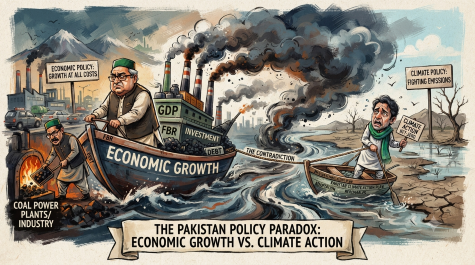
Sustainable development demands the integration of climate policy with economic policy so that economic growth becomes part of the solution to climate change rather than another source of the problem.
Kashif Rauf Niazi
Economic growth has been a commonly used indicator of a country’s development, and Pakistan is not an exception in this regard. At the same time, Pakistan has pledged to address climate change, protect natural resources, and move towards sustainable development. But these objectives are not necessarily aligned. In several sectors, policies used to promote economic activity can weaken the very climate objectives the country has promised to pursue.
Consider industrialization. Pakistan is interested in boosting the manufacturing as well as export of its goods, however many industries are still reliant on electricity and energy from fossil fuels. Thermal sources accounted for approximately 48.8% of electricity generation while hydel, nuclear, and renewables accounted for approximately 51.2% in FY2025. Increased production can also lead to increased emissions, unless cleaner energy and efficient technology increases as well.
The contradiction is also found in the progress of CPEC SEZ. The zones aim at attracting investment, creating jobs and bolstering exports. However, when factories depend on polluting energy, and do not have adequate systems to treat the factory waste and wastewater, industrial development can be an expensive environmental burden. A study on environmental-policy coherence in Pakistan reveals that energy, agriculture, and industrial policies tend to ignore climate and environmental goals within the CPEC context.
A similar situation exists in agriculture. Rice and sugarcane are important crops that ensure farmers’ livelihoods, employment, food industries and exports in rural areas. Both, however, have high water requirements, particularly in areas of inefficient irrigation. Pakistan is already under increasing stress on its water resources as agriculture uses approximately 90 % of available water, and five major crops: rice, wheat, cotton, sugarcane and maize use 85 % of the total water but contribute less than 5 per cent of GDP. Agricultural policy has been used to promote growing crops that can be sold for profit, and climate policy has promoted water conservation, improved irrigation and climate-smart agriculture. Crop selection is not easy because it’s linked to the income of farmers and supply for industries, but without water it becomes harder and harder to sustain this economic model.
Yet another: the cost of growth-led policies is air pollution. In particular, the use of fossil fuels, crop burning, brick kilns, and transport contribute to the presence of high levels of particulate pollution. The annual concentration of PM2.5 in 2025 was approximately 13.5 times higher than the annual guideline value set by World Health Organization (WHO). Currently, Lahore is still one of the most polluted cities around the world and transport accounts for approximately 35% of the PM2.5 pollution in the city. In Pakistan, > 22,000 people die annually due to air pollution, demonstrating that air pollution is a public-health and economic problem as well as an ecological one.
There is a policy conflict in forests as well. Timber businesses are a source of livelihood and the timber is used for construction and making furniture. But unmanaged harvest degrades forests which sequester carbon, buffer soils and maintain biodiversity. The forest cover in Pakistan is 4.8% to 5.4% only and the deforestation rate is calculated to be approximately 15,000 ha per year during 2004-2016. If we are to encourage forest conservation and extensive tree planting in the country, we must not be blind to unsustainable logging. While commercial timber activity shouldn’t be eliminated, it should be controlled and the forests be given time to regenerate.
Tourism is in a similar situation. Pakistan is also keen on bringing in the visitors and providing incentives for the investment in hotels, resorts and restaurants, especially in the northern region. Tourism provides employment and helps to promote local businesses. However, a badly planned hotel development can put strain on water supplies, add to the load of sewage and solid waste, and adversely affect sensitive mountain ecosystems. If tourism grows unchecked without adequate planning and protection, the natural beauty which draws visitors may be lost over time.
Although increased livestock production and production of meat and dairy will improve the farmer’s income levels, it is worth noting that conventional livestock production also produces methane, a potent greenhouse gas. Energy and agriculture contribute approximately 91% of the emissions, out of which approximately 46% of the emissions come from energy and 45% of the emissions come from agriculture and livestock. Heavy reliance on petrol and diesel leads to more emissions, but a robust transport and automobile industry can provide jobs. Housing, roads and infrastructure would be impossible without cement; however, the manufacturing of cement is very energy intensive and generates carbon dioxide.
Pakistan’s climate commitments also reveal the gap between ambition and implementation. Under its Nationally Determined Contribution, Pakistan aims to reduce projected greenhouse-gas emissions by 50% by 2030 compared with a business-as-usual scenario. Of this target, 15% is to be achieved through domestic resources, while 35% is conditional on international climate finance, technology transfer, and capacity-building support. However, when this support remains insufficient, Pakistan continues to rely on fossil fuels, water-intensive agriculture, polluting industries, and unplanned construction to sustain economic growth.
Pakistan does not have to choose between economic growth and climate protection. It requires that it put both policies together. Economic planning should incorporate climate targets and climate policies should reflect the country’s economic needs and priorities. Industrialization, agriculture, tourism, transport and infrastructure development should all go in the same direction that promotes economic development, but not at the expense of natural resources.
This will need improved coordination between government institutions, climate-smart investments, harsher environmental law enforcement, and more stringent environmental laws against unplanned construction, industrial pollution, and illegal logging. If the economic policies are not aligned with the commitments that are being made for Pakistan’s climate change, it will be impossible for the country to be effective in dealing with climate change. Sustainable development demands the integration of climate policy with economic policy so that economic growth becomes part of the solution to climate change rather than another source of the problem.
Read: Gender Inequality remains Systemized
_______________
 Kashif Rauf Niazi is a graduate of Political Science from the University of Peshawar. He is currently pursuing MPhil in Strategic Studies at the National Defence University (NDU), Islamabad. His academic interests include international relations, strategic affairs, and public policy.