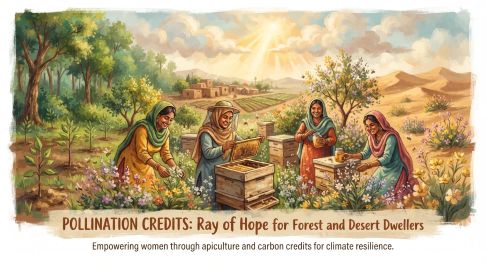
These apiculture initiatives will provide an opportunity for women folk to earn a share of carbon credits alongside apiculture earnings.
The climate fund investors should focus on these multilateral approaches meant to provide employment, improve livelihoods, and reduce poverty by investing in Climate Resilience Actions in these deprived areas.
By Mohammad Zafar Wassan
The Developed world emits, Developing suffers. The suffering are deluges, erratic rainfalls and Celsius increases. It bring woes in the lives of developing countries. The woes are losses to life, property, soils and crops. It disturbs the nature. It obstructs the biological cycles, ecosystems leading annihilation of the creatures who work symbiotically. The anthropogenic actions are just to meet the greed instincts. With the lapse of time, the development workers, scientists and environmentalists are conceiving new ideas to recover and compensate the losses incurred in the name of Emissions. The Pollination Credits are one of compensatory answer to these tyrannical emissions by corporate entities.
When we refer the pages about the history of biodiversity destruction, it reveals that pesticides caused a significant loss to insects, birds, and many creatures who were living alongside other elements of nature. The indiscriminate use of fertilizers and pesticides annihilated these natural mechanisms meant to perpetuate life and nature. First of all, we have to understand why pollination has been taken as an issue to be tackled. Pollination is the process that ensures fruit and seed formation. Biological cycles start from the seed and end in the fruit. Some plants are endowed with biological mechanisms for self-pollination, whereas other plants are pollinated through cross-pollination. There are different pollination agents that make cross-production possible between two different plants. In addition to other pollination agents, insects are considered the best pollination agents for producing fruits and seeds from plants. When we take into consideration the symbiotic interactions of nature’s elements, it reveals marvelous discoveries. Honey bees depend upon the nectar of flowers to produce honey. It is a behavioral function of honey bees to collect and convert flower nectar into a delicious food for humans. It is the best example for understanding biological cycles and diverse life interactions that perpetuate the multiplication of life. In addition to collecting nectar, bees cause the cross-pollination of plants to incept the next progeny.
Now, we should discuss pragmatic means for biodiversity revival through anthropogenic stewardship. If nature-based solutions are incorporated into Biodiversity Adaptation Plans, and if the livelihoods of people are connected with these plans, it will be far more feasible to write ultimate success stories. Apiculture is a very good source of earning to improve livelihoods. Practically, it is very difficult to exercise apiculture operations alongside agricultural crops, as our farmers have not switched to biological pest control on our lands. However, the deserts and forests of the country are the best pieces of land to carry out apicultural activities. Forests are quite safe places, devoid of pesticide and fertilizer use, ensuring the survival of bees. Likewise, cultivation activities in deserts are quite limited due to drought. It seems that droughts have turned into a blessing for desert communities, in the sense that they are living in a pesticide and fertilizer free atmosphere.
In view of the above-described strengths of forest and rangeland landscapes, apiculture activities may be promoted as a livelihood source for poor communities inhabiting the deserts of the country. This initiative will serve to improve the biodiversity of the area, coupled with poverty reduction. Furthermore, it would create a niche to earn credits under the pollination head. These apiculture initiatives will provide an opportunity for women folk to earn a share of carbon credits alongside apiculture earnings. Furthermore, climate fund investors should focus on these multilateral approaches meant to provide employment, improve livelihoods, and reduce poverty by investing in Climate Resilience Actions in these deprived areas.
Read: Sindh Deserts: Prospects of Eco Tourism
_____________
 Hailing from Sanghar district of Sindh, the author is a freelance writer. He writes for different newspapers on the subjects of Governance, Climate Change, Current Affairs and Natural Resources Management.