A clean and healthy environment is not a luxury; it is a basic public necessity and a shared responsibility.
By Dr. Mahmood Laghari
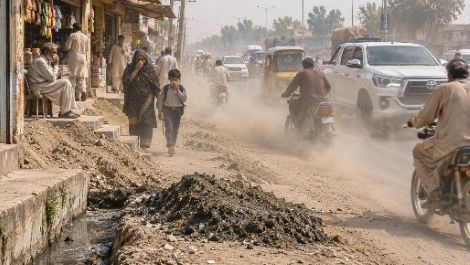
Dust has become an almost unavoidable part of everyday life in many small towns and cities of Sindh. From busy highways to commercial areas and narrow streets, clouds of dust rise whenever vehicles pass. Although people have gradually become accustomed to this unpleasant environment, the problem is much more serious than an ordinary inconvenience. It reflects poor municipal management, inadequate infrastructure, and a lack of civic responsibility, with potentially serious consequences for public health.
The Hyderabad–Mirpurkhas dual carriageway and various commercial areas of Tandojam provide examples of how everyday practices contribute to dust pollution. Many shopkeepers raise the level of their shop entrances by placing loose soil between their doorways and the road surface to prevent rainwater from entering their shops. However, in the absence of properly designed and constructed roadside drainage channels, this soil gradually spreads towards the road through pedestrians and passing vehicles. Eventually, it accumulates along road edges, where traffic continuously disturbs it and releases dust into the surrounding atmosphere.
The situation becomes worse because of irresponsible driving. It is not only motorcycle and rickshaw riders who use roadside areas to overtake other vehicles; drivers of Vigo vehicles, private cars, and other expensive vehicles frequently do the same. In their haste to move ahead, they drive over accumulated loose soil, generating clouds of dust that affect shopkeepers, customers, pedestrians, and nearby residents. This demonstrates that traffic indiscipline is not restricted to any particular category of vehicle or social class.
An even more concerning situation exists in the internal roads and streets of Tandojam and several other towns and cities across Sindh. Poor sewage management has created another source of potentially hazardous dust. Sewage sludge removed from open roadside drains is frequently dumped along roads and simply abandoned, without any arrangement for its subsequent collection, transportation, or safe disposal.
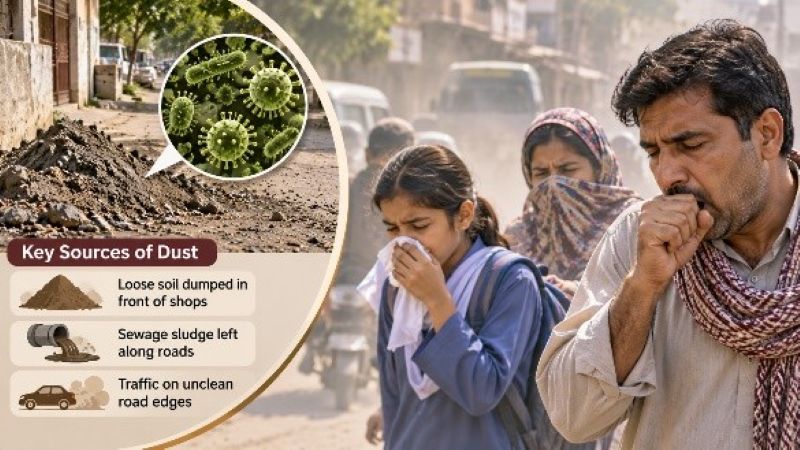
A particularly disturbing example can be observed along Mir Colony Road in Tandojam. The sludge removed from roadside drains is left exposed indefinitely. It gradually dries, breaks down, and spreads across the road through passing vehicles and pedestrians. As vehicles move over this material, considerable amounts of dust are generated and dispersed into the surrounding environment. During rainfall, the contaminated material is washed away and carried into roadside depressions and other open drainage channels, creating further sanitation problems.
This practice is particularly alarming because sewage sludge may contain harmful microorganisms, including disease-causing bacteria, viruses, and parasites. When contaminated material dries and becomes airborne, people living, working, shopping, or walking nearby may be exposed to potentially harmful particles. Children, elderly people, shopkeepers, and other vulnerable individuals deserve particular protection. Therefore, leaving sewage sludge exposed along public roads is not merely a matter of poor cleanliness; it is a potential public-health hazard.
The economic consequences are equally important. People spend considerable amounts on medical consultations and medicines, while shopkeepers and customers continue to work and conduct business in an unhealthy environment. The problem becomes particularly noticeable during winter, when relatively weaker winds may allow dust to remain around streets and commercial areas for longer periods.
The most important question is why such a preventable problem continues to persist when its causes are clearly identifiable and practical solutions are available. Municipal authorities must take the lead in addressing this issue. Properly designed roadside drainage channels should be constructed to prevent rainwater accumulation and reduce the need for shopkeepers to raise their entrances using loose soil. Regular street-cleaning arrangements must be established, particularly along commercial roads and busy streets. Most importantly, sewage sludge removed from open drains must be collected, transported, and safely disposed of immediately, preferably on the same day. Municipal authorities must ensure that their responsibility does not end with removing sludge from drains but extends to its final disposal. Leaving it exposed along public roads simply transfers one sanitation problem into another.
Shopkeepers and traders must also fulfil their civic responsibilities by keeping the areas outside their establishments clean and avoiding the accumulation of loose soil along road edges. Where shop entrances need to be raised, permanent and properly constructed solutions should be adopted. Similarly, traffic authorities must discourage irresponsible overtaking and the use of roadside areas by all types of vehicles, regardless of their size or social status. Regular mechanical sweeping, where feasible, and controlled water sprinkling can also help suppress ordinary roadside dust.
Public participation is equally important. Residents, traders, and local community organizations should cooperate with municipal authorities, report locations where sewage sludge and loose soil are left unattended, and discourage practices that contribute to environmental pollution. Municipalities should introduce routine inspections, effective complaint mechanisms, and accountability for sanitation workers and contractors. Many of these measures do not necessarily require substantial financial resources; they require proper planning, consistent implementation, and a sense of responsibility.
Ultimately, clean streets and a healthy environment cannot be achieved through government action alone, nor can citizens be expected to solve problems arising from inadequate public infrastructure. Both must fulfil their respective responsibilities. The dust filling our streets is not simply a seasonal inconvenience; it reflects how we manage our towns, treat our shared public spaces, and value the health of our communities.
If the causes of this problem are visible, its consequences are being experienced by everyone, and practical solutions are available, why do we continue to tolerate it? A clean and healthy environment is not a luxury; it is a basic public necessity and a shared responsibility.
Read: Time to Address the Toxic Smoke of 2-Stroke Rickshaws in Hyderabad, Sindh
___________________
The author is a Professor and Chairman of the Department of Energy and Environment at Sindh Agriculture University, Tandojam, Pakistan.