Forced Migration, Loss of Assets, Debt and Growing Risks for Minority Communities
By Mir Mohammad Junejo
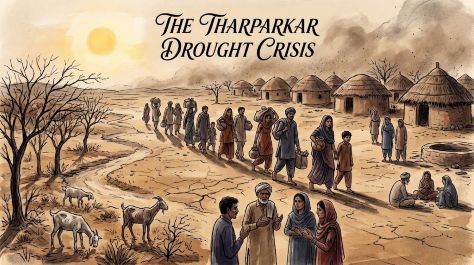
The prolonged drought in Tharparkar District, Sindh, is threatening food security, livestock survival and rural livelihoods, forcing vulnerable families to consider migration in search of animal feed and employment. The crisis demands urgent action to protect affected households, preserve their productive assets and prevent children from losing access to education.
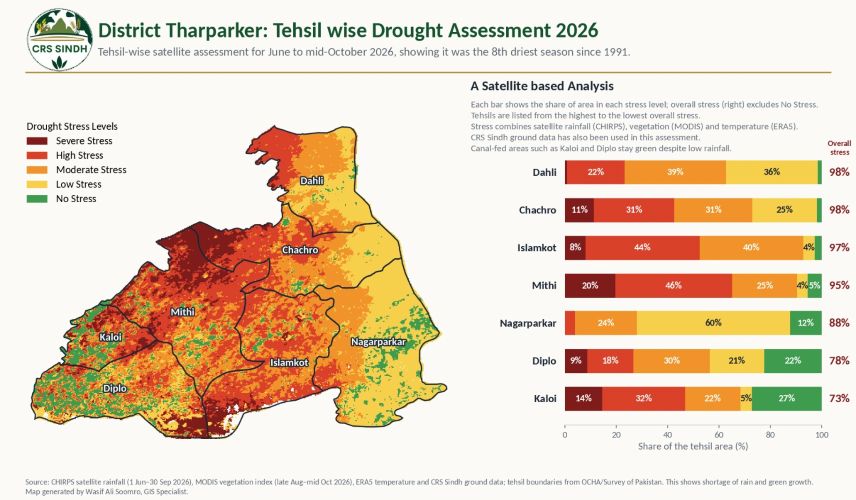
A satellite-based drought assessment covering June to mid-October 2026 indicates widespread environmental stress across all seven tehsils of Tharparkar. The year 2026 has been recorded as the eighth driest season since 1991. Drought stress affected 98% of the geographical areas of Dahli and Chachro, 95% of Mithi, 97% of Islamkot, 88% of Nagarparkar, 78% of Diplo and 73% of Kaloi. Mithi recorded the highest proportion of severe drought stress at 20%, followed by Chachro at 11% and Islamkot at 8%.
These conditions threaten drinking-water supplies, agricultural production and natural grazing lands.
Local activists and media reports estimate that approximately 700,000 to one million people could be affected by the drought, as declining rain-fed agricultural production threatens household food stocks.
These stocks traditionally include millet, sesame, mung beans, moth beans and dried vegetables, which families store for consumption throughout the year. Poor harvests could leave many households without sufficient food reserves and increase their dependence on humanitarian assistance.
Livestock is a principal source of income, savings and financial security for many Tharparkar households. Under normal conditions, seasonal rainfall supports natural grazing lands, which provide fodder until approximately December. Livestock owners subsequently rely on fodder harvested and stored from rain-fed agriculture to sustain their animals during the lean season. Reduced rainfall and poor crop yields threaten both grazing resources and stored fodder supplies, increasing the risks of livestock malnutrition, declining productivity and animal deaths.
As food, fodder and employment opportunities diminish, vulnerable families are increasingly at risk of leaving their ancestral villages for agricultural and irrigated areas of lower Sindh, including Taluka Kunri, Taluka Jhuddo, Taluka Kaloi, Taluka Tando Bago and Taluka Badin. Kolhi, Bheel and Meghwar families belonging to Hindu minority communities warrant particular attention because many depend on livestock, rain-fed agriculture and seasonal wage labor, with limited savings or alternative income sources.
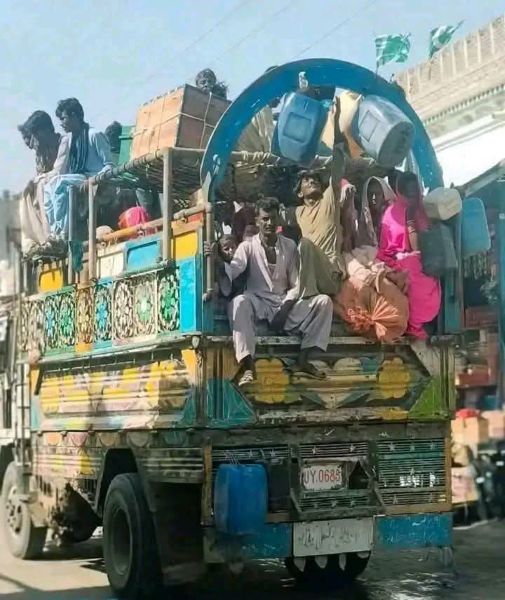
In the migrant families, migration begins with the loss of productive assets or the accumulation of debt. To finance food, transportation and other essential expenses during the migration, households may sell livestock or borrow money from local moneylenders, sometimes under high-interest conditions. Others resort to both. Losing livestock undermines future income, while debt repayments consume earnings from temporary employment, making recovery increasingly difficult.
Migration does not necessarily provide security. Families arriving in receiving districts may establish temporary shelters with limited protection against adverse weather and face inadequate access to safe drinking water, food, sanitation, healthcare and reliable employment. Those who have already sold animals or borrowed money are particularly vulnerable to further financial losses. Families unable to afford migration may also remain in drought-affected villages without sufficient resources to cope.
Economic hardship can be compounded by social exclusion, caste-based discrimination or unequal access to public services where these barriers exist. Migrant households may also be overlooked by assistance programs that rely on permanent residence or registration in their home villages.
Children’s education is particularly vulnerable when families relocate repeatedly or settle far from schools. Financial pressures and limited educational facilities can lead to prolonged school absences and permanent dropout.
The Government of Sindh, district administrations, disaster management authorities, humanitarian organizations and donors should urgently coordinate assistance for affected households and migrant communities. Priorities include emergency food, livestock feed and veterinary services, emergency winter shelter to migrant families, and nutritional and cash support. Timely cash assistance and livelihood support are also essential to help families meet basic needs without selling their remaining assets or accumulating additional debt.
The drought in Tharparkar is not merely an environmental emergency; it threatens household wealth, financial security and children’s futures. The critical question is not only how many people are affected or have migrated, but how many families have been forced to sell their livelihoods or borrow money simply to survive.
Read: Protecting Thar’s Natural Wealth
_____________
 Mir Mohammad Junejo, Monitoring & Evaluation Coordinator, Research and Development Foundation RDF