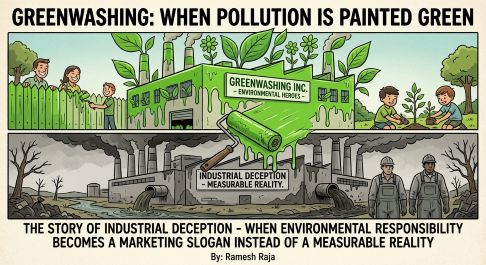
The Story of Industrial Deception When Environmental Responsibility Becomes a Marketing Slogan Instead of a Measurable Reality
By: Ramesh Raja
What Is Greenwashing?
The easiest way to understand greenwashing is to think of whitewashing. Whitewashing makes something look clean and respectable by covering its stains. Greenwashing does something similar, but with the colour green. It makes a company, product, project or institution look environmentally friendly without providing enough evidence that its overall activities are actually environmentally responsible.
A company may use words such as green, eco-friendly, sustainable, natural, clean, climate-friendly, carbon neutral or environmentally responsible. It may show pictures of forests, leaves, rivers, solar panels and smiling children. It may organize a tree-planting ceremony and issue a beautiful sustainability report. None of these things, by themselves, prove that the organization is genuinely protecting the environment.
The real question is much simpler: What is happening to the environment because of the organization’s actual business?
The word greenwashing is generally credited to American environmentalist Jay Westerveld, who used it in 1986 after observing a hotel asking guests to reuse towels supposedly to “save the environment”. Westerveld argued that the environmental message could distract from the hotel’s much broader business practices and resource consumption. The term deliberately echoed whitewashing, meaning to conceal or gloss over faults.
Since then, greenwashing has become a widely used term for misleading or incomplete environmental claims. The concern is serious enough that the US Federal Trade Commission developed its Green Guides, first issued in 1992, to help prevent deceptive environmental marketing. The FTC warns particularly against broad claims such as “eco-friendly” or “environmentally friendly” when they cannot be properly substantiated.
When the Green Advertisement Hides the Grey Reality
Greenwashing does not always mean that everything a company says is completely false. Sometimes the statement may be technically true but deliberately incomplete.
For example, a manufacturer may say, “We planted 100,000 trees.” That may be perfectly true. But what if the same company has cut 50,000 mature trees, discharged untreated wastewater, generated thousands of tons of waste and continued increasing its carbon emissions?
The trees deserve recognition, but the advertisement should not allow the plantation campaign to conceal the larger environmental footprint.
This is one of the most important characteristics of greenwashing: highlighting a small green action while hiding a much larger environmental problem.
Another common method is changing the appearance of a product rather than changing its environmental impact. Green colours, leaves, natural landscapes and words such as “pure”, “earth”, “renewable” or “sustainable” can create an emotional impression. But a green label is not scientific evidence.
The FTC specifically advises that environmental claims should be clear, specific and supported by competent scientific evidence. It also warns that broad claims such as “environmentally friendly” can communicate far-reaching benefits to consumers that a product may not actually provide.
This gives us a very simple test: Don’t ask how green the advertisement looks. Ask how green the business actually is.
What Has the World Taught Us?
The international corporate world provides many lessons.
One of the most famous environmental deception cases involved Volkswagen. Its diesel vehicles were equipped with software that detected emissions testing conditions and altered the vehicle’s emissions-control behaviour. The US Environmental Protection Agency said the affected vehicles were equipped with “defeat devices” designed to cheat federal emissions tests. The case resulted in enormous financial settlements and compensation programs.
This was more than a misleading advertisement. It demonstrated the danger of presenting an environmentally cleaner image while actual environmental performance was different.
The plastics industry provides another important lesson. Environmental groups have repeatedly criticized major consumer brands for promoting recycling and packaging improvements while continuing to produce enormous quantities of single-use plastic. Greenpeace, for example, has criticized Coca-Cola’s sustainability messaging while pointing to continued growth in single-use plastic bottle production. In 2023, Greenpeace reported that Coca-Cola’s single-use bottle production had increased while its stock of refillable bottles had remained broadly unchanged. These are Greenpeace’s findings and criticisms, rather than a legal determination that Coca-Cola committed greenwashing.
The lesson is broader than Coca-Cola or Volkswagen.
A company cannot solve a pollution problem merely by changing its advertisement, its packaging colour or its public-relations campaign.
Real environmental responsibility requires measurable reduction in pollution, resource consumption, waste and emissions.
What About Pakistan? Is Greenwashing Happening Here?
Pakistan is not immune to this phenomenon. In fact, the country provides many areas where the public should begin asking harder questions.
Consider tree plantation. A housing scheme, industrial project, road project or commercial development may proudly announce the plantation of thousands of trees. But where were the mature trees before the project? How many were removed? How many saplings survived after one, three or five years? Who watered them? Who monitored them? What is their survival rate?
Planting 10,000 saplings for a publicity photograph is not the same thing as creating a healthy forest.
The same principle applies to road and infrastructure development. A project may be called sustainable because it includes landscaping, solar lighting or tree plantation. But the complete environmental account should also consider quarrying, cement production, steel consumption, asphalt production, fuel consumption, construction waste, tree cutting, land disturbance, drainage and the project’s long-term carbon footprint.
The cement, steel, textile, chemical, petroleum, automobile, food, beverage, real-estate and packaging sectors all have legitimate opportunities to improve their environmental performance. But a few green initiatives should not become a substitute for addressing their principal environmental impacts.
For example, a factory that publishes photographs of employees planting trees should also disclose its energy consumption, water consumption, wastewater quality, air emissions, hazardous waste, ordinary waste and greenhouse-gas emissions.
A bottled-water company talking about recycling should also tell consumers how much plastic it puts into circulation and how much is actually recovered.
A housing project promoting a “green community” should disclose how much existing vegetation was removed, how much new vegetation survived, how stormwater is managed and how much groundwater the development consumes.
A construction company claiming sustainable construction should demonstrate how much concrete, steel, asphalt and construction-and-demolition waste it has reused or recycled.
This is not an accusation against every Pakistani company. It is a demand for evidence.
Pakistan has already begun moving in this direction. The Securities and Exchange Commission of Pakistan introduced ESG disclosure guidelines for listed companies and revised them in December 2025 in alignment with the Pakistan Green Taxonomy. SECP’s ESG Sustain platform also provides environmental sustainability disclosures submitted by companies. This is an important step because environmental claims become much more meaningful when they are supported by comparable and transparent data.
The Greenwashing Test: Five Questions Every Citizen Should Ask
The public does not need to become an environmental scientist to detect possible greenwashing. Five simple questions can expose much of it.
First: What exactly is the environmental claim?
“Eco-friendly” is too vague. Does it mean 30% recycled material? Lower electricity consumption? Less plastic? Lower carbon emissions? The claim should be measurable.
Second: Where is the evidence?
Who measured it? Is there a baseline? Is the information independently verified? A photograph of a plantation ceremony is not evidence of long-term environmental benefit.
Third: What is being hidden?
If a company talks extensively about recycling but says nothing about how much plastic it produces, consumers should ask why.
Fourth: What is the total environmental footprint?
A product can improve one environmental characteristic while worsening another. The FTC specifically recognizes the importance of considering such trade-offs rather than exaggerating one small environmental benefit.
Fifth: What happened after the publicity campaign?
This may be the most important question of all.
A tree plantation campaign should be followed by survival monitoring. A recycling campaign should be followed by recovery data. A carbon-neutral claim should be supported by transparent calculations. A wastewater-treatment promise should be demonstrated through actual water-quality results.
Greenwashing often lives in the gap between the ceremony and the result.
How Pakistan Can Stop Greenwashing
Pakistan needs to move from green publicity to green accountability.
Environmental claims made in advertisements, annual reports, product packaging and corporate sustainability reports should be specific, measurable and verifiable. Regulators should discourage vague claims such as “100% green”, “eco-friendly” or “environmentally safe” unless the claim has a clearly defined and demonstrable meaning.
Companies should disclose their environmental performance using measurable indicators: carbon emissions, energy consumption, water consumption, wastewater discharge, waste generation, recycling rates, plastic production, tree survival rates and land disturbance.
Independent environmental audits should become more important, particularly for large industrial and infrastructure projects. Corporate environmental reports should not merely describe what a company plans to do. They should disclose what it actually did, what changed from the previous year and whether targets were achieved.
Public procurement can also become a powerful tool. Government departments awarding major contracts should give genuine weight to environmental performance rather than accepting sustainability statements at face value.
Investors, journalists, engineers, universities and civil-society organizations also have a role. They can compare corporate claims with actual data.
And consumers have perhaps the simplest weapon of all:
Ask questions.
If a company says it is green, ask: How green? Compared with what? Measured by whom? And what happened to the rest of the environmental footprint?
From Greenwashing to Genuine Green Development
There is nothing wrong with companies planting trees, installing solar panels, reducing plastic, recycling materials or improving energy efficiency. These are all worthwhile.
The problem begins when green activities become a curtain behind which environmental damage remains hidden.
Genuine sustainability is not a photograph of a CEO planting a sapling. It is the survival of that tree five years later.
It is not a green logo on a plastic bottle. It is reducing the amount of plastic entering the environment.
It is not a sustainability report full of attractive photographs. It is measurable reductions in emissions, water consumption and waste.
It is not calling a new road “green infrastructure”. It is designing, constructing and maintaining that road with lower resource consumption, recycled materials, proper drainage, protection of existing vegetation and consideration of its full life-cycle environmental impact.
The difference between greenwashing and genuine environmental responsibility is therefore quite simple:
Greenwashing asks, “How can we look green?”
Sustainability asks, “How can we actually cause less damage?”
Pakistan needs the second question.
Our environment cannot be protected by advertisements, slogans and plantation ceremonies alone. The country needs measurement, transparency, independent verification, enforcement and informed citizens.
Because in the end, green is not a colour to be painted on a company. Green is a performance that must be demonstrated.
And perhaps the most important public message is this:
Do not judge a company by the colour of its advertisement. Judge it by the colour of the water it discharges, the air it releases, the waste it generates, the trees it preserves and the resources it consumes.
That is where the real green story begins.
Read: Bridges Built for Decades, Failing in Years
____________________
 The author of this article, Engr. Ramesh Raja, is a Civil Engineer, visionary planner, PMP certified and literary enthusiast with a passion for art and recreation. He can be reached at engineer.raja@gmail.com