When a few hours in the forest can feel like a complete holiday
By Abdullah Usman Morai | Sweden
There are days when we do not need a long journey, an expensive ticket, or a carefully planned itinerary to feel that we have travelled somewhere special. Sometimes, all we need is a sunny morning, a car, good company, and a desire to leave the city behind for a few hours.
One such weekend morning, Pernilla, Gun-Britt and I decided to make a small escape from our everyday surroundings in Nacka. We headed to Tyresta National Park, approaching from the Tyresö side.
It was not a long drive, and that was precisely the beauty of the plan. We were not preparing for a major expedition. We simply wanted to spend a few hours among trees, rocks, lakes and fresh air to walk a little, talk a little, look around, and allow nature to do what it often does best: quietly refresh the mind.
 From Nacka towards Tyresö
The morning had the kind of brightness that immediately makes you want to go outdoors.
We left Nacka and drove towards Tyresö, watching the familiar urban landscape gradually give way to greener surroundings. Stockholm is of wonderful quality: you can be surrounded by roads, buildings, buses and the routines of city life, and yet, before you know it, you are driving through forests and alongside water.
That transition always fascinates me.
We continued towards the Tyresta area and eventually entered a landscape that felt increasingly distant from the city, although Stockholm was still surprisingly close. Tyresta National Park lies only about 20 kilometers south of central Stockholm, yet it offers a remarkably different atmosphere old forests, rocky ground, lakes and a feeling of wilderness that is difficult to associate with a capital city.
There are several entrances to the wider Tyresta area. From the Tyresö direction, the Brakmaren and Storängen/Långsjön entrances provide access to the northern side of the park and nature reserve.
For a short outing like ours, this side was ideal.
We parked without much difficulty in a designated parking area and began our little adventure.
 Not every walk needs to be a long hike
I had visited Tyresta a long time ago and remembered that it was possible to make a much longer journey through the area. There are trails that cross the landscape and connect different parts of Tyresta.
One of them, Sjöleden, runs for about 16 kilometers between Alby and Sandemar and can take one or two days if you want to experience it properly. It passes a series of lakes and offers places to stop and rest along the way.
But this time we had no such ambition. We were not trying to conquer Tyresta. We simply wanted to be there. That distinction is important.
Sometimes we turn even leisure into a competition how many kilometres did we walk, how many places did we see, how many photographs did we take? But nature does not ask us to prove anything.
A short walk under tall trees can be enough.
So we walked for a while, following the paths through the forest, sometimes stopping to admire a view, sometimes simply continuing without saying much.
The forest itself became the conversation.
A forest that feels much older than the city
Tyresta is not simply another green recreational area.
It is one of Sweden’s remarkable remaining areas of old-growth forest. The park contains ancient pine and spruce forests, rocky outcrops, valleys and freshwater environments. Some of the pine trees are several centuries old.
Standing beneath those trees creates a strange feeling.
A city such as Stockholm is constantly changing. Buildings are renovated, roads are repaired, new apartments appear, businesses open and close, and people come and go.
But some of the trees in Tyresta have been standing there through generations of human life.
They were there before today’s roads. Before smartphones. Before many of the buildings we now consider old. Perhaps even before some of our grandparents were born.
Walking beneath them makes you feel small but in a comforting way. The forest reminds us that human life is only one small chapter in a much larger story.
 Green everywhere
The day was bright, and the sunlight filtered beautifully through the trees.
The forest floor was covered with different shades of green. Moss, grass, bushes, and vegetation seemed to compete gently for space. Tall trees stretched upwards, creating a natural ceiling through which pieces of blue sky appeared.
At other places, the forest opened. There were rocky sections, small hills, and glimpses of water. And then came those little details that make a walk memorable.
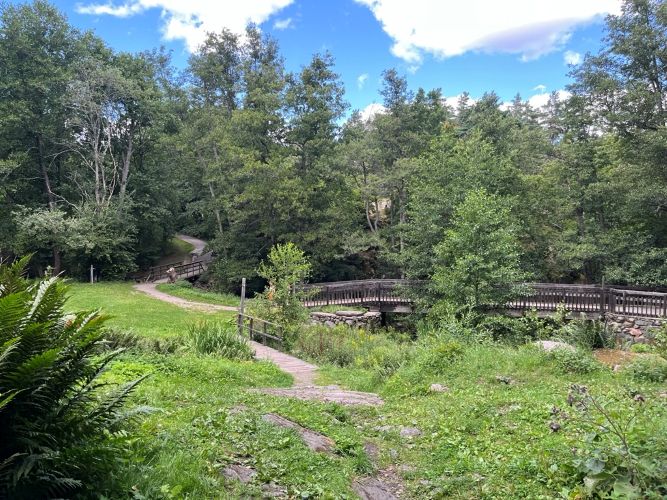
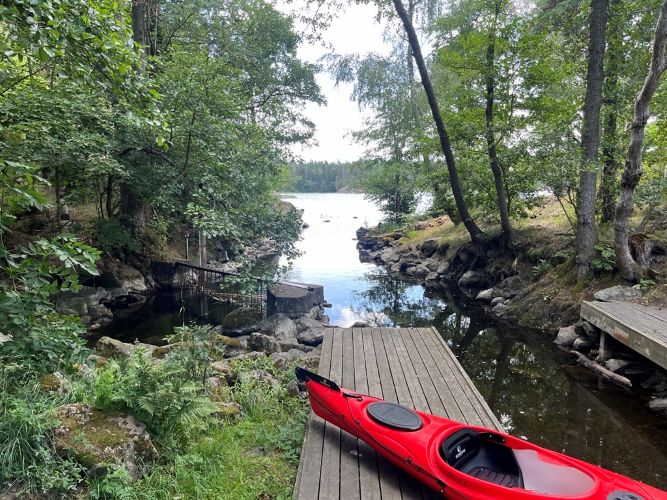
A narrow wooden bridge crossing a stream. A path disappearing between trees. Moss growing over rocks. A tree trunk shaped by time. Sunlight falling on a quiet patch of water. A family walking ahead of us with children. A couple sitting quietly beside a lake.
None of these things would appear spectacular in a city advertisement. Yet together they create something much more valuable a sense of peace.
Lakes hidden among the trees
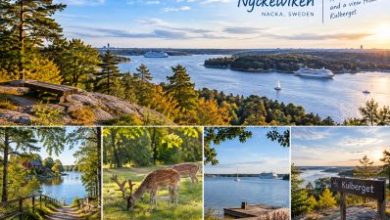
Water is one of Tyresta’s greatest attractions.
The park and surrounding nature reserve contain numerous lakes and ponds, including Bylsjön, Årsjön, Långsjön and Stensjön, while the wider Tyresta area also includes other smaller waters.
The Bylsjöpromenaden, for example, is a relatively easy five-kilometer trail around Bylsjön, making it particularly suitable for people who want a gentle walk rather than a demanding hike.
The Sörmlandsleden section between Tyresta by and Nyfors passes both Bylsjön and Årsjön, moving through old spruce forest and pine-dominated rocky terrain.
Elsewhere, trails pass Långsjön and Stensjön, adding water to the forest experience.
The lakes change character with the weather.
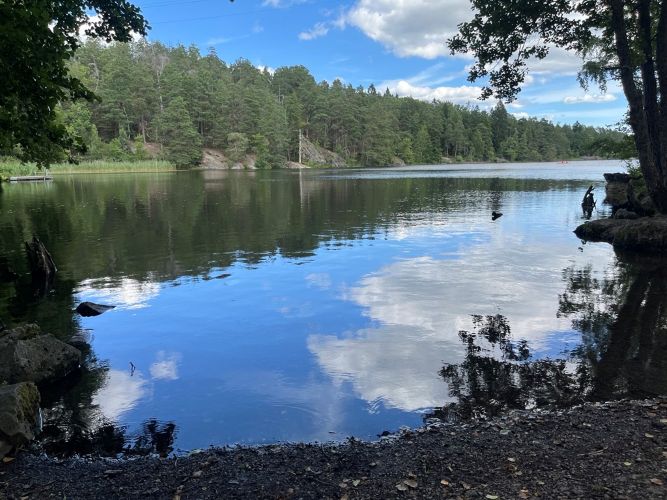
On a sunny day, they become mirrors.
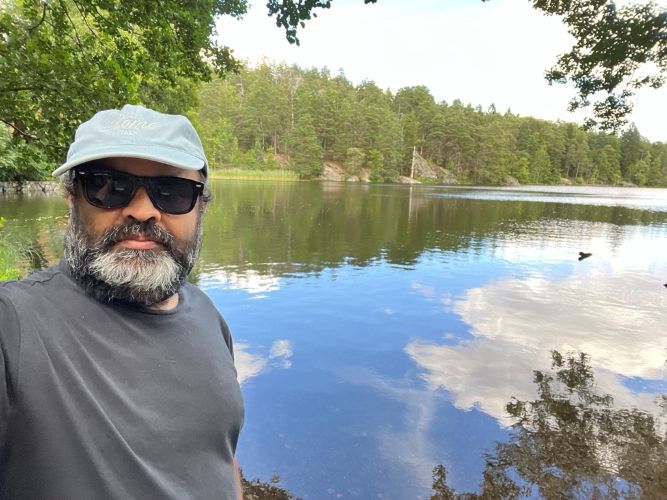
Standing beside the water, we could see the reflections of tall trees, the blue sky, passing clouds, and the surrounding hills. In some places, the reflections were so clear that it was difficult to tell where the real landscape ended and its mirror image began.
A red-roofed house appearing beyond the trees added another beautiful element.
Red roofs. Green forest. Blue sky. White clouds. Dark water. It was almost like someone had deliberately designed the landscape. But nobody had. Nature had simply been doing its work for centuries.
Families, hikers and the simple joy of being outdoors
One of the nicest things about Tyresta is that it does not belong exclusively to serious hikers.
We saw families with children, people walking alone, couples, older visitors, and others who seemed to have come simply to breathe some fresh air.
Some were prepared for a long walk, carrying backpacks and food.
Others appeared to be there for only an hour or two. And I liked that.
Everyone seemed to understand the value of being in nature in their own way. A child may see a fallen tree as something to climb. An adult may see the same tree as an interesting reminder of the forest’s life cycle. Someone else may simply sit beside it and drink coffee. All of them are experiencing the same place differently.
That is one of the beautiful things about public nature areas in Sweden. Nature is not merely scenery. It is part of everyday life.
 Animals are part of the experience
Tyresta is also home to a wide variety of wildlife.
The park is particularly known for birds such as black woodpeckers and owls, while capercaillie also has a strong presence. Around the lakes, visitors may hear the distinctive call of the great crested grebe. Mammals include moose, roe deer, squirrels and hares, while traces of wild boar and beavers can also be found. With some luck, visitors may even encounter less commonly seen animals such as pine martens or lynx.
Of course, nature does not guarantee an appointment. The animals do not come out because tourists have arrived. Perhaps that is precisely why an unexpected encounter feels so special. A sudden movement among the trees. A bird calling from somewhere above. Tracks in the mud. Marks left by a beaver.
Or simply the feeling that something is watching from the forest while remaining invisible. Even when we do not see an animal, we know that the forest is full of life.
 Kayaks, water and another side of Tyresö
The relationship between Tyresö and water is also particularly strong.
The wider Tyresö area has an extensive network of lakes and waterways, and kayaking, boating and fishing are among the recreational activities available around its waters.
From time to time, you can see people enjoying the water in kayaks or small boats, adding another dimension to the landscape.
But remember this important distinction: fishing is not permitted inside Tyresta National Park itself. Fishing is allowed in certain waters in the surrounding nature reserve and Tyresö’s lake system, subject to the applicable fishing rules and permits.
That small difference illustrates something important about Swedish nature management: different parts of the landscape may look continuous to a visitor, but different protection rules apply.
The forest does not necessarily announce where one administrative boundary ends, and another begins. The signs and regulations do.
The little wooden bridges
Among my favourite details were the small wooden bridges. They may sound insignificant, but they add something almost storybook-like to a forest walk.
You approach a stream, hear the gentle movement of water, and then see a simple wooden bridge crossing it. Nothing grand. No concrete construction. No complicated architecture. Just wood, water, trees, and a path. These are the kinds of things that make walking enjoyable.
You slow down. You look down at the water. You look up at the trees. You take a photograph. Then you continue.
And perhaps five minutes later, you have already forgotten what you were worrying about earlier in the morning.
The Stockholm paradox
While walking through Tyresta, I found myself thinking again about Stockholm.
The city is the capital of Sweden and one of the major urban centres of Scandinavia. More than a million people live in Stockholm and its immediate urban environment.
Yet one of the city’s greatest luxuries is not necessarily found inside a shopping center, restaurant or modern apartment.
It is access to nature. Forest. Lakes. Rocky islands. Walking paths. Archipelago landscapes. Parks. Nature reserves. And places like Tyresta.
This combination is one of the things I appreciate about living around Stockholm.
You can spend the morning surrounded by the rhythms of city life and, within a relatively short drive, find yourself among ancient trees.
That is quite a privilege.
In many megacities around the world, escaping the urban environment can require hours of traffic, long journeys and significant planning.
Here, nature is much closer. The city and the countryside do not seem to be enemies. They coexist. And perhaps that is one reason Stockholm feels different from many other large cities.
A few hours can be enough
Our intention had been simple: a little walking, some fresh air and a break from routine.
And that was exactly what we got. We did not walk through the entire park. We did not attempt one of the longer routes. We did not spend the whole day there.
We simply explored a small part, enjoyed the landscape, talked, stopped here and there, looked at the water, and allowed the morning to unfold naturally.
There is something liberating about not having a strict plan. We were not checking the time every few minutes. We were not asking, “What’s next?”
For those few hours, this was what was next. A forest path. A lake. A bridge. A hill. A conversation. A photograph. A breath of fresh air.

And then came fika
Of course, in Sweden, a nature outing is rarely complete without fika. Hiking and fika seem to belong together. After walking through the forest, even an ordinary cup of tea/ coffee with a piece of cake seems to taste better. Maybe it is because we have earned it.
Maybe because we are sitting somewhere surrounded by trees. Or perhaps tea/ coffee simply tastes better when you have spent some time outdoors.
At Tyresta, there is a café serving simple food and fika, and there are also places where visitors can sit with their own food. For us, the idea of fika was almost as much a part of the outing as the walk itself.
Nature first. Tea/Coffee afterwards. A simple formula but a very effective one.
 A small journey with a large reward
As we eventually made our way back, I thought about how little effort had been required for such a refreshing experience.
We started from Nacka. Drove towards Tyresö. Entered the Tyresta area. Walked through the forest. Saw water, trees, rocks, and open sky. Watched families enjoying the outdoors. And then planned to end the outing with fika.
Nothing extraordinary happened. And yet, somehow, the day felt special. Perhaps this is what good day trips are supposed to do. They do not necessarily give us dramatic stories. They give us a little space inside our own minds.
A few hours away from screens. A few hours away from traffic. A few hours without the feeling that we must constantly be productive. Just trees. Water. Sunlight. Fresh air. And good company.
Tyresta reminded me once again that travelling does not always mean going far.
Sometimes, the best journey is the one that takes you only a short distance from home but a long distance away from your routine.
And on a sunny weekend, with Pernilla and Gun-Britt beside me, that little escape from Nacka towards Tyresö and Tyresta felt exactly like what we needed.
A small trip into nature. A little hiking. A little conversation. A little fika. And a lot of fresh air.
Perhaps that is one of the quiet blessings of Stockholm: the city gives you the life of a capital, while nature waits just around the corner.
And sometimes, all you have to do is get in the car and go.
Read: The Music of the Memories
__________________
Abdullah Soomro, penname Abdullah Usman Morai, hailing from Moro town of Sindh, province of Pakistan, is based in Stockholm Sweden. Currently he is working as Groundwater Engineer in Stockholm Sweden. He did BE (Agriculture) from Sindh Agriculture University Tando Jam and MSc water systems technology from KTH Stockholm Sweden as well as MSc Management from Stockholm University. Beside this he also did masters in journalism and economics from Shah Abdul Latif University Khairpur Mirs, Sindh. He is author of a travelogue book named ‘Musafatoon’. His second book is in process. He writes articles from time to time. A frequent traveler, he also does podcast on YouTube with channel name: VASJE Podcast.