Rain-soaked cobblestones, centuries of history, technological innovation, a Baltic Sea crossing, and an unexpected tragedy that reminded us how uncertain life can be.
By Abdullah Usman Morai | Sweden
A Short Flight to a Historic Baltic Capital
It was 24 September 2026 when I landed in Tallinn, the beautiful and historic capital of Estonia. The flight from Stockholm took less than an hour. I often joke about such short flights: by the time you are airborne, order a cup of tea and finish drinking it, the aircraft is almost ready to land!
I visited Tallinn many years earlier, travelling by cruise ship from Stockholm. This time, however, I arrived by plane, while my travel companion, Ada Jan Mangrio was travelling from Cardiff, UK, to join me.

The weather was rainy and a little cold. After landing, I decided to take the tram rather than wait at the airport. Hotel St. Barbara had already provided directions, but I confirmed the route with a young woman waiting at the tram stop and with the female tram driver. I took tram number 4 towards the city center and got off at Vabaduse Väljak, or Freedom Square. From there, the hotel was only about a three-minute walk away.
Within approximately half an hour of leaving the airport, I had reached my accommodation on Roosikrantsi Street.

Hotel St. Barbara occupied an old building whose character suited the historical surroundings. Its central location made it convenient for exploring the city on foot. I had requested a kettle for my room, and as the rain continued outside, a warm cup of tea in a cozy room felt like a small luxury.
I settled down to read while waiting for Jan. When he eventually arrived at the hotel, we greeted each other, talked, laughed, and enjoyed tea together. After resting for a while, we decided to venture outside despite the rain.
Tallinn: Where History Meets the Digital Age
Tallinn is one of those cities where the past and the present exist side by side. Its Old Town, recognized as a UNESCO World Heritage Site in 1997, preserves the character of a medieval Northern European trading city. Its narrow streets, stone-paved lanes, merchant houses, churches and defensive walls tell stories of centuries of Baltic trade and cultural exchange.
Before leaving the hotel, we had another cup of tea and put on our raincoats. We were not going to let the weather spoil our first evening.

Our walk took us past Kaarli Church, an impressive landmark with distinctive architecture. A little later, we encountered the beautiful National Library of Estonia, whose imposing structure offered a different architectural experience from the churches and older buildings around it.
Libraries are more than buildings filled with books. They preserve a nation’s language, literature, knowledge, and collective memory. In a country with such a complex history, a national library represents an important connection between cultural heritage and future generations.
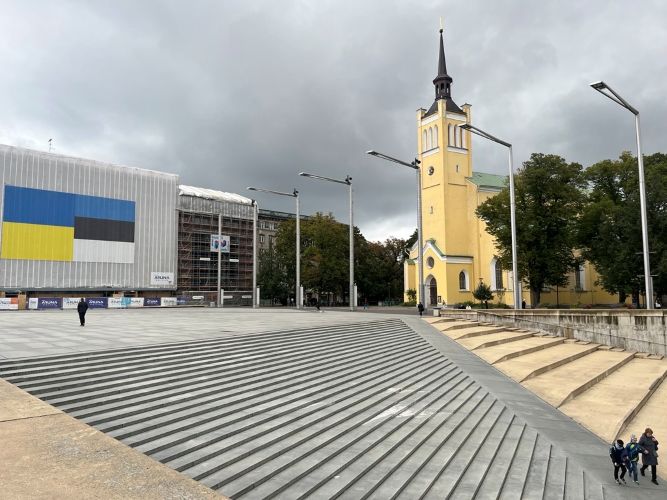
We continued walking until we reached Freedom Square. Such public spaces are often the heart of European cities, hosting national celebrations, public gatherings and commemorations. For Estonia, which restored its independence in 1991 after decades of Soviet rule.
From the square, we made our way towards the Old Town, where the atmosphere became increasingly medieval.
One of our principal stops was Alexander Nevsky Cathedral, with its magnificent domes and elaborate exterior. Nearby, we saw the Nun’s Tower and sections of the old defensive walls. The surrounding streets were filled with historic buildings, churches, restaurants, and shops.
 Tallinn’s Old Town is not simply a collection of monuments. It is a living urban environment in which centuries-old architecture continues to accommodate everyday life. Walking through it, one can imagine merchants trading goods, residents gathering in the squares, and generations of people passing through the same narrow streets.
The rain added another dimension to the experience. Water glistened on the cobblestones, the shade of trees softened the grey surroundings, and the old buildings appeared even more atmospheric. We loved the flower shops in a row, wet and colorful. Although September was approaching the low tourist season, plenty of visitors were still exploring the streets.
Eventually, the weather persuaded us to return to the hotel. We bought Turkish doner kebab from a fast-food establishment whose owners were from Azerbaijan. For dessert, we chose baklava, which proved an excellent decision when accompanied by another warm cup of tea.
We chatted for a while before falling asleep, leaving the rest of Tallinn for the following day.
 A Morning Among Tallinn’s Historic Streets
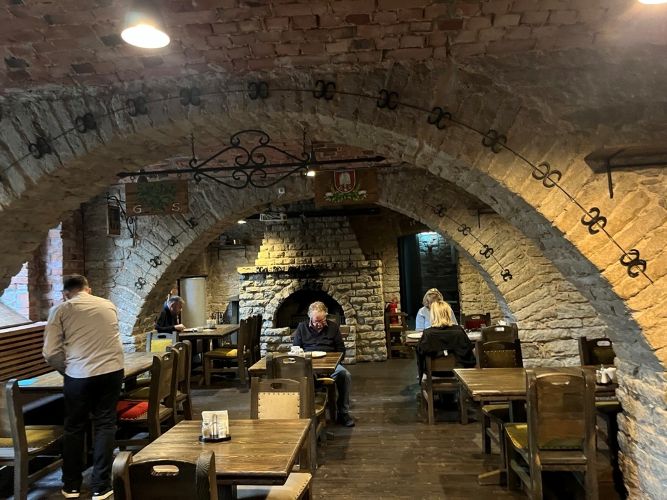
The next morning, we enjoyed breakfast in the hotel’s basement dining area. Although it was downstairs, windows opened onto the street, allowing daylight and glimpses of the outside world to enter.
Both the food and the atmosphere of the old building were wonderful. There was something particularly cosy about enjoying breakfast in such surroundings. The experience reminded me that a hotel’s character is not determined only by its size or modern facilities. Sometimes, an old building, a welcoming dining room and a satisfying breakfast create a more memorable experience than luxurious surroundings.
After breakfast, we checked out and returned to the Old Town for further exploration.
We again passed Freedom Square and Alexander Nevsky Cathedral. We also noticed several embassies in the historic area, another reminder that Tallinn is not only a destination for tourists but also an important administrative and diplomatic center.
We walked along the stone-paved and cobblestone streets, admiring the buildings and the way the rainwater reflected their façades. The atmosphere was beautiful, and we continued taking photographs to preserve our memories.
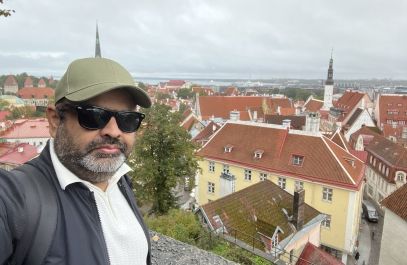
Our most rewarding viewpoint was Patkuli, reached by the Patkuli staircase, known locally as Patkuli trepp. From this elevated position, we enjoyed a wonderful panorama of Tallinn’s Old Town, its red rooftops, church towers, and historic skyline. The view offered a different perspective from walking through the narrow streets below.
Sometimes, the best way to understand a city is to see it from above. The individual buildings and winding lanes become part of a larger picture, revealing how the historic settlement developed and how its different parts fit together.
We purchased a few souvenirs and took more photographs before leaving the Old Town, satisfied that we had experienced something of its remarkable character.
 Towards Kalamaja and the Baltic Waterfront
Our next plan was to walk towards Kalamaja, a district just outside the Old Town.
Kalamaja has a different personality from Tallinn’s medieval center. Historically associated with fishing, it later developed into an industrial and working-class neighborhood. Today, it is known for its wooden houses, creative spaces, cafés and relaxed atmosphere. Areas such as Telliskivi Creative City have helped make it a center for contemporary culture, design and entrepreneurship.
The contrast between the two areas is part of Tallinn’s appeal. Within a relatively short walk, visitors can move from medieval fortifications and historic churches to neighborhoods that express a more contemporary and creative side of Estonia.
We continued towards the waterfront, where we saw a few tourists walking with a guide and some teenagers spending time together. We also noticed several people swimming in the cold water.
Seeing people swimming in such conditions was interesting, especially for those of us accustomed to observing how weather influences daily activities. In Nordic and Baltic countries, cold-water swimming is familiar to many enthusiasts, although the experience is certainly not for everyone.
The waterfront gave us another glimpse of Tallinn beyond its most famous historical attractions. The city is closely connected to the Baltic Sea, which has influenced its trade, transport, economy and cultural relationships for centuries.
Unfortunately, our time was limited. We had a ferry to catch that evening, so we continued towards the port.
 A Ferry Across the Baltic Sea
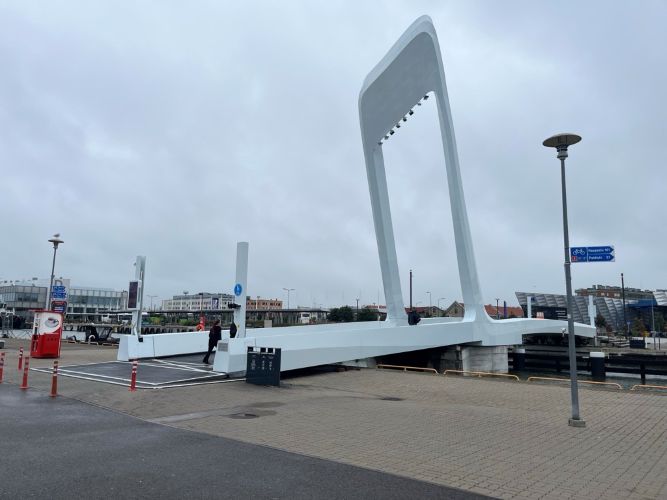
Our ferry was operated by Tallink Shuttle, departing from Tallinn’s port, Terminal D. Rather than taking a taxi, we walked towards the terminal, crossing a pedestrian Admiralisild bridge that could also be moved to accommodate the passage of vessels. Watching the waterfront infrastructure and the movement around the harbour added another interesting detail to our walk.
Later, we came across a shopping mall, Nautica Keskus, and decided to explore it for a while. Many people were sitting inside with their shopping bags, probably waiting for their ferries. The mall seemed to offer a convenient place to pass the time before departure.
We also noticed a few Pakistanis walking by. We wondered whether they might be working in Estonia’s technology sector, although we had no way of knowing their occupations.
Estonia has earned an international reputation for digital government and technology entrepreneurship. Its secure digital infrastructure, electronic identification systems and online public services have made it a particularly interesting example of how a relatively small country can embrace innovation.
The country is also associated with Skype, whose development involved Estonian engineers, and with X-Road, the secure data-exchange infrastructure used by public institutions and participating organizations. Its e-Residency program has enabled eligible non-residents to access certain Estonian digital services and establish and manage companies remotely.
I find such developments fascinating. They demonstrate that a country’s influence does not depend entirely on its population, geographical size or natural resources. Education, institutional planning, technical expertise and a willingness to innovate can help a small nation establish a significant international presence.
After spending some time in the shopping center, we proceeded to Terminal D, checked in, and waited for our departure.
Soon, it was time to say goodbye to Tallinn and begin the sea journey to Helsinki, Finland.
The ferry was enormous, more like a cruise ship than the ordinary ferry one might imagine. It had spacious seating areas, cafés, shopping facilities and other amenities. There may also have been sleeping cabins, although we did not explore every part of the vessel.
One detail that caught my attention was a Burger King outlet on board. It was amusing to see a familiar international fast-food brand operating in the middle of the Baltic Sea.
We bought some snacks and drinks and settled down to enjoy the crossing. The ship carried passengers across the water, connecting two neighboring capitals whose histories and economies have long been linked by the Baltic Sea.
As Helsinki drew nearer, however, our journey took an unexpected and deeply painful turn.
 A Message That Changed Everything
While we were approaching Helsinki, Jan received a message on WhatsApp. It carried tragic news: his elder brother had died in Pakistan.
The atmosphere changed immediately. A journey that had been full of sightseeing, conversations, and plans suddenly became a moment of grief and uncertainty.
There are moments when even the most beautiful surroundings lose their significance. The sea may remain calm, the ship may continue towards its destination, and other passengers may carry on with their conversations, but for someone who has received news of a loved one’s death, the world can feel entirely different.
I felt deeply for Jan. Losing an elder brother is a devastating experience, and receiving such news while travelling far from home makes the situation even more difficult. He now had to think about returning to Pakistan as quickly as possible.
The incident also brought back painful memories of my own.
I remembered receiving news of my aunt Chache Fatima’s death while travelling in Istanbul alone. Years later, while Jan and I were travelling together in Naples, Italy, I received the news of the death of my maternal uncle, Mama Ghullam Nabi Soomro.
Both memories returned with clarity. Travel usually represents freedom, discovery and enjoyment, but life does not pause its difficulties simply because we are away from home. News of illness, bereavement or other family emergencies can reach us anywhere in the world.
In such moments, the distance between countries feels much greater than it does on a map.
Jan and I had been planning to continue our journey together. He was supposed to accompany me to Stockholm, stay for two nights, and then visit Malmö and Copenhagen by himself before returning to Cardiff. Those plans suddenly became irrelevant.
We had imagined one journey, but circumstances had prepared another.
As we say, we human beings make our plans, but God has different plans.
Arriving in Helsinki Under Grey Skies
 When we arrived in Helsinki, our priority was no longer sightseeing. We took two connecting trams to reach our Euro Hostel, where we had booked a private room with shared toilets and bathrooms.
The continuous rain followed us into Finland. The city was wet, the evening was gloomy, and our thoughts were occupied by the sad news.
Our original intention had been to explore Helsinki, enjoy its streets and discover its attractions. Now, however, our plans have been suspended. We were simply trying to manage the immediate situation and work out the next steps.
Later, Tanveer Lashari, a decent fellow from Dadu who had come to Finland to study and was now settled there, came to pick us up. His visit was a welcome gesture of friendship at a difficult time.
He took us to an Arabic restaurant named Shish kebab in Kontula Ostari shopping center, a little outside the city, where we had dinner. Meanwhile, Jan was searching for available flights to Pakistan for the following morning. Tanveer shared his experience when his father died, and he had to fly to Pakistan.
The practical demands of an unexpected family emergency can be exhausting. One must deal with flight bookings, transport, and other arrangements while also processing the emotional reality of what has happened.
Tanveer later drove us back to the hostel. Jan had to leave early the next morning, taking a taxi to the airport to begin his journey home.
Our shared trip had effectively ended, even though we had originally planned to spend more time together.
A Quiet Morning and the Old Market Hall
After Jan departed, I checked out of the hostel and walked towards Helsinki’s historic Old Market Hall, known in Finnish as Vanha Kauppahalli.
The market hall has served Helsinki since 1889 and is located near the city’s waterfront and Market Square. It is known for its food stalls and traditional market atmosphere, offering products ranging from fish and cheese to baked goods, coffee, tea, and other delicacies.
I bought a loaf of Finnish malt bread, known as maltlimppu. It was a small purchase, but food is one of the pleasures I associate with travel. Trying local products allows us to take a little of a place’s culture with us, sometimes quite literally.
A loaf of bread may not be as impressive as a famous monument, but it can become a pleasant reminder of a journey long after the photographs have been stored away.
Later, Sain Jagdesh Rajani, originally from Radhan in Dadu district, Sindh, who had been living in Helsinki for a long time, came to pick me up.
We spent some quality time together at Café Carusel, a well-known waterfront café. Our conversation moved naturally between life in Sindh, our experiences in Sweden and the realities of living in Finland.
These meetings are among the most rewarding parts of travelling. When people from the same region meet abroad, conversations often move between memories of home and reflections on their adopted societies. We compare ways of living, discuss opportunities and difficulties, and remember places and people who remain important to us.
For those of us who have spent years outside our birthplace, such conversations create a bridge between different stages of life. One can be physically settled in Northern Europe while remaining emotionally connected to Sindh, its people, language and culture.
After our meeting, Sain Jagdesh dropped me near Helsinki railway station. From there, I took the train to Helsinki Airport for my flight back to Stockholm.
The journey that had begun with excitement and a plan to explore two neighboring capitals was now ending much sooner than expected.
When Plans Change, Life Reminds Us What Matters
Looking back, our visit to Tallinn and Helsinki was not the journey Jan and I had imagined.
Tallinn had offered us medieval streets, historic churches, remarkable viewpoints, waterfront walks and glimpses of Estonia’s technological achievements. We enjoyed good food, warm tea, baklava and the pleasure of travelling together.
Helsinki had been intended as the next chapter, but it became a place where an unexpected tragedy reshaped our plans. Instead of exploring the city together, Jan had to return to Pakistan to be with his family, while I continued towards Stockholm.
Yet the journey was not without meaning.
It reminded me that travel is not simply about visiting destinations or completing itineraries. It is also about friendship, the kindness of people we meet, the memories we carry, and our ability to respond when circumstances change.
Sain Jagdesh’s and Tanver’s willingness to warmly welcome us, and the conversations shared with friends in unfamiliar surroundings, became important parts of the experience. These gestures may seem ordinary, but they are often what make travelling feel human.
I also thought about those earlier journeys when news of a family death had reached me far from home. Such experiences leave a lasting impression because they reveal how fragile the boundary is between an ordinary day and a life-changing moment.
We can plan flights, book hotels, purchase ferry tickets and organize every detail of a holiday. We can research destinations and prepare lists of places to visit. But there are things beyond our control, and no itinerary can account for every turn life may take.
Perhaps that is one of the most important lessons travel teaches us: remain curious, appreciate the present, value people beside you, and be prepared to adapt when life takes an unexpected direction.
I returned to Stockholm with memories of Tallinn’s rain-soaked cobblestones, the impressive Baltic ferry, the warmth of conversations in Helsinki and the sadness of a friend’s loss.
Jan’s planned journey through Stockholm, Malmö and Copenhagen would have to wait for another time.
For now, the photographs and memories remain, along with the understanding that a successful journey is not always one in which everything goes according to plan.
Sometimes, the most meaningful travel stories are those that remind us of the limits of our plans, the importance of friendship, and the simple truth that, while we may choose our destinations, we cannot always choose the road that life takes us down.
Read: Lund, Rind, Sand of Sindh and Sweden
_________________
Abdullah Soomro, penname Abdullah Usman Morai, hailing from Moro town of Sindh, province of Pakistan, is based in Stockholm Sweden. Currently he is working as Groundwater Engineer in Stockholm Sweden. He did BE (Agriculture) from Sindh Agriculture University Tando Jam and MSc water systems technology from KTH Stockholm Sweden as well as MSc Management from Stockholm University. Beside this he also did masters in journalism and economics from Shah Abdul Latif University Khairpur Mirs, Sindh. He is author of a travelogue book named ‘Musafatoon’. His second book is in process. He writes articles from time to time. A frequent traveler, he also does podcast on YouTube with channel name: VASJE Podcast.