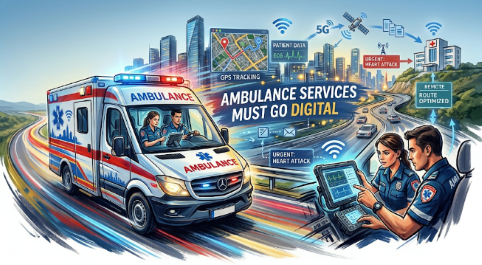
Every ambulance must be given the data it needs to reach the right patient, and the right hospital, without losing a minute.
By Nuzair Ahmed Jamro
A man collapses at home with chest pain. His family dials 1122. What happens in the next few minutes decides whether he lives: how quickly the call-taker records the address, how quickly the nearest free ambulance is found, whether the crew knows which hospital has a cardiac bed ready, and whether that hospital knows he is coming. Each of those steps is a handover of information. Every time that information moves by phone call, memory or handwritten note, time is lost, and in an emergency time is the patient. Pakistan has built an ambulance service that people know and trust. The question now is whether it can run on data rather than on telephone calls.
What has already been built?
It is fair to begin with what exists. In Punjab, a Rescue 1122 introduced a digital “E-Rescue” system in 2021 that covers call management, dispatch, vehicle tracking and communication, including live location, call recording and identification of the closest emergency vehicle to an incident. In Sindh, the Sindh Integrated Emergency and Health Services (SIEHS) runs a free 1122 ambulance service that uses a call triage model and describes crew-to-hospital communication that lets a hospital prepare a trauma room or surgical suite before the patient arrives.</cite> In the federal capital, the Interior Minister has directed that Islamabad’s ambulance, fire and water rescue services be brought under one helpline, with unified control room to monitor emergency vehicles in real time through GPS.
These are real steps, and the people who built them deserve credit. But the same research that praises the model also points to the gap. A case study of Rescue 1122 in Lahore identified supply chain management and expanded data utilization as areas for improvement. In other words, the service collects information, but it does not yet use that information to run the whole journey from the caller’s door to the hospital bed.
Where the delay remains
A digital dispatch system finds the ambulance. The patient’s journey, though, has several more steps, and this is where a paper-and-phone process tends to slow everything down:
- At the call: the caller describes the location in words, a call-taker writes it down, and details of the patient’s condition are noted by hand.
- On the road: the crew does not know which nearby hospital has a free ICU bed, a ventilator or a specialist on duty, so it phones to ask, or takes the patient to the nearest door and hopes.
- At the hospital: the emergency room receives the patient without a record. Vital signs, medicines given and time of onset have to be asked again, from a patient who may be unconscious.
- Between hospitals: when one hospital refers a patient to another, the receiving doctor often has to be reached by phone, and the patient’s file travels on paper, if it travels at all.
- For managers: without a clean record of every call, response time, route and outcome, nobody can say where ambulances are idle, where they are needed, or where the delays occur.
The idea: one record that travels with the patient
The proposal is simple to state. Every ambulance becomes an “e-ambulance”: it carries a tablet or device connected to a shared system that follows the patient from the first call to the hospital handover. That system has five parts.
- Automatic location. When a call comes in, the caller’s location is captured automatically or confirmed through a text link, so the call-taker does not have to guess or write down directions.
- A live dashboard of ambulances. The control room sees every ambulance on a map: where it is, whether it is free, how long it would take to reach the patient. The system suggests the nearest available vehicle and sends the job directly to the crew’s device.
- A digital patient record in the ambulance. The crew enters the patient’s complaint, vital signs, treatment given and time of onset. The record is built on the way, not rewritten at the hospital.
- Hospital readiness data and pre-alert. Hospitals update the number of free emergency, ICU and operating-theatre beds and the specialists available. The system suggests the nearest hospital that can actually treat the patient. The hospital receives an alert with the patient’s record and expected arrival time, and sends back an acknowledgement that a bed and team are ready.
- Digital referral between hospitals. A referring doctor fills in an electronic form, and the receiving hospital accepts or declines it in the system, so the transfer is arranged in minutes instead of through a chain of phone calls.
All of this feeds one dashboard for managers, showing response times, ambulance utilization, hospital capacity and outcomes.
A journey, before and after
Consider the man with chest pain. In a connected system, his location appears on the control-room map as soon as the call connects. The dashboard shows an ambulance four minutes away and sends it. On the way, the paramedics record his blood pressure and ECG on a tablet. The system shows that one nearby hospital has a catheterization team ready and another does not, and routes the ambulance to the first. That hospital receives his record and arrival time, and confirms that a bed is ready. He arrives, and treatment begins at the door instead of after a round of questions. Each of those minutes is one he may not have had otherwise.
What it would mean for the budget
For a policy-maker, the argument is not only about speed. It is also about public money. An ambulance that is sent to the wrong place, or that travels to a hospital with no bed and then has to be redirected, burns fuel, uses crew time and stays out of service for the next emergency. A system that sends the nearest free vehicle to the right hospital the first time saves fuel and kilometres on every trip, and raises the number of patients each ambulance can serve in a day. A hospital that knows a patient is coming can use its staff and beds more sensibly instead of waiting in the dark.
Data is also what makes planning possible. With a year of records, a provincial department can see which districts have too few ambulances, which routes cause delays, which hospitals are overloaded and where the next ambulance station should go. Today, much of that planning has to rely on guesswork. A connected system replaces guesswork with evidence, which is how public budgets are supposed to be allocated.
What others are doing
The idea is not untested. The government of Rajasthan in India has announced plans for a digital emergency referral system in which referring doctors upload patient details and estimated arrival time by scanning a QR code on a smartphone, a 24-hour digital control room lets specialists assess the patient while the ambulance is on its way, and live GPS tracking lets the receiving hospital monitor the ambulance and prepare teams in advance. The state describes it as aimed at reducing referral delays and improving response times. Readers should treat it as an announced plan rather than as proof of results, but it shows the direction in which emergency systems are moving, including in countries with similar income and geography to ours.
Risks to manage
A system like this has to be built carefully, and several risks need an answer from the start.
Patient privacy. A shared record of people’s health and location is sensitive. The system needs clear rules on who can see what, access logs, and protection against misuse.
Connectivity. Much of Sindh and Baluchistan has weak mobile coverage. The devices must work offline and sync when a signal returns, and communications need backup for remote and flood-hit areas. Rescue 1122 in Punjab has recently added a command-and-control dispatch system with digital radios designed for remote and flood-impacted areas where conventional networks may fail.
Accurate hospital data. A bed dashboard is only useful if hospitals keep it current. Staff needs a simple way to update it, and managers need to check it, or the system will send ambulances to hospitals that are in fact full.
Several agencies, one system. In Sindh, rescue and ambulance functions sit with different departments. If their systems cannot share data, the patient is still handed over from one silo to another. Common standards matter more than any single product.
People, not only devices. Call-takers, paramedics and hospital staff need training, and a help desk to fix problems quickly. A tablet that no one knows how to use will be left in the cab.
What should be done?
- Treat the ambulance as part of the hospital. Give every ambulance a connected device and an electronic patient record that follows the patient to the emergency room.
- Build a hospital readiness dashboard. Require emergency departments to report available beds, ICU capacity and on-call specialists, and make that visible to dispatchers.
- Introduce pre-alert and acknowledgement. The receiving hospital should confirm that a bed and team are ready before the ambulance arrives.
- Digitize referrals between hospitals. Replace phone chains with an electronic referral form and an accept-or-decline step.
- Set common data standards across provinces and agencies, so that rescue, ambulance and hospital systems can talk to each other.
- Write privacy and security rules before launch, and publish them.
- Start with a pilot. Choose one city or district, measure response time, time to treatment, fuel use and ambulance utilization before and after, and scale up only what the data supports.
Conclusion
A patient who calls 1122 is not asking for a vehicle. He is asking for a hospital that is ready for him, and the shortest possible time between the call and the treatment. The ambulance is only one link in that chain. Pakistan has already shown it can build the first links. If the whole chain, from the first call to the hospital bed, is connected by data, the same ambulances and the same budget will save more lives.
Read: Untrained Hands Mismanage Billion-Rupee Hospital Equipment
______________
 The writer is a civil servant with expertise in IT and economics, and a freelance columnist on governance, technology and public-sector reform. He is based in Shikarpur, Sindh. najamro@gmail.com