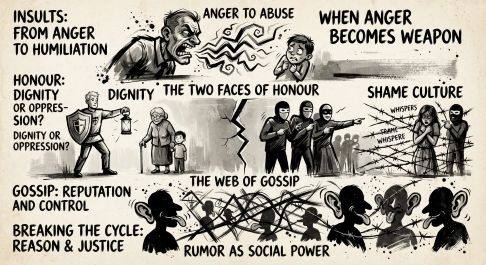
Insults, honor and gossip all become dangerous when people treat emotion or identity as exempt from responsibility.
Turning anger into reasoned argument, grounding honor in justice and self-respect, and replacing rumors with direct, verified conversation are all things we can learn.
By Riaz Ahmed Soomro
When people see no reward for their hard work, feel alone among their own, or cannot find a way to speak about injustice, their anger can sometimes come out as abuse. A sense of honor can prompt someone to stand against oppression, but it can also lead them to police customs created by society. And gossip? It may pass along information about someone’s conduct or damage their reputation in their absence.
So when do insults, honor and gossip take hold, and how are they shaped by our psychology, upbringing and social values? Let us consider them at the individual, social and national levels.
A number of figures in politics and journalism have been known for using abusive language. I once asked someone with a background in both fields why people swear. He said they do so to express anger. When people receive no reward despite tireless work, loyalty and sacrifice or face failure among their own, and their anger can surface in this way. He named several prominent political figures.
Recently, a political leader of Sindh expressed his anger over the proposal for new provinces or administrative units in abusive terms. Public anger appears even stronger, people are expressing it freely, and humiliating posts are circulating on social media. It is unclear why police and intelligence personnel so often use abusive language to intimidate people. There are also accounts of how prisoners are received at Central Jail, with heads bowed and a few blows from a shoe.
This opens a window onto anger, but anger and abuse is not the same thing. Anger is an emotion; abuse is one chosen way of expressing it. Threatening or humiliating someone, or attacking their identity, can also take the form of abuse. But anger does not always turn into verbal aggression. The frustration, aggression debate in psychology suggests that blocked goals and injustice can intensify anger and aggressive responses, but aggression is not inevitable. People can respond differently depending on what they have learned, the environments they inhabit and the alternatives available to them. Psychological research also suggests that aggression can sometimes be an attempt to reclaim a sense of importance or status. Someone who has repeatedly been ignored may try to make them heard through a raised voice, humiliation or threats.
From a scientific and biological perspective, anger is a complex emotional state, not the result of a single anger button being pressed. The body may respond to a perceived threat, insult or injustice. But what counts as an insult, and how a person responds to it, are also shaped by society, upbringing and experience. Darwin connected emotional expression with human evolution and communication, contemporary research likewise treats emotions as both bodily responses and actions that carry social meaning. Anger, then, is not just a sound, it is also a message to others, I will not accept this treatment. But when that message relies on abuse rather than reason, the original issue recedes and humiliation takes center stage.
On the question of honor, the person mentioned earlier (who has a political and journalistic back ground) posed a deeper question: how does honor take root? Is it instilled by a “dose of honor pills”, by reading mountain of books, or through upbringing? Perhaps the answer lies partly in all three. But honor is neither uniform nor an inborn trait. It is shaped by social learning, personal experience and the values that teach people what is worth protecting and what calls for protest.
Honor can be understood at three levels, individual, collective and national. Individual honor is rooted in dignity, freedom and fairness towards oneself. It does not mean fighting back against every criticism. It means protecting oneself and others from humiliation, admitting one’s mistakes and speaking out against injustice. This kind of honor is about inner dignity, not display or revenge.
Collective honor concerns the shared name of a family, neighborhood, community or political party. It can take two paths. One leads towards the common good, protecting the vulnerable, pursuing justice and accepting shared responsibility. The other makes a group’s reputation so sensitive that it seeks to control even the opinions, choices and lives of its members. Anthropological research on honor and shame shows that in some societies, honor is tied less to personal character than to reputation and the eyes of others. In such settings, fear of humiliation can be used to justify retaliatory violence.
Reviews of research on honor and violence show that where the justice system is weak, some communities may regard a reputation for retaliation as a way to protect themselves or enforce agreements. That may explain the practice, it does not justify it. Calling restrictions on women’s freedom or violence against them “honor” does not change the nature of the abuse.
National honor may mean protecting a nation’s language, history, resources, political rights and collective dignity. But if it is reduced to slogans, flags or the humiliation of other nations, it becomes self-deception. Benedict Anderson described the nation as an “imagined political community” most of its members do not know one another personally, yet see themselves as connected by a shared history and future. Free journalism, education, the development of language and justice can strengthen that shared sense of belonging.
The Stanford Encyclopedia of Philosophy, in its discussion of nationalism, also examines the ethics of nationalism, self-determination and the question of when disagreement is wrongly labeled treason.
The philosophical test of honor is whether it upholds human dignity or diminishes someone else’s. A national or collective identity can bring people together. But when it becomes a person’s entire identity, it becomes easier to treat those who disagree as enemies. In Identity and Violence, Amartya Sen reminds us that people have multiple identities, language, religion, profession, family, class and citizenship, among others. When political leaders elevate one identity above all the others, the risk of division and violence grows, obscuring the complexity of who people are.
Now to gossip. In everyday speech, gossip, idle talk and discussion of someone with a third party often run together, but they are not always the same. Even a true statement about someone who is absent can amount to gossip if it is made to harm or humiliate them. Telling a responsible person about someone’s abuse or exploitation, by contrast, can be a way of seeking accountability.
Sociological and evolutionary research suggests that gossip can serve a purpose, people share information about others’ behavior, trustworthiness and cooperation. Such information can sometimes encourage social responsibility. The same channel can also spread rumors, deepen factions and damage reputations. Studies of everyday gossip and reputation show that people judge others’ cooperation or dishonesty based on what they hear about them. Gossip, then, is not merely a personal habit; it can also become a tool of social power. We should ask who starts a story, who passes it on and who benefits from it.
Insults, honor and gossip all become dangerous when people treat emotion or identity as exempt from responsibility. Turning anger into reasoned argument, grounding honor in justice and self-respect, and replacing rumors with direct, verified conversation are all things we can learn. There may be no magic dose of honor, but families, schools, political organizations and society can teach people that dignity lies in justice, not revenge and that disagreement need not end in division if people are willing to talk and listen.
Read: Sindh’s Well-Wishers: Be Cranes, Not Crows
___________
 The author is a journalist, based in Hyderabad, Sindh