Sindh needs to move beyond slogans to sit together, hear differences, make arguments and work collectively with public trust.
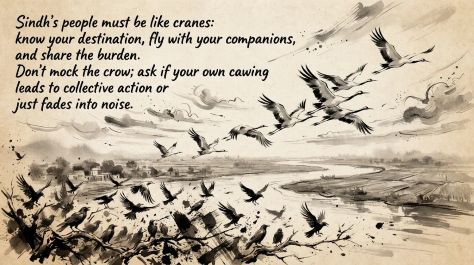
People of Sindh should be like cranes: know your destination, fly alongside your companions and do not fear taking turns in carrying responsibility. Instead of mocking the crow, ask whether our own cawing leads to collective action or disappears into noise.
By Riaz Ahmed Soomro
While scrolling through Facebook today, I came across a video explaining, on scientific grounds, the natural cooperation among cranes. It described how, when winter arrives and conditions become harsh, cranes and other migratory birds from Siberia set out on a new journey, using a strategy that helps them survive.
The video’s message was that these birds travel together for thousands of miles, maintaining remarkable discipline in the sky. They fly at great heights, where oxygen is scarce and the cold is severe, yet they do not lose heart. They form a distinctive pattern in the sky known in English as a “V formation.” This arrangement has a scientific basis: the bird at the front cuts through the air, making it easier for those behind to fly. The whole flock can therefore travel with less effort. When the leading bird grows tired, it moves back and another takes its place. This cooperation is the secret of their survival.
The sight may look like nothing more than birds in flight, but it also offers lessons in travelling together, sharing responsibility and supporting one another. Leadership does not pass from one bird or group to another according to a single fixed formula. Research into bird flight shows that the benefits of a V formation depend on air currents, the distance between birds and the order in which they fly. Measurements of some species have also found lower heart rates and reduced energy use during coordinated flight.
That question has become increasingly important in Sindh’s political life. Debate in Pakistan about new provinces and administrative units is intensifying again. Any administrative proposal should be assessed against the facts and official statements, rather than presented as either a rumors or a settled plan. At the same time, any proposal affecting Sindh’s boundaries or unity raises fundamental questions about the province’s history, resources, representation and public consent. The Sindh Assembly has passed a resolution opposing changes to the province’s unity and boundaries, while proposals and statements about administrative units at the national level have become part of public debate.
In this climate, the assembly’s resolution has become a major test and an opportunity for joint action for Sindh’s political parties, nationalist groups, social organizations, intellectuals, lawyers and ordinary citizens. It is essential to understand the sensitivity surrounding Sindh’s unity. But that concern will carry weight only when it is backed by knowledge, reason, legal understanding and a peaceful political strategy. Statements, mutual accusations and branding opponents as enemies will not create a strong public position. People need to know what the issue is, which legal and constitutional principles apply, and how the people of Sindh can express their views through democratic means.
One basic distinction must remain clear: discussing better administration is not the same as proposing changes to a province’s historic, geographic or constitutional boundaries. If people in an area face problems accessing public services, securing local representation or obtaining development, those issues deserve serious discussion focused on empowered local government, better planning and a fair distribution of resources. But if changing Sindh’s boundaries or political unity is presented as the solution, the consequences will differ for the provinces many languages, communities, cities and villages. Any such decision would require public trust, open debate and a central place for the views of those affected.
International movements also offer useful lessons. Before Scotland’s 2014 independence referendum, supporters of independence brought different political parties and social groups together under the “Yes Scotland” banner. The campaign included the Scottish National Party, Greens, socialists and other supporters. They did not all share identical views about their ultimate destination, but they found a common platform for campaigning on a specific political question. Independence supporters did not win the referendum, but the campaign saw broad public participation and involvement from many groups.
Scotland’s experience cannot be applied directly to Sindh: every country has its own history, laws and political circumstances. But it does offer a practical lesson. Parties and groups can work together on a shared issue without resolving all their differences. A united front does not require every group to abandon its name, ideology or political identity. It means agreeing on a few basic principles and working towards a common goal while retaining their separate identities. If a shared position is to be built around Sindh’s unity, public consent and democratic process, the voices and identities of different groups must be respected.
Unity has helped many movements around the world, but it does not mean blind support. A united front is stronger when it makes room for disagreement, sets clear procedures for decisions and shares leadership responsibilities. That, too, is a lesson from the cranes’ formation: make room for a fellow traveler, do your share of the work and step forward when needed. In a political organization, the same person or party need not always lead. The aim should be to keep the collective effort moving.
The United Nations Declaration on the Rights of Indigenous Peoples affirms the right to maintain and develop one’s own political, social and cultural institutions. The declaration does not, by itself, decide the borders of any particular state or province. It does, however, recognize rights connected to people’s identity, representation and institutions.
All of Sindh’s political and social groups should develop a common, practical way forward. First, they should gather verified material on Sindh’s history, constitutional status, resources and population. Second, they should hold open discussions with people from different linguistic and community backgrounds, so their concerns can be heard directly. Third, they should seek clear advice from lawyers and constitutional experts and explain it to the public in plain language. Fourth, they should work towards a written agreement among different political groups on minimum shared principles concerning Sindh’s unity and public consent. Fifth, every protest and campaign should remain democratic, peaceful and accountable to the public.
Students, teachers, women, farmers, workers, traders and young people should also take part. Debate about Sindh should not be confined to party leaders, because its consequences will reach every city, village, language and social class. A video, post or slogan on social media can start a discussion, but sustained political work also requires meetings, study groups, legal knowledge and respectful communication. When people feel connected and included, a shared position becomes broader and more durable.
Sindh’s political groups should ask themselves: do we use our voices in ways that bring people together, or drive them further apart? Disagreement is a natural part of politics, but turning every difference into a personal feud weakens a common struggle. Those at the front should make room for their companions instead of leaving them behind; those following should be ready to take on the responsibility of leading. That is how a group can travel a long way.
As debate about new provinces returns to public discussion in Sindh, the province’s political groups should move beyond reaction and prepare in advance. They should set out their position in writing, prepare answers to likely questions, understand the constitutional process and deliver consistent, credible information to people in cities and rural areas alike. Political emotion has its place, but a movement becomes stronger when emotion is joined with knowledge and organization. Spreading fear or deepening conflict will not earn the public’s trust. Trust grows when the message is clear, the purpose is understood and the approach is democratic.
The cranes’ flight does not provide an answer to any particular political program, but it does offer an image of travelling together: benefiting from a companion’s effort, contributing according to one’s ability, stepping forward when needed and supporting a tired companion. These are valuable lessons for any collective movement. Nor should a crow’s cawing be dismissed as meaningless; it, too, is a social call. But in human politics, sound alone is not enough. Alongside speaking, there must be listening; alongside argument, respect; and alongside slogans, a practical program.
People of Sindh, be like cranes: know your destination, fly alongside your companions and do not fear taking turns in carrying responsibility. Instead of mocking the crow, ask whether our own cawing leads to collective action or disappears into noise. Sindh needs to move beyond slogans to sit together, hear differences, make arguments and work collectively with public trust.
Read: The Mohajir Paradox
____________
 The author is a journalist, based in Hyderabad, Sindh