Language, thought, and culture are closely connected. The way we speak influences how we see the world, and our cultural background shapes the language we use.
By: Bisma Aziz
Language is more than just a tool for communication. It influences how we think, perceive the world, and interact with others. As anthropology students, we explore the deep connection between language, thought, and culture to understand human societies better. This article discusses how language shapes the way people think and how it reflects cultural values.
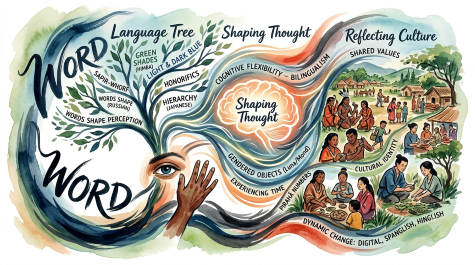
One of the most famous theories in linguistic anthropology is the Sapir-Whorf Hypothesis. It suggests that the structure of a language affects how its speakers perceive and understand the world. There are two key ideas in this theory: Linguistic Determinism, which suggests that language completely controls thought, and Linguistic Relativity, which argues that language influences thought but does not entirely determine it. For example, the Hopi people of North America have a different way of describing time compared to English speakers. Instead of past, present, and future tenses, their language focuses on whether events are completed or ongoing. This suggests that language may affect how people experience time.
Language and Perception
Language influences how we categorize and understand the world around us. One of the best examples of this is color perception. The Himba people of Namibia have more words for different shades of green than English speakers. As a result, they can distinguish between shades of green much better than someone who speaks English. In contrast, Russian speakers have separate words for light blue and dark blue, while English has only one word—”blue.” Studies show that Russian speakers can identify different shades of blue more quickly than English speakers. These examples show that the words we have in our language shape how we see and understand things in our environment.
Language is deeply connected to culture because it carries the values and beliefs of a society. Different languages emphasize different aspects of life, showing what is important to a particular culture. In Japanese, there are many forms of politeness built into the language. The use of honorifics like -san (Mr./Ms.) or -sama (a highly respectful form) shows Japan’s emphasis on hierarchy and respect. The Pirahã people of the Amazon have no fixed words for numbers beyond “a few” and “many.” Their language reflects their culture, where exact numbers are not necessary in daily life. This demonstrates that language is not just a way to communicate but also a reflection of a society’s values and way of life.
Bilingualism and the Changing Nature of Language
People who speak more than one language often develop greater cognitive flexibility. Bilingual individuals can switch between languages depending on the situation, which may help them see multiple perspectives. For example, in Spanish and German, objects have genders (e.g., “la luna” for the moon in Spanish is feminine, while “der Mond” in German is masculine). Studies suggest that speakers of these languages may unconsciously describe objects differently based on their assigned gender. This shows that language can subtly influence how we think.
Language is constantly evolving as societies change. The rise of digital communication has introduced new words, slang, and even emojis that shape modern communication. Additionally, globalization and migration have led to the blending of languages, such as Spanglish (Spanish and English) and Hinglish (Hindi and English). These changes show that language is dynamic and continues to adapt to cultural transformations.
In conclusion, language, thought, and culture are closely connected. The way we speak influences how we see the world, and our cultural background shapes the language we use. By studying language in anthropology, we gain a deeper understanding of human societies and how they evolve over time.
Read: Culture’s Impact on Identity and Language
________________
 Bisma Aziz is a third year student of Anthropology and the department of Anthropology and Archaeology, University of Sindh, Jamshoro