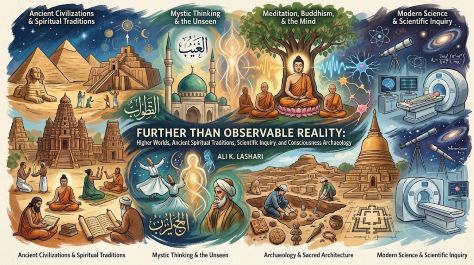
Higher Worlds, Ancient Spiritual Traditions, Scientific Inquiry, and Consciousness Archaeology
Humanity’s awareness of a hidden reality through ancient civilizations, religious philosophy, archaeology, and modern science
Ali K. Lashari
Humanity’s Everlasting Search for the Undiscovered
Human civilizations have tried to understand a fundamental question: can reality do exist deeper than our physical senses?
From Mesopotamian temples to South Asian sacred landscapes, Egyptian funeral statues to Greek intellectual norms, humanity has expressed beliefs about invisible powers, spiritual aspects, and life beyond death.
Religious institutions, architecture, burial rituals, art, and philosophy were shaped by these ideas.
In Part I, we investigated Rudolf Steiner‘s spiritual philosophy, notably his views on clairvoyance and higher awareness. Steiner believed humans may develop spiritual perception to perceive things beyond sensory experience.
His thoughts are part of a larger intellectual tradition.
Ancient societies had deep understandings of material life and invisible worlds before Anthroposophy.
Studies of these traditions can reveal humanity’s spiritual imagination and the history of consciousness, symbolism, and religion.
Archaeology, comparative religion, philosophy, and neuroscience can help us understand why higher worlds are so powerful across societies.
Divine Worlds in Ancient Religions Traditions
The belief that existence contains many ancient civilizations believed in visible and invisible dimensions.
Mesopotamian religions described a universe with gods, humans, and supernatural forces. Temples linked earthly societies to divine authority.
Ancient Egyptians had extensive afterlife beliefs.
Spiritual journeys, divine judgement, transformation, and afterlife were described in their funeral texts.
Pyramids, tombs, and funeral temples expressed these beliefs.
Ancient Indian traditions explained awareness, reincarnation, liberation, and the link between individual life and ultimate truth in complicated philosophical ways.
The Upanishads examined Atman and Brahman, although succeeding philosophical systems interpreted the self and universe differently.
These traditions vary, but they show a human concern for unobservable truths.
Importantly, their parallels do not prove they describe the same spiritual realities.
Instead, they show how different civilizations used symbolic and philosophical frameworks to answer existential concerns.
Mystic Thinking in Islam and the Unseen World
Regarding the connection between material and immaterial realities, Islamic intellectual traditions offer an additional viewpoint.
As a part of reality beyond what is often known to humans, the unseen (al-ghayb) is mentioned in the Qur’an.
Knowledge of the unseen is more closely associated with divine revelation in Islamic theology than with unfettered human access via supernatural powers.
Later on, Sufi traditions and Islamic philosophy got quite deep into questions like the soul, creation, and the nature of spiritual knowledge.
Questions of reality, creativity, and enlightenment in the spiritual realm were investigated by the great mystic Ibn Arabi.
The idea of alam al-mithal, or the imaginary universe, emerged in subsequent philosophical traditions as well.
This idea is not the same as regular fantasy. Symbolic forms and spiritual experience are linked to a hypothesized intermediate reality, according to its philosophical setting.
Henry Corbin, a researcher and philosopher from France, looked into these traditions and highlighted how they differed from the imaginal.
Their theological underpinnings are very different; however, these concepts have certain similarities with Steiner’s spiritual cosmos.
Islam views spiritual knowledge through the unique lenses of revelation, divine authority, and religious activity, in contrast to Steiner’s presentation of higher knowledge as something fostered through his own system of spiritual development.
For appropriate comparative studies, these distinctions are crucial.
Transcendental Meditation, Buddhism, and the Evolution of Mind
The constraints of everyday awareness can be better understood via the lens of Buddhist philosophy.
Researching pain, attachment, impermanence, and the mechanisms through which experience comes to pass is more fundamental to many Buddhist traditions than focusing primarily on unseen worlds.
An integral part of this inquiry is meditation.
The goal of practicing disciplined attention is to gain insight into one’s thought patterns, emotional responses, and the dynamic character of one’s subjective experience.
Heavenly and inhuman realms are described as multiple levels of existence in certain Buddhist cosmologies.
It would be a mistake to equate Steiner’s ethereal and astral realms with his cosmic concepts.
Also, spiritual traditions that hold that each person has an immortal soul are at odds with Buddhism’s view of consciousness.
Human identity is not based on an immutable core, according to the non-self-concept of Anatta.
When compared to Steiner’s view of spiritual individuality, this makes for a significant philosophical difference.
However, there is a common thread running across both traditions: a desire to alter one’s state of mind by means of regular meditation.
When compared, they show how seemingly identical enquiries on consciousness can lead to very diverse philosophical justifications.
The Role of Archaeology in the Study of Religion and Spiritual Belief
When it comes to researching different faiths and practices, archaeology offers a unique perspective.
In contrast to theological philosophy, which delves into concepts through writings and rational arguments, archaeology seeks to understand belief systems through tangible cultural artefacts.
Archaeological artefacts such as temples, tombstones, holy images, ritual objects, and ceremonial landscapes provide light on the religious practices and institutions of ancient societies.
The artefacts unearthed at Mohenjo-Daro from the Indus Civilization show that they were masters of urban planning, building, water management, and manufacturing.
The symbolic images, seals, figurines, and the Great Bath have sparked a great deal of debate about potential religious and ceremonial uses.
However, the indecipherable Indus script and the lack of a comprehensive archaeological record make it challenging to reconstruct the spiritual worldview of the civilization with precision.
There is still much discussion over whether certain items reflect gods, meditation, or supernatural abilities.
There is additional evidence from Buddhist archaeological sites in the surrounding areas of Sindh.
Sacred architectural arrangements, sculptures, reliquaries, monasteries, and stupas show how Buddhist cultures used physical places to communicate religious ideals.
Investigating the connection between religious imagery, ritual movement, holy architecture, and nearby villages is possible at sites like Dhamrah-jo-Daro.
The ways in which communities saw and cared for sacred landscapes can be better understood with the aid of these studies.
But the supernatural worlds mentioned in religious texts cannot be independently confirmed by archaeology.
It can be used to determine the ways in which ideas shaped people’s actions, organizations, and the physical world around them.
Due to this difference, archaeology is highly beneficial for researching the social and spiritual connections of the past.
The Role of Sacred Architecture in the Realization of Universal Harmony
One way in which religious cosmologies have been physically represented throughout history is through architectural construction.
Ancient pyramids in Egypt, ziggurats in Mesopotamia, stupas in Buddhism, and temples in Hinduism all developed from separate cultural and religious currents of creativity.
Sacred space, the presence of God, cosmic structure, and spiritual transformation were common themes in their forms.
One example is the multiple roles that stupas have in Buddhist rituals, including as reliquaries, objects of adoration, and centers for circumambulation.
Religious doctrine and lived practice can be brought together through its architectural symbolism.
In a similar vein, the placement of sacred places like temples and landscapes may mirror the interplay between religious practice, governmental power, and cosmic faith.
From an archaeological point of view, these buildings show how spiritual concepts may become part of everyday life.
Building religious structures calls for human effort, expert understanding, material means, and coordinated community action.
As a result, one’s spiritual views are more than just an internal experience. They have the power to transform not only monetary systems and cultural traditions, but also urban environments and communal identities.
Among archaeology’s greatest contributions to the study of religion is the discovery of the connection between unseen belief and tangible material manifestation.
The Enigma of Awareness in the Age of Modern Science
The field of modern neuroscience has revolutionized our comprehension of how the human brain works.
Evidence from the brain and spinal cord strongly suggests a connection between conscious experience and neural activity.
Multiple brain networks operate together to process visual information, store memories, process emotions, focus attention, and develop self-awareness.
Also studied by scientists are lucid dreams, altered states of consciousness associated with meditation, near-death experiences, and shifts in how one perceives their own body.
People who are experiencing such things often find great significance in them.
But the fact that an experience was intense for the person having it does not prove that the supernatural explanation for it actually exists.
Scientific studies that strictly adhere to protocol have failed to prove that clairvoyance can reliably open doors to other dimensions or reveal otherwise unavailable data.
Similarly, Steiner’s etheric and astral bodies have not been proven to exist through empirical means.
Nevertheless, theories of consciousness continue to have a significant place in both philosophy and science.
Scientists are still trying to figure out the nature of conscious experience and the connection between subjective awareness and brain activity.
While these mysteries beg for more investigation, they do not prove the existence of a supernatural answer.
Differentiating between generalized unresolved problems and proof for specific metaphysical assertions is an important aspect of any scientifically sound methodology.
Human Significance, Psychological Factors, and Spiritual Experience
Dispassionate observation is not the only way for humans to perceive the world.
A person’s interpretation of events is shaped by their memory, emotions, culture, expectations, and beliefs.
Transformative experiences such as dreams, visions, moments of great insight, and emotions of unity have the power to alter one’s perspective on life.
Psychologists study these occurrences without passing judgement on the religious meanings ascribed to them.
Mindfulness and contemplation, for instance, may have an effect on focus, emotional control, and happiness perceptions.
These shifts are understood by some as a spiritual awakening, and by others as the result of mental processes.
Although they entail different types of claims, both interpretations can be explored.
Proving the presence of an objective spiritual dimension is not necessary for the psychological validity of spiritual experience.
Similarly, scientific confirmation of a belief’s metaphysical assumptions is not necessary for the belief’s cultural importance.
Because of this differentiation, academics can treat spirituality with dignity while still being rigorous in their analysis.
It promotes communication between the scientific community and the arts and humanities as a whole.
Importance of Higher World Studies in the Modern Era
Beyond arguments over clairvoyance, the modern significance of traditions from the upper realms goes beyond that.
Our collective efforts to make sense of death, self-definition, ethics, and our position in the universe are mirrored in these traditions.
Furthermore, they show how cultural and historical factors shape the evolution of knowledge.
In contrast to the distinct intellectual and religious histories of Buddhism, Hinduism, and Islam, Steiner’s Anthroposophy arose within a specific European intellectual milieu.
To avoid reducing complicated spiritual systems to a single universal explanation, it is important to be aware of these distinctions.
Researchers in the fields of archaeology and cultural heritage can learn more about the interplay between religion, built environment, and social structure by delving into questions of spiritual belief.
It makes philosophers wonder about the nature of knowledge, the limits of human comprehension, and the nature of consciousness itself.
This emphasizes, for scientists, the significance of conducting thorough and repeatable investigations into unusual occurrences.
It prompts societal-level contemplation on the connection between information and moral obligation.
Researching these traditions is worthwhile because of the metaphysical assertions they make as well as the intellectual and cultural legacy they have left behind.
Final Thoughts: Making Sense of the Invisible by Examining What’s Obvious
A deep want to comprehend reality beyond our senses lies at the heart of humanity’s quest for ethereal realms.
One significant interpretation was put out by Rudolf Steiner in his work on spiritual vision and enlightened consciousness.
Through contemplation, revelation, intellectual study, and sacred cosmology, ancient religious traditions arrived at alternative interpretations.
The study of ancient artefacts and their contexts in sacred settings provide light on the ways in which religious beliefs shaped the building of monuments and the expansion of human societies.
Meanwhile, modern science seeks to understand consciousness by examining observable facts and proposing testable explanations.
While not mutually exclusive, these methods do help shed light on how humans interact with the unknown.
Being receptive to philosophical enquiries while avoiding the pitfalls of equating speculation with known facts is no easy feat.
One of the most important things that can come out of this investigation is a better knowledge of how people make sense of the world, how they interpret events, and how they change their perspectives on life.
Past civilizations’ beliefs in or fantasies about unseen realms have left tangible marks on human history. Although we do not find evidence of supernatural aspects in our meticulous examination of those traces, we do get a deeper appreciation for the astounding intricacy of human thought, tradition, and faith.
Read: Above and beyond Something Human
_______________
 Ali Lashari is an Assistant Director (Excavation & Exploration) & Cultural Heritage Advocate, Directorate of Archaeology & Antiquities Wing, Culture, Tourism, Antiquities & Archives Department, Government of Sindh.