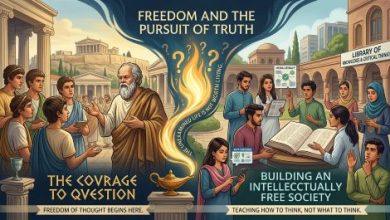
Above and beyond Something Human-1
Rudolf Steiner, Supervision, and the Enigmas of Enlightenment

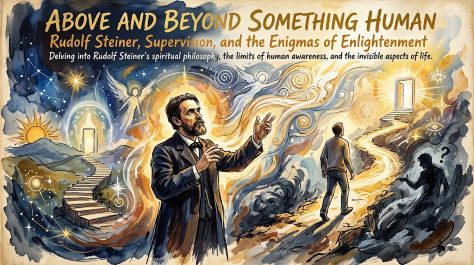
Delving into Rudolf Steiner’s spiritual philosophy, the limits of human awareness, and the invisible aspects of life.
Ali K. Lashari
Does Everything That We Can See Really Exist?
People have been wondering, for a very long time, whether what they can see with their five senses really is the whole universe. Philosophers, religious leaders, and spiritual instructors from all walks of life have posited the possibility that there is a world beyond our physical cosmos.
We see the world through our sense of sight, hearing, touch, and smell, and we use our brains to make sense of it all. But there is a lot of physical reality that our senses can’t pick up on. Ultraviolet rays, magnetic fields, and frequencies above the human hearing range are all invisible to humans.
We now know more about these previously unreachable physical events thanks to scientific technology. However, a more fundamental philosophical inquiry lingers: are there parts of reality that defy comprehension by means of our five senses?
The Austrian philosopher and Anthroposophy founder Rudolf Steiner centered his spiritual philosophy around this subject.
The potential of human consciousness, according to Steiner, goes beyond what is typically recognized. He theorized that there is a spiritual existence beyond the material world and that people might achieve heightened perception by actively working on themselves.
His seminal works, Theosophy and How to Know Higher Worlds, provide out a comprehensive system for comprehending the spiritual realms he characterized.
Religious thinkers, philosophers, and anybody curious about consciousness keep coming back to these concepts. Nonetheless, Steiner’s accounts are still just that—claims, rather than proven facts.
Their relevance can be seen by delving into Steiner’s intellectual worldview and the notion of clairvoyance.
- Using Clairvoyance: The Ability to See Things That Aren’t There
The French word clairvoyance means “clear seeing” in its literal sense. Conventionally, it denotes the asserted capacity to perceive facts, occurrences, or realities that are outside the realm of typical physical perception.
Spectacular perceptions have made appearances in philosophical debates, mystical traditions, and religious stories throughout history.
Visions, prophetic dreams, and contacts with supernatural entities were recounted by ancient religious and spiritual practitioners. Depending on the culture, people may attribute supernatural insights, symbolic experiences, or even psychological phenomena to such occurrences. Through his work, Steiner came to a unique interpretation of clairvoyance.
Spiritual sense, he maintained, was more than just a rare talent enjoyed by a select few. He framed it instead as a skill that, ostensibly, could be developed via deliberate practices of mindfulness, including meditation, self-observation, and ethical restraint. According to him, rational thought and bodily experiences are still integral parts of everyday awareness. In contrast, it was thought that higher awareness might unveil realities that were invisible to the naked eye.
More than imagination, according to Steiner, was needed for this growth. Truthful spiritual understanding, in his view, necessitated calm composure and self-awareness. However, one must differentiate between having anomalous states of consciousness and proving that they disclose separate spiritual realms.
There is no evidence from current scientific studies that clairvoyance is a valid way to get information beyond what can be gleaned via the senses or inferred. Thus, it is most appropriate to view Steiner’s theories within the context of spiritual philosophy and the evolution of our capacity to comprehend consciousness.
- Rudolf Steiner: A Philosopher Seeking Greater Understanding
During a time of profound intellectual upheaval, Rudolf Steiner—who was born in the Austrian Empire in 1861—developed his theories.
There was a confluence of factors in Europe at the time, including a surge in industrialization and scientific understanding as well as heated discussions over religion, materialism, and the meaning of life.
At first, Steiner sought answers to philosophical problems concerning human cognition, freedom, and knowing. German philosophy and Johann Wolfgang von Goethe’s scientific publications shaped his early intellectual growth.
The connection between material and ethereal experiences piqued his curiosity as time went on.
Over time, Steiner formulated Anthroposophy, a spiritual philosophy that aimed to explore the nature of humanity’s connection to the universe via introspection.
To him, people were more than just another species. He proposed a model of human nature with many dimensions, one of which was the corporeal.
Among the many facets of human nature that Steiner elaborated upon were the physical, etheric, astral, and spiritual bodies.
His comprehension of other dimensions was built upon these ideas.
Steiner argued that one may gain spiritual knowledge through developed inner vision, in contrast to traditional scientific methods that rely on outwardly testable proof.
He considered his spiritual enquiries to be a methodical type of research, even though his techniques failed to meet the standards of modern empirical science when it came to independent verification.
However, his ideas permeated many fields, including farming, alternative spiritual movements, schools, and architecture.
Despite the lack of evidence for their metaphysical assertions, the enduring impact of Anthroposophy proves the historical significance of his views.
- Where Are the Exalted Realms Located?
The higher worlds are more than just undiscovered regions outside of our visible cosmos, says Steiner.
Instead, they stand for the several tiers of reality that he thought existed alongside the material world.
According to him, the tangible world is the one aspect of life that one can perceive right away. Subtler realms linked to existence, awareness, and enlightened spirit were his suggestions beyond it.
Matter, biological processes, and the laws of nature determine what we can see in the first, the physical universe.
Steiner linked the etheric plane, the second, with the structuring forces inherent in all forms of life. He thought that life and development were supported by an etheric body.
Emotions, wants, feelings, and parts of one’s conscious experience are all part of the astral dimension, which makes up the third in his theory.
Going beyond these, Steiner outlined ethereal realms linked to transcendental thinking, cosmic development, and deeper significance.
Devachan, a spiritual realm spoken of in esoteric traditions, was one of the terms he used that had been passed down from Theosophy.
These tiers were not separate entities, according to Steiner. They came together to build a spiritual framework in which humans could take part.
According to this theory, there are many facets to being human beyond the physical body.
However, etheric or astral bodies that have been independently shown are not recognized by modern biology and physics. Rather than being recognized as elements of nature, these conceptions stay within Steiner’s spiritual cosmology.
They are important from a philosophical standpoint because they seek to explain reality by establishing a relationship between existence, awareness, and purpose.
- Achieving a Greater Self-Awareness
Steiner held the view that startling revelation was not necessary for reaching greater spiritual vision but that a more gradual transformation was necessary.
He said that growing spiritually is a disciplined process that requires focus, moral accountability, and shifts in one’s perception of one’s own inner life.
His main point was that it’s hard to maintain a state of heightened awareness when one is distracted, emotionally unstable, or unable to regulate their habitual reactions.
Concentration and self-observation, he said, are the bedrock of enlightenment.
Steiner argued that in order to reach enlightenment, one must learn to be calm under pressure and to examine one’s ideas without reacting to them.
An individual’s moral character and their capacity for spiritual insight were, in his view, intertwined.
He worried that people may become confused or abuse their supposed spiritual skills if they had access to knowledge without being responsible for it.
His method differs from the common perception of clairvoyance as a means to foretell the future or gain magical abilities due to this ethical consideration.
Steiner shares several similarities with contemporary mindfulness traditions in his emphasis on attention and introspection.
Some contemplative practices can help with emotional management and mental health, according to research.
But don’t mistake these benefits for proof of extraterrestrial intervention.
It is not necessary to accept Steiner’s assertions about spiritual awareness in order to recognize the psychological benefit of reflection.
- Creative Thinking, Motivation, and Gut Feelings
Imagination, inspiration, and intuition were the three pillars upon which what Steiner called “higher knowledge” rested.
These words had specific connotations in the field of anthropology.
The development of inner symbolic perceptions, which Steiner thought could communicate spiritual wisdom, was symbolized by imagination. He asserted that a trained spiritual imagination might provide deeper meanings than surface-level fantasies.
When people spoke about being “inspired,” they meant they had reached a more profound level of spiritual awareness, one that did not rely on symbolic images to guide them. According to Steiner, this is related to the awareness of deeper spiritual connections.
According to him, intuition was an even higher level of direct spiritual awareness. According to his description, it’s a condition in which the boundary between the observer and spiritual truth dissolves.
According to Steiner, there is an objective spiritual realm, and these stages are meant to illustrate a deeper and deeper involvement in that universe.
Today, though, we can also look at these kinds of experiences through the lenses of neuroscience, philosophy of mind, and psychology.
A person’s state of consciousness can cause them to have heightened perceptions of themselves, profound insights, transformed self-perceptions, and even emotions of oneness.
No one disputes the reality of these events. Their purported ability to deliver direct insight into separate spiritual realms is still up for debate.
To understand Steiner’s theory in a balanced light, this difference is essential.
- The Multi-Faceted Essence of the Human Being
The idea that there is more to a person than their biological make-up was one of Steiner’s most groundbreaking claims.
The material basis of terrestrial life is provided by the physical body in his spiritual framework, while the life-organizing energies are represented by the etheric body.
The spiritual self-offers the foundation for individuality and higher development, whereas the astral body is linked to feeling and consciousness.
According to Steiner, there is more to human evolution than just a process of natural selection. Consciousness, he said, is an agent in a higher spiritual movement.
Among the concepts he interpreted were reincarnation, karma, and the fact that each person’s unique identity develops throughout the course of their lifetime.
His larger effort to link human life with cosmic purpose is reflected in these ideas.
Such assertions may not have any empirical backing, but they do pose important philosophical concerns about the nature of reality, the persistence of awareness, and the search for purpose in human existence.
In spite of going through life’s ups and downs, what remains constant about a person? In what ways is the body related to consciousness? Is it possible for material processes to fully explain human purpose?
Even though contemporary scientific and philosophical explanations diverge greatly from Steiner’s spiritual ones, these concerns nevertheless manage to spark discussion.
- The Moral Significance of Enlightenment
The idea that seeking knowledge should lead to ethical reform is one of Steiner’s most enduring tenets.
Spiritual growth, he said, necessitated meekness, compassion, self-control, and accountability to others.
He believed that a more enlightened understanding of human connections was the true goal of higher consciousness, rather than its segregation from society.
This basic tenet links his philosophies to a longer line of thought in which knowledge is viewed as more than just a body of facts.
Intellectual knowledge and practical wisdom are often seen as separate concepts in philosophical and religious traditions.
Someone can know a lot of facts, but they don’t have to have any empathy, good judgement, or sense of moral obligation.
The goal of Steiner’s spiritual approach was to unite these aspects.
The link between knowing and doing the right thing is worth considering even if you don’t buy into his explanations of other dimensions.
Thus, the capacity for critical thought, responsible action, and a deeper awareness of others can be seen as markers of human consciousness development alongside uncommon experiences.
Final Thoughts: Launching a More Comprehensive Investigation
An intriguing endeavor to comprehend human existence beyond the limits of common awareness is offered by Rudolf Steiner’s philosophy.
His detailed spiritual worldview, which he describes in terms of clairvoyance, etheric and astral realms, and higher consciousness, has an ongoing impact on modern esoteric philosophy.
It is important to note that scientifically proven knowledge is distinct from these descriptions.
Perception, identity, consciousness, and the connection between knowledge and morality are some of the important issues that Steiner’s work brings up.
Both empirical data and philosophical speculation have always played a role in humanity’s quest for knowledge. Recognizing the distinction while maintaining an openness to meaningful investigation is crucial for progress.
This begs the question: how have various cultures made sense of unseen realities, and what can field as diverse as science, theology, philosophy, and archaeology bring to the table when discussing how other cultures have made sense of the cosmos?
References for Part I
- Steiner, Rudolf. Knowledge of the Higher Worlds and Its Attainment. 1904–1905.
- Steiner, Rudolf. Theosophy: An Introduction to the Spiritual Processes in Human Life and in the Cosmos. 1904.
- Steiner, Rudolf. Occult Science: An Outline. 1910.
- Hammer, Olav. Claiming Knowledge: Strategies of Epistemology from Theosophy to the New Age. Brill, 2001.
- Hanegraaff, Wouter J. Esotericism and the Academy: Rejected Knowledge in Western Culture. Cambridge University Press, 2012.
Part II will continue with topics such as the Archaeology of Consciousness, Scientific Inquiry, Ancient Spiritual Traditions, and Higher Worlds.
___________________
 Ali Lashari is an Assistant Director (Excavation & Exploration) & Cultural Heritage Advocate, Directorate of Archaeology & Antiquities Wing, Culture, Tourism, Antiquities & Archives Department, Government of Sindh.