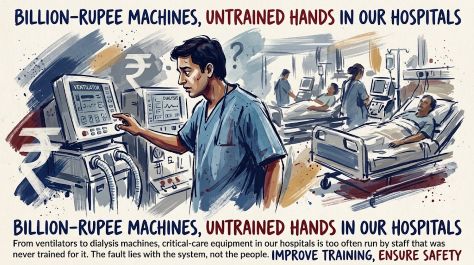
From ventilators to dialysis machines, critical-care equipment in our hospitals is too often run by staff that was never trained for it. The fault lies with the system, not the people.
By Nuzair Ahmed Jamro
Ask any family waiting outside a Pakistani ICU what they fear most, and the answer is usually the same: a bed, a ventilator, a doctor. Rarely does anyone ask who will actually operate the machine, and whether that person was trained to do it.
That question deserves an answer. A modern ICU is a tightly connected set of life-support devices, and each one needs a trained specialist. In many of our hospitals, these devices are run by OT technicians and nurses who were never formally trained on them. Some learned from a senior colleague, others from a one-day demonstration by the supplier. Staff in this position is not at fault. The fault lies with a system that buys machines without building the workforce to run them.
The money is spent, the workforce is not
Pakistan does spend heavily on this equipment. A ventilator costs between Rs3 million to Rs.5 million. One 2020 estimate put Punjab’s public hospitals at nearly 1,300 ventilators. At those prices, that one province’s ventilators alone represent roughly Rs4 billion to Rs.6.5 billion, before counting a single monitor, dialysis machine or anesthesia unit.
Yet hospital administrators say the machines are only part of the story. PIMS’s executive director has said that the shortage of human resources means more ventilators alone would not solve the problem, since staff is needed to run them. The Polyclinic spokesperson made the same point: ventilators cannot function without specialized personnel.
The shortage of machines is also real. PIMS has more than 90 ventilators across its ICUs, yet almost all are in use, and Polyclinic’s 35 ventilators are occupied most of the time. A machine that is set up badly used wrongly or left unrepaired gives the patient little in return for the money spent on it.
We have seen what happens when technical support is missing. During the first COVID wave, about 100 Pakistani engineers volunteered to repair broken ventilators in different cities and to train hospital staff to use them. A health system should not depend on volunteers for this.
It is not just the ventilator
Public discussion focuses on ventilators, but an ICU patient is typically connected to several devices at once, and each one can help or harm depending on who handles it. Wrong alarm limits on a monitor, an incorrect infusion pump rate, or an uncelebrated blood gas analyzer can be as dangerous as a wrong ventilator setting.
The table below shows the main ICU, emergency and operating theatre equipment and the professionals who, in well-run hospitals, are responsible for each.
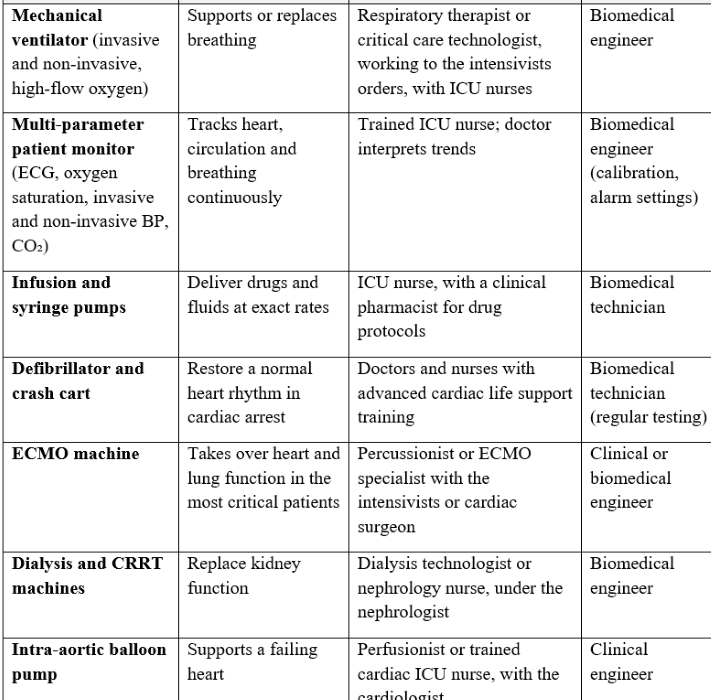 The pattern is clear. Clinical staff treat the patient, a trained specialist operates the device, and an engineer keeps it safe and accurate. Pakistan has the doctors and nurses, but too many hospitals lack the other two.
What other countries do
In the United States, respiratory therapists are a permanent part of the ICU team. At Brigham and Women’s Hospital in Boston, a 60-member respiratory care department staffs ten ICUs, and therapists round daily with pulmonary consultants and surgeons on ventilator weaning. At New York-Presbyterian, teams of a pulmonologist, internist, respiratory therapist, nurse, social worker and physical therapist meet daily to plan ventilator care, and a study found that days on the ventilator for tracheostomy patients fell by a week. A national credential is the standard in the US: in the ICU, a registered respiratory therapist manages ventilator settings, performs breathing trials, assists with intubation and responds to cardiac arrest calls.
Singapore sets its bar similarly high. A respiratory therapists post in an ICU at Woodlands Hospital asks for a bachelor’s degree in respiratory therapy, registration, and preferably five years of ICU experience. The role includes bedside ventilator monitoring, airway management and basic equipment troubleshooting.
In the UK and many other health systems, hospitals also keep in-house clinical or biomedical engineering departments that buy, test, service and train staff on equipment. They also employ perfusionists, dialysis technologists and anesthesia technicians as recognized professions.
The economics of an idle machine
Viewed as a public finance question, the problem is plain. A ventilator is a capital asset, and its value comes from the years of safe, productive use it delivers. A machine that is idle, broken or misused earns nothing, yet the money has already been spent and the depreciation keeps running. Procurement offices tend to count only the purchase price. The real cost of owning a machine includes training, consumables, servicing, calibration and replacement parts, and when those are left unfunded, the purchase price is partly wasted.
The cost to families is just as real. Private ICU treatment can cost up to Rs.300, 000 per day for one patient, which is why people crowd into public hospitals. Every ventilator that stays out of service because no one can fix or operate it pushes another family toward debt or toward a bed that is not there.
Information technology can help, and it does not need to be expensive. Few hospitals can answer simple questions today: how many ventilators and monitors do we have, which ones work, when were they last serviced, and how long has each one been down? A basic digital asset register can answer them. Each machine would get a unique tag, with its purchase date, supplier, warranty, calibration schedule, repair history and the staff trained to use it. Provincial health departments could then see in one dashboard which hospitals have equipment sitting idle, which have too little, and which suppliers’ machines fail most often. That information would let them move equipment between hospitals, hold suppliers to their service promises, and decide where to place their next biomedical engineer. For a department, the cost of such a system is small compared with the cost of a single imported ICU machine.
What needs to change?
Create posts and career structures. Every major hospital should have a biomedical engineering department with proper positions, grades and authority, not a single technician reporting to the purchasing office.
Build the missing professions. Respiratory therapy, perfusion, dialysis technology and anesthesia technology should be recognized programs with standard curricula and certification.
Tie every purchase to training and service. Contracts should include repeated training for staff, spare parts and maintenance, not one demonstration at handover.
Regulate competence. The relevant regulators should set minimum qualifications for staff that operate critical care devices, and hospitals should check them.
Keep digital records. A provincial asset register covering calibration, repairs and downtime for every machine would show where the system is failing and who is responsible.
Budget for the full cost of ownership. Health budgets should set aside funds for training, servicing and spare parts alongside the purchase of equipment.
Support nurses and technicians. Those already in the wards need regular, structured training and a clear line of support from engineers and specialists.
The cost of doing nothing
Every machine in an ICU is a promise to the patient on the bed. A promise kept requires more than a purchase order. It requires people who know how to use the machine and a system that keeps it working. Until Pakistan staffs its ICUs with trained specialists and engineers alongside its doctors and nurses, we will keep spending billions on equipment whose benefits never fully reach the patient.
Read: From Water Scarcity to Water Security
_________________
 The writer is a civil servant with expertise in IT and economics, and a freelance columnist on governance, technology and public-sector reform. He is based in Shikarpur, Sindh. najamro@gmail.com