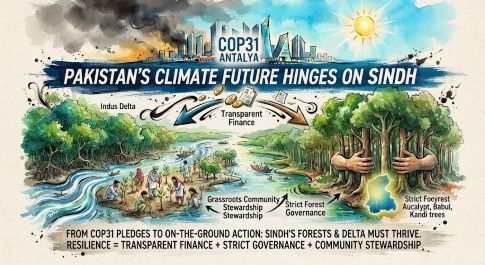
As global leaders conclude COP31 in Antalya, Pakistan faces an urgent mandate to turn international climate pledges into on-the-ground protection for Sindh’s threatened forests and the Indus Delta.
Achieving true climate resilience requires transparent finance, strict forest governance, and grassroots community stewardship.
By Zain Daudpoto
The 31st Conference of the Parties to the United Nations Framework Convention on Climate Change (COP31), held in Antalya, Türkiye, from 9 to 20 November 2026, took place at a critical moment in human history. Climate change is no longer a distant environmental threat; it has become a direct challenge to human survival, economic stability, food security, water resources, and the ecological balance of our planet.
Rising global temperatures, melting glaciers, devastating floods, prolonged droughts, forest degradation, biodiversity loss, and rising sea levels are affecting millions of people, particularly in developing countries.
Although the Paris Agreement established the objective of limiting global warming to 1.5°C above pre-industrial levels, the world’s collective efforts remain insufficient. COP31 was therefore expected to focus not merely on making promises, but on implementing practical climate actions.
The negotiations in Antalya addressed fossil fuel dependence, climate finance, adaptation, loss and damage, renewable energy, forest conservation, and the responsibilities of developed and developing countries. However, disagreements remain over the pace of the energy transition and the financial obligations of developed nations.
Climate Justice and the Responsibility of Developed Countries
One of the fundamental principles of international climate negotiations is climate justice. Developing countries have contributed relatively little to historical greenhouse gas emissions, yet they are among the most vulnerable to climate disasters.
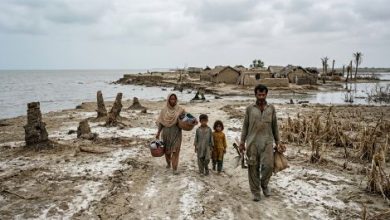
Pakistan is a clear example. The devastating floods of 2022 demonstrated how climate-related disasters can destroy communities, agriculture, infrastructure, and livelihoods. The people of Sindh—particularly those living in coastal and riverine areas—face escalating threats from floods, droughts, seawater intrusion, and environmental degradation.
Developed countries must fulfil their climate-finance responsibilities. Financial assistance should be predictable, accessible, and preferably provided through grants rather than loans that increase the debt burden of vulnerable nations.
Climate justice must mean more than international declarations. It must translate into financial resources, technology transfer, capacity building, and practical support for communities suffering from climate impacts.
Climate Finance and the Protection of Vulnerable Ecosystems
Climate finance remains a central pillar of the COP31 agenda. Developing countries require substantial resources to adapt to climate change, protect ecosystems, and rebuild after disasters.
International climate-finance discussions include the existing commitment to mobilize US$300 billion annually by 2035 for developing countries, alongside the wider ambition of scaling finance toward US$1.3 trillion annually.
Another critical issue is the proposed increase in adaptation finance. The COP31 Presidency’s draft cover decision includes a proposal for adaptation finance to reach US$120 billion annually by 2035. While this remains a proposal under negotiation rather than an adopted commitment, Pakistan must develop strong, transparent, and scientifically supported projects to access international climate funds.
Such projects should include:
Restoration of the Indus Delta and mangrove ecosystems
Rehabilitation of degraded riverine forests
Protection of biodiversity and wildlife habitats
Climate-resilient agriculture and water management
Flood and drought preparedness
Community-based natural resource management
The objective must be to ensure that international climate finance reaches vulnerable communities and produces measurable environmental improvements.
Forests Must Become Central to Climate Action
Forests are not simply collections of trees; they are living ecological systems that regulate climate, conserve biodiversity, protect soil, maintain the water cycle, and support millions of livelihoods.
Deforestation and forest degradation increase carbon emissions, destroy wildlife habitats, weaken ecosystems, and intensify the vulnerability of communities to climate disasters.
An important development associated with the COP30 Presidency is the international roadmap for halting and reversing deforestation and forest degradation by 2030. Although this is a voluntary international initiative rather than a legally binding COP31 decision, it provides a vital opportunity for countries to strengthen forest governance, improve monitoring, mobilize finance, and restore degraded landscapes.
Pakistan must translate these international objectives into national and provincial programs. Sindh’s riverine forests, mangrove forests, and other natural ecosystems should be recognized as essential climate infrastructure—their protection is just as critical as the construction of roads, dams, and other development projects.
Pakistan’s Climate Challenges: The Special Case of Sindh
Sindh is among the regions where the consequences of climate change and ecological degradation are most visible.
The Indus River is the lifeline of Sindh. Its water supports agriculture, drinking-water supplies, wetlands, forests, and the livelihoods of millions of people. However, the river system faces multiple environmental pressures, including reduced freshwater flows toward the delta, untreated municipal sewage, industrial effluents, agricultural pollution, and the degradation of natural riverine habitats.
Consequently, the Indus Delta has suffered from seawater intrusion, mangrove degradation, coastal erosion, and the displacement of local communities. Similarly, the decline of riverine forests threatens biodiversity, natural flood protection, and the ecological stability of the Indus basin.
Climate change cannot be addressed without protecting these natural systems. Pakistan must therefore treat environmental protection, forest restoration, water security, and biodiversity conservation as interconnected national priorities.
What Pakistan Must Demand and Achieve Through COP31
Pakistan should engage with the post-COP31 process not merely as a participant in international negotiations, but as a country securing practical support for its vulnerable population and threatened ecosystems. Five priorities stand out:
Restoration of the Indus Delta
Pakistan should seek international climate finance for a comprehensive Indus Delta restoration program focusing on:
Large-scale mangrove restoration using scientifically appropriate native species
Protection of existing mangrove forests
Restoration of natural tidal channels and coastal wetlands
Scientific assessment of freshwater requirements
Protection of fishing communities and coastal livelihoods
Monitoring of seawater intrusion and coastal erosion
Mangrove forests provide natural protection against storms, store significant amounts of carbon, and support fisheries and biodiversity. The Indus Delta must be treated as a national ecological asset and a core component of Pakistan’s climate commitments.
Restoration and Protection of Riverine Forests
Pakistan should develop a dedicated national program for the restoration of degraded riverine forests along the Indus, including:
Scientific mapping of existing forest cover
Identification of degraded and encroached forest areas
Restoration through indigenous species
Protection of natural regeneration
Community participation and transparent forest management
Independent monitoring through satellite imagery and GIS technology
Forest land must remain protected for ecological purposes. Illegal occupation, unauthorized conversion, and the destruction of natural forest ecosystems must be addressed through strict enforcement of the law.
Climate Adaptation and Water Security
Pakistan needs substantial investment in water conservation, flood management, drought resilience, and climate-resilient agriculture. Sindh particularly requires programs for rainwater harvesting, groundwater protection, wetland restoration, efficient irrigation, and the treatment of municipal and industrial wastewater. Water security and ecological restoration must be planned together rather than treated as separate development sectors.
Loss and Damage Support
Pakistan should continue advocating for accessible financial assistance for communities affected by climate disasters. Coastal communities facing seawater intrusion, farmers impacted by floods and droughts, and families losing their homes and livelihoods must be prioritized in climate-resilience programs. International loss and damage arrangements must support recovery, rehabilitation, and long-term resilience.
Accessible Climate Finance and Technology
Pakistan should demand transparent access to international climate funds, modern monitoring technology, scientific expertise, and institutional capacity. Climate finance must reach provincial governments, local institutions, and community-based organizations implementing genuine environmental projects. Grants, technical assistance, and knowledge sharing should be prioritized so that climate action does not become another source of financial pressure on developing countries.
A New Role for Forest Protection Organizations and Civil Society
International climate commitments will remain ineffective unless they are translated into practical action at the local level. This is where environmental organizations, civil society, researchers, local communities, and forest protection movements carry a significant responsibility.
In Sindh, organizations such as the Bela Bachayo Committee (Forest Protection Committee) can play a vital role in connecting international climate objectives with local environmental realities by developing a structured program around six priorities:
Independent GIS-Based Forest Monitoring
A scientific monitoring system should be established to document forest cover, deforestation, degradation, and illegal occupation of forest land. Satellite imagery, GIS mapping, and field verification can identify changes in forest areas and provide evidence for environmental advocacy and legal proceedings. Forest degradation must be recognised as a serious environmental offence, even where trees have not been completely removed.
Documentation and Legal Protection of Forest Land
Historical land records, forest notifications, government maps, land-use records, and judicial decisions should be systematically documented. Civil society organizations should monitor illegal conversions, unauthorized allotments, and encroachments on protected forest land, submitting credible evidence before competent courts and relevant government authorities. The objective must be the restoration of forest land to its ecological purpose, not merely the resolution of individual land disputes.
Restoration of Indigenous Forest Species
Tree-plantation campaigns should not be limited to numerical targets; restoration must be based on ecological suitability, local biodiversity, soil conditions, and water availability. For riverine forests, indigenous species such as Acacia nilotica (Babul), Prosopis cineraria (Kandi), and other naturally occurring local flora should be selected according to site conditions. For coastal areas, mangrove restoration must use suitable native species and follow natural tidal and hydrological conditions, while protecting natural regeneration wherever possible.
Community Participation and Public Awareness
Local communities should become active partners in forest protection rather than passive beneficiaries of government projects. Village-level forest protection committees, community monitoring, environmental education, and local employment in restoration programs can strengthen long-term conservation. Farmers, fishermen, women, and young people must have meaningful participation in decisions affecting their natural resources.
International Climate Finance and Partnerships
The Bela Bachayo Committee and other environmental organizations should develop technically sound project proposals for international climate-finance programs and environmental grants. Potential areas of cooperation include:
UN climate adaptation programs
Global Environment Facility (GEF) funding opportunities
Green Climate Fund (GCF) programs through eligible accredited entities
UNCCD land restoration initiatives
Mangrove and blue-carbon projects
Biodiversity conservation and community-based restoration
Organizations should establish transparent financial systems, measurable targets, scientific baselines, and independent monitoring to build credibility with international partners.
A Five-Year Sindh Forest Restoration Strategy
A coordinated five-year program—developed in consultation with environmental experts, universities, local communities, and government institutions—should focus on:
GIS-based assessment of forest degradation
Restoration of degraded riverine and coastal forests
Prevention of illegal forest-land conversion
Community-based protection systems
Scientific biodiversity assessment
Independent annual reporting on forest conditions
Conclusion: From International Promises to Ecological Action
COP31 must be judged not by the number of speeches and declarations delivered in Antalya, but by the practical actions that follow.
For Pakistan, climate action is inseparable from water security, forest protection, biodiversity conservation, and the restoration of the Indus Delta. Sindh’s environmental future depends upon protecting the Indus River, restoring riverine forests, conserving mangroves, and halting the degradation of natural ecosystems.
International climate finance offers vital opportunities, yet financial resources alone cannot solve the crisis. Strong environmental governance, transparent institutions, scientific monitoring, and public participation are equally essential.
The protection of forests must become a national responsibility rather than a limited departmental activity. Environmental organizations, particularly the Bela Bachayo Committee, have an opportunity to transform public awareness into organized conservation, scientific documentation, legal advocacy, and practical restoration.
The time has come to move beyond tree-plantation slogans and adopt a comprehensive approach to ecological protection. Saving the forests of Sindh is not merely an environmental duty; it is an investment in water security, climate resilience, biodiversity, human survival, and the future of coming generations.
Read: Sorrows of CRP Graduates
____________
Zain Daudpoto is based in Hyderabad Sindh