When Nature Strikes: What Nepal’s Devastating Floods Teach South Asia About Disaster Preparedness
By Abdullah Usman Morai | Sweden
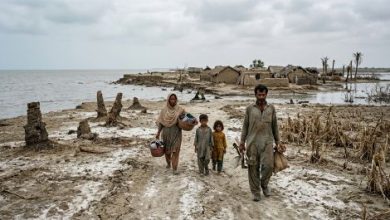
Natural disasters do not ask whether a country is rich or poor. Mountains collapse, rivers overflow, cyclones arrive, earthquakes shake the ground, and droughts silently destroy livelihoods. Yet the consequences of the same natural hazard can be dramatically different from one country to another.
A powerful earthquake may cause limited damage in a country with strict building codes, strong emergency services, and well-prepared communities, while a similar earthquake can become a national catastrophe where buildings are poorly constructed and emergency institutions are weak.
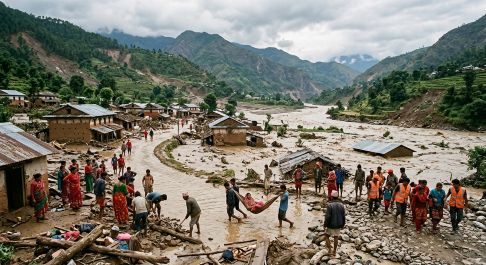
This distinction is important when looking at the devastating floods that struck Nepal in August 2026. The disaster, associated with a massive collapse of rock and glacial material in the Himalayas, generated a destructive surge of water and debris. By September 7, reports indicated that more than 1,300 people had died and thousands remained missing in Nepal and Tibet, while rescue operations were continuing. Hundreds of hydropower workers were among those missing, with many believed to be trapped in tunnels.
Nepal’s tragedy is therefore not simply a story about one country’s floods. It is a warning for the entire Himalayan and South Asian region.
For countries such as Pakistan, India, Bangladesh, Nepal, and other developing nations, the question should not be only “How much damage did the disaster cause?” The more important question is:
“What can we learn before the next disaster arrives?”
What Is a Natural Disaster?
A natural hazard and a natural disaster are not exactly the same thing.
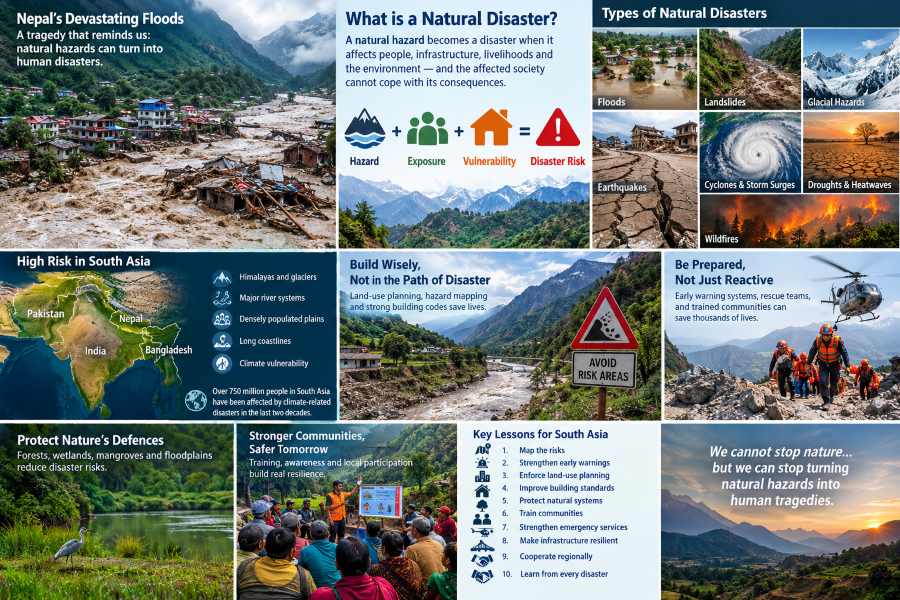
A natural hazard is a potentially dangerous natural event such as an earthquake, flood, cyclone, or landslide. It becomes a disaster when it seriously affects people, infrastructure, livelihoods, economies, or the environment, and the affected society cannot cope with the consequences using its own resources.
In simple terms: Hazard + Exposure + Vulnerability = Disaster Risk
The danger comes not only from nature itself but also from where and how human beings live.
For example, heavy rainfall in an uninhabited forest may be a natural event. The same rainfall falling over a densely populated city with inadequate drainage, settlements on floodplains, and weak infrastructure can become a disaster.
This is why disaster management is not simply about fighting nature. It is about reducing human vulnerability to natural hazards.
 The Many Faces of Natural Disasters
Natural disasters come in many forms, and they often interact with one another.
- Floods
Floods are among the most frequent disasters in South Asia. They can result from prolonged rainfall, overflowing rivers, sudden cloudbursts, glacial lake outbursts, dam failures, or rapid snow and ice melt.
Floods can destroy homes, crops, roads, bridges, schools and water-supply systems. They can also contaminate drinking water and create conditions for disease outbreaks.
Pakistan’s catastrophic 2022 floods demonstrated the scale of the problem. Millions of people were affected, and the World Bank estimates damages and economic losses in the billions.
- Flash Floods
Flash floods are particularly dangerous because they can develop extremely quickly.
Mountainous regions such as Nepal, northern India and northern Pakistan are especially vulnerable. A sudden cloudburst, landslide, glacial event, or intense rainfall can transform a relatively small mountain stream into a destructive wall of water and debris.
The recent Nepal disaster demonstrated how rapidly water, rocks, mud, and ice can move through narrow mountain valleys.
- Glacial and Mountain Hazards
The Himalayas contain enormous quantities of snow and ice. As temperatures rise, glaciers retreat, and mountain environments become increasingly unstable.
One danger is a Glacial Lake Outburst Flood (GLOF), which occurs when water stored behind a natural glacial dam is suddenly released.
But glacial hazards are not limited to GLOFs. Rockfalls, landslides, avalanches, ice collapses, and debris flows can also generate devastating floods.
The World Meteorological Organization (WMO) reports that Asia is warming at nearly twice the global average and that accelerated glacier melting is becoming an important climate concern.
- Earthquakes
Nepal, India and Pakistan lie close to one of the world’s most active tectonic zones. Earthquakes can kill thousands within minutes, particularly where buildings are not designed to withstand seismic forces.
Earthquakes can also trigger secondary disasters, landslides, avalanches, dam failures, and river blockages.
- Landslides
Landslides are common in mountainous areas and can be triggered by rainfall, earthquakes, road construction, deforestation, glacier activity, or unstable slopes.
They become especially dangerous when roads and settlements are constructed without adequate geological assessment.
- Cyclones and Storm Surges
Bangladesh, India, and Pakistan’s coastal areas face risks from tropical cyclones and storm surges.
Bangladesh, in particular, has invested heavily in disaster preparedness, early-warning systems, and community-level response. Its experience demonstrates that even a highly vulnerable country can significantly reduce disaster mortality through sustained investment in preparedness.
- Droughts and Heatwaves
Not every disaster arrives with water.
Droughts can gradually destroy agricultural production, reduce groundwater recharge, increase food insecurity, and force migration. Heatwaves can kill silently, particularly among elderly people, outdoor workers, and vulnerable communities.
South Asia increasingly faces the paradox of too much water at one time and too little water at another.
- Wildfires
Changing temperatures, prolonged drought, and dry vegetation can increase wildfire risks. Mountain and forest ecosystems in countries such as India, Nepal, and Pakistan can be particularly vulnerable.
Why South Asia Is So Vulnerable
South Asia is a region of extraordinary geographical diversity.
It contains the Himalayas, enormous river systems, densely populated plains, extensive agricultural areas, long coastlines, major megacities, and some of the world’s most climate-vulnerable communities.
The same geography that provides water, fertile soil and energy also creates enormous risks.
The Himalayas feed some of Asia’s largest rivers. These rivers support hundreds of millions of people across countries including Pakistan, India, Nepal and Bangladesh.
But when rainfall becomes extreme, glaciers destabilize, rivers rise rapidly, or drainage systems fail, the same river systems can become instruments of destruction.
The World Bank estimates that more than 750 million people in South Asia have been affected by one or more climate-related disasters over the past two decades. It also warns that nearly a quarter of the region’s population could face severe flooding risks by 2030.
This means disaster preparedness cannot be treated as a secondary development issue. It must become part of development itself.
Lessons to Learn
Early Warning Systems Save Lives
Perhaps the most important lesson from disasters around the world is simple:
A few hours of warning can save thousands of lives. Modern disaster management should combine: weather forecasting, river-level monitoring, satellite imagery, seismic monitoring, glacier and glacial-lake observation, rainfall gauges, automated alarms, mobile-phone alerts, radio communication, evacuation routes, and trained local volunteers.
However, an early-warning system is useful only if the warning reaches the people who need it.
A sophisticated warning sitting inside a government office is not enough.
The fisherman, farmer, mountain villager, factory worker, and schoolchild must receive the message in time and in a language they understand.
The WMO emphasizes that early warnings and early action save lives, while the World Bank has repeatedly highlighted the importance of better hydrometeorological services across South Asia.
Do Not Build in the Path of Disaster
One of the greatest mistakes developing countries make is treating land as if every piece of it is equally safe. It is not.
Floodplains are not ordinary land. Mountain slopes are not ordinary land. Riverbanks are not ordinary land. Coastal lowlands are not ordinary land. Glacial valleys are not ordinary land.
Before constructing a road, bridge, village, hotel, industrial project, or hydropower plant, governments should ask: What natural hazards exist here?
Nepal’s disaster also raises important questions about critical infrastructure in remote mountainous terrain. Reports indicate that numerous hydropower projects were affected and hundreds of workers were missing from tunnels, where rescue operations were complicated by blocked roads, debris, and difficult terrain.
Development should therefore begin with hazard mapping, not construction.
Infrastructure Must Be Designed for the Future
A bridge designed according to yesterday’s rainfall may not be adequate for tomorrow’s extreme rainfall.
A drainage system designed for historical storms may fail under unprecedented precipitation.
A road cut into an unstable mountain slope may become a death trap after an intense rainstorm.
Developing countries need to move from minimum-cost infrastructure toward risk-informed infrastructure.
This does not necessarily mean that every bridge must be enormously expensive.
It means that engineers and planners must consider the full range of hazards and the cost of failure.
Spending more on a resilient bridge today may save many times that amount in reconstruction tomorrow.
The World Bank’s work in South Asia increasingly emphasizes resilient infrastructure and development that can withstand climate and disaster shocks.
Rescue Capacity Is as Important as Construction Capacity
Nepal’s recent tragedy offers another painful lesson.
A country may have engineers capable of building tunnels, dams, roads, and hydropower plants. But disaster response requires a different set of capabilities.
Where are the specialized rescue teams? Where are the tunnel-rescue experts? Where are the drones and thermal cameras? Where are the helicopters? Where are the emergency bridges? Where are the mobile hospitals? Where are the water-purification units? Where are the emergency communication systems?
And, most importantly, have these people and systems practiced together before disaster strikes?
Reports from Nepal indicate that rescue operations were severely hampered by difficult terrain, damaged infrastructure, blocked tunnels and shortages of specialized equipment. This should be a warning for every developing country.
Disaster preparedness cannot begin after the disaster.
South Asian Countries Must Cooperate
Floods, rivers, cyclones, glaciers and weather systems do not respect political borders.
A river can begin in one country, pass through another and eventually reach the sea in a third.
A cyclone can cross several countries.
A glacier can destabilize a mountain valley whose river flows across an international border.
Climate and disaster management therefore require regional cooperation.
Nepal, India, Pakistan and Bangladesh have different political systems and national priorities, but they share interconnected geographical risks.
South Asia needs stronger cooperation in river-basin management, flood forecasting, glacier monitoring, weather data sharing, earthquake preparedness, cyclone warnings, emergency communication, search and rescue, disaster-response training, and humanitarian assistance.
The World Bank has repeatedly emphasized that floods, droughts, cyclones, and other climate risks cross national borders and require regional approaches.
Pakistan: A Particularly Important Warning
Pakistan should pay close attention to what is happening in Nepal. The country faces multiple interconnected hazards.
The northern areas contain some of the world’s highest mountains and glaciers. Khyber Pakhtunkhwa, Gilgit-Baltistan, and parts of Punjab are exposed to floods, landslides, glacial hazards, and earthquakes.
Meanwhile, Sindh and other low-lying regions face major river and urban flooding risks.
Pakistan’s experience in 2022 should already have demonstrated that disaster risk is not theoretical.
The floods affected millions of people and caused billions in damage and losses, according to the World Bank.
But the deeper lesson is that a flood disaster begins long before the rain falls.
It begins with unplanned settlements. It begins with inadequate drainage. It begins with deforestation and environmental degradation. It begins when floodplains are occupied. It begins when warnings are ignored. It begins when infrastructure is designed without considering future climate conditions. And it begins when disaster management receives attention only after tragedy has occurred.
India and Bangladesh Face Their Own Challenges
India’s enormous population and geographical diversity expose it to almost every major category of natural hazard.
The Himalayan states face earthquakes, landslides, flash floods and glacial hazards, while central and southern regions experience droughts, heatwaves, floods and cyclones.
India’s challenge is therefore not simply to build more infrastructure, but to make its enormous infrastructure network climate- and disaster-resilient.
Bangladesh presents a different but equally important example.
Much of the country is low-lying and exposed to river flooding, cyclones and storm surges. Yet Bangladesh has developed considerable experience in community preparedness, cyclone shelters, warning systems and disaster management.
Its experience demonstrates an important principle: Vulnerability is not destiny.
A country can be geographically vulnerable and still become more resilient through investment, planning and community participation.
The Poor Pay the Highest Price
Natural disasters are rarely socially neutral.
The wealthy may lose property, but the poor often lose everything.
A wealthy family may move temporarily to a hotel or another city. A poor family living beside a river may lose its home, livestock, crops, documents, tools, and source of income in a single night.
This is why disaster management must also be considered a poverty-reduction strategy.
The World Bank notes that disasters can reverse years of development progress and push vulnerable people back into poverty.
A country cannot claim sustainable development if a single flood can destroy decades of progress.
From Disaster Management to Disaster Risk Reduction
Perhaps the biggest conceptual change developing countries need is to stop thinking primarily about disaster response.
Traditional thinking asks: “What will we do when disaster happens?”
Modern thinking asks: “What can we do today so that the disaster causes less damage tomorrow?”
That means moving from Relief → Prevention, Reaction → Preparedness, Reconstruction → Resilient Reconstruction, Damage assessment → Risk assessment, and Centralized response → Community-based resilience
The UN’s disaster-risk framework increasingly emphasizes understanding and reducing risk before disasters occur.
Climate Change Is Changing the Risk Equation
It would be wrong to attribute every flood or landslide entirely to climate change. Natural hazards have always existed.
But climate change can alter the intensity, frequency, or conditions associated with many hazards.
Asia is already warming rapidly. The WMO says the continent is warming at nearly twice the global average, while glacier melting is accelerating.
For South Asia, this means governments must prepare for a future in which historical experience may no longer be a sufficient guide.
The question should no longer be: “Has a flood of this magnitude happened here before?”
Instead, planners should ask: “What is physically possible under future climatic conditions, and are our communities prepared for it?”
That is a fundamentally different approach.
What Should Developing Countries Do Now?
The lessons from Nepal, Pakistan, India and Bangladesh point toward a practical agenda.
Map the risks.
Every village, city and infrastructure project should be assessed for flood, earthquake, landslide, cyclone, drought, wildfire and other relevant hazards.
Strengthen early-warning systems.
Warnings must reach ordinary people quickly through mobile phones, radio, television, sirens and community networks.
Enforce land-use planning.
Do not permit uncontrolled construction on floodplains, unstable slopes or other high-risk areas.
Improve building standards.
Buildings should be designed according to local earthquake, flood, wind, and climate risks, and building codes must actually be enforced.
Protect natural systems.
Wetlands, forests, mangroves, floodplains, and watersheds are not obstacles to development. They are part of a country’s natural defence system.
Train communities.
A trained local community can respond during the crucial first hours before outside assistance arrives.
Strengthen emergency services.
Search-and-rescue teams, helicopters, drones, emergency medical services and specialised equipment should be available before disasters occur.
Make infrastructure resilient.
Roads, bridges, dams, tunnels, hospitals, schools and power plants must be designed for future risks.
Cooperate regionally.
South Asian countries need to share data, technology, forecasts and emergency resources.
Finally, learn from every disaster.
After every major event, governments should conduct an independent assessment, not merely to calculate financial losses but to determine why the damage occurred and how it can be prevented next time.
Nepal’s Tragedy Should Become South Asia’s Warning
The devastation in Nepal is a human tragedy first. Behind every number is a family waiting for someone who may never return, a destroyed home, a lost livelihood, and a community trying to understand how life changed within minutes.
But disasters also create an obligation to learn. The tragedy should not end with rescue operations, compensation, and reconstruction. It should lead to questions.
Were people warned? Were they living in safe locations? Were infrastructure projects designed for the hazards of the region? Did emergency agencies have the equipment and training they needed? Could technology have provided earlier information? Were local communities prepared?
And most importantly:
What should be changed before the next disaster?
South Asia cannot prevent every earthquake, flood, cyclone, landslide or glacial collapse.
But it can reduce the number of people killed. It can reduce the destruction of homes. It can protect roads, bridges, hospitals and schools. It can strengthen communities. It can improve forecasting. It can move people away from the most dangerous locations. And it can ensure that development does not create new disaster risks.
The World Bank estimates that disaster-related losses in South Asia could be billions annually by 2030 under current trends.
That is not merely an economic warning. It is a warning about the future of nearly two billion people.
The lesson from Nepal is therefore much bigger than Nepal itself.
Nature will continue to produce hazards. The real question is whether human beings will continue to turn those hazards into catastrophes.
For developing countries, the most valuable investment may not be another emergency relief program after disaster strikes.
It may be the warning system installed before the flood. The bridge strengthened before the storm. The building code enforced before the earthquake. The community trained before the evacuation. The forest was protected before the landslide.
And the decision-maker is willing to say:
“We cannot stop nature, but we can stop turning natural hazards into human tragedies.”
Read: Sindh under the War of Nerves
_____________________
 Abdullah Soomro, penname Abdullah Usman Morai, hailing from Moro town of Sindh, province of Pakistan, is based in Stockholm Sweden. Currently he is working as Groundwater Engineer in Stockholm Sweden. He did BE (Agriculture) from Sindh Agriculture University Tando Jam and MSc water systems technology from KTH Stockholm Sweden as well as MSc Management from Stockholm University. Beside this he also did masters in journalism and economics from Shah Abdul Latif University Khairpur Mirs, Sindh. He is author of a travelogue book named ‘Musafatoon’. His second book is in process. He writes articles from time to time. A frequent traveler, he also does podcast on YouTube with channel name: VASJE Podcast.