The War of Nerves is a battle designed not necessarily to defeat people physically, but to exhaust their confidence, create anxiety, divide opinion, and make them believe that resistance is pointless.
By Abdullah Usman Morai | Sweden
There are moments in the history of a people when the greatest battle is not fought with guns, armies, or weapons. It is fought in the mind.
A rumour is circulated. A frightening possibility is repeatedly discussed. An uncertain future is presented as though it were already inevitable. Every conversation begins to revolve around the same threat. People start asking one another: What will happen to us? What will happen to our land? What will happen to our future?
No physical border may have moved, no soldier may have crossed a frontier, and no shot may have been fired. Yet something has already happened: people have been placed under psychological pressure.
This is what is commonly described as a “War of Nerves”: a battle designed not necessarily to defeat people physically, but to exhaust their confidence, create anxiety, divide opinion, and make them believe that resistance is pointless.
In the present debate surrounding reports and speculation about dividing Sindh into different provinces, many Sindhis perceive something more than an ordinary political discussion. For them, Sindh is not merely an administrative unit drawn on a map. It is a homeland with centuries of history, culture, language, memories, and emotional attachment.
That is why any discussion concerning the territorial or political division of Sindh can generate an exceptionally strong emotional response.
For many Sindhis, the principle is simple: a mother is not divided.
Whether one agrees or disagrees with this political position, it is important to understand the depth of the sentiment behind it.
What is War of Nerves?
“War of Nerves” is not a precise legal or military term. It is better understood as a description of a psychological struggle in which fear, uncertainty, pressure, and anticipation become instruments of influence.
Modern conflict has increasingly demonstrated that controlling perceptions can sometimes be almost as important as controlling territory.
Psychological warfare, information operations and strategic communication can involve attempts to influence how people think, what they fear, whom they trust and how they respond to events. The International Committee of the Red Cross has noted that information and psychological operations can spread confusion, fear and terror, while modern communication technologies have enormously increased their speed and reach.
A nervous war therefore does not necessarily announce itself.
It can appear through repeated threats or alarming predictions, deliberately creating uncertainty about the future, continuously circulating provocative statements, exploiting existing social divisions, presenting one political outcome as unavoidable, overwhelming people with contradictory information, creating fear that resistance will bring consequences, and encouraging people to believe that their concerns are already lost causes.
The objective is often psychological exhaustion.
If people become sufficiently anxious, they may stop asking “Is this right?” and begin asking only, “How can we survive it?”
That change in thinking can itself become a strategic objective.
The battlefield inside the mind
A conventional war attacks physical targets. A psychological battle attacks confidence.
The first damages buildings, infrastructure, or military capabilities. The second attempts to damage morale, trust and collective confidence.
This is why the battle of nerves can be so powerful.
An individual experiencing prolonged uncertainty may lose sleep, become irritable, constantly anticipate danger, and struggle to concentrate. The human mind does not respond well to indefinite uncertainty. When people do not know whether a threat is real, imminent, or merely speculative, they may repeatedly imagine the worst.
Now multiply that anxiety across thousands or millions of people.
The result can become collective anxiety.
A society constantly exposed to political uncertainty may experience declining trust, polarization, and emotional fatigue. People living far from their homeland can experience the same anxiety because modern communication has eliminated geographical distance. A person in Karachi, Hyderabad, or Sukkur can receive the same alarming message at the same moment as someone living in Stockholm, London, Dubai, Toronto, or elsewhere.
The physical distance may be thousands of kilometers. The psychological distance is zero.
From individual stress to national stress
Stress is not exclusively an individual phenomenon.
Nations and communities can also experience prolonged uncertainty, insecurity and collective fear.
A person may worry about losing a home. A community may worry about losing its cultural identity. A nation may worry about the future of its territory, resources, institutions or political voice.
These are different scales of the same psychological phenomenon.
That is why responsible governments and political leaders have a particular obligation to avoid unnecessarily frightening their populations.
This does not mean that every uncomfortable political discussion should be prohibited. Democracies must allow disagreement, criticism and competing constitutional proposals.
But there is a profound difference between debating an idea and deliberately intimidating a population with an idea.
International humanitarian law, particularly in situations of armed conflict, recognizes the seriousness of psychological harm and coercion. The ICRC notes that threats whose primary purpose is to spread terror among civilians are prohibited in armed conflict, while the Fourth Geneva Convention expressly prohibits physical or moral coercion against protected persons.
These rules do not mean that every political controversy or disturbing statement is automatically a crime. The legal context matters enormously. But they demonstrate an important modern principle: mental and psychological well-being is not something that responsible institutions are free to disregard.
Is the fear itself the weapon?
This is where the idea of a nervous war becomes particularly interesting.
Suppose people repeatedly hear that their homeland might be divided.
The first announcement may shock them. The second may frighten them. The tenth may exhaust them. The hundredth may make the possibility feel normal.
This process is psychologically important. Repetition can transform an extraordinary possibility into something that appears inevitable.
That is why societies should carefully examine not only what is being said, but also how, how often, by whom and for what apparent purpose.
If a proposal is legitimate, it should withstand rational discussion, evidence and constitutional scrutiny. It should not require psychological intimidation.
And if a proposal is unpopular, its proponents should expect democratic disagreement rather than assuming that repeated pressure will automatically produce acceptance.
The danger of pushing people against a wall
There is an old observation about human behavior:
The harder you push someone against a wall, the more difficult it becomes to expect them to remain passive.
Political history contains countless examples of populations becoming more determined when they believe that their fundamental identity, dignity or homeland is under threat.
This does not mean that every response should be confrontational. Quite the opposite.
The strongest response to psychological pressure is often calmness, organization, knowledge and patience.
Fear feeds confusion. Clarity weakens fear.
That is why societies facing intense political pressure should avoid reacting to every rumour, provocation or social-media post. They should verify information, distinguish fact from speculation and insist upon peaceful constitutional debate.
A nervous war thrives on emotional reaction. A resilient society does not surrender its judgment to emotion.
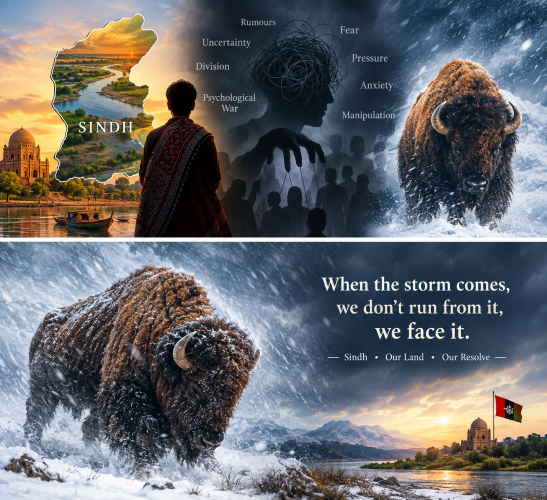
Sindh and the question of homeland
For many Sindhis, Sindh is more than geography.
It is the landscape of their ancestors, the language of their childhood, the stories of their elders, the poetry of Shah Abdul Latif Bhittai, the Indus River, the villages, cities, deserts, agricultural lands, and historical memories that together create a sense of belonging.
Consequently, when people perceive a threat to the territorial integrity of their homeland, the reaction cannot be understood purely through administrative terminology.
A map may show boundaries. People see memories.
A government may discuss districts and provinces. People may think about generations.
That emotional dimension should never be ignored.
At the same time, genuine political questions should be addressed through constitutional, democratic, and peaceful mechanisms rather than through intimidation, misinformation, or threats.
If there is a proposal for administrative change, it should be openly debated. If people oppose it, their opposition should be heard. If others support it, they should be allowed to explain their reasoning.
The answer to political disagreement should be dialogue, not psychological warfare.
The silent resilience of the bison
There is a remarkable lesson in nature that provides a powerful metaphor for this situation.
The American bison is built for harsh environments. It develops a thick winter coat, possesses a powerful body, and uses its massive head and shoulders to move through deep snow. The National Park Service notes that bison can turn toward approaching winter storms, lower their profile, and endure severe weather rather than simply exposing their backs to the wind.
This behaviour is not heroism in the human sense.
It is survival. The bison does not negotiate with the storm. It does not panic. It does not pretend that the storm does not exist. It faces the conditions and endures them.
That makes the bison a compelling metaphor for resilience.
Its power is not merely speed. It is endurance. Its strength is not the absence of storms. Its strength is the ability to remain standing while the storm passes.
The bison mentality
There is a lesson here for any society confronting prolonged uncertainty.
When a storm approaches, there are two possible instincts: run blindly or prepare intelligently.
Running does not always solve the problem.
Sometimes the better strategy is to lower your head, strengthen your footing, and wait for the worst conditions to pass.
For many Sindhis, this metaphor resonates deeply.
When they perceive a storm threatening their homeland, identity, or resources, they do not necessarily see migration, silence, or surrender as the only possible answers. Their instinct may instead be to remain connected to their land and defend their interests through peaceful, democratic, and lawful means.
That is the bison mentality:
Do not create the storm, but do not be frightened by the storm.
Do not attack the storm, but do not run blindly from it.
Stand firm, remain rational, and allow the storm to exhaust itself.
The danger of manufacturing fear
If the current discussion surrounding the possible division of Sindh is being used deliberately to create anxiety, then the most important question is not simply what is being proposed.
The deeper question is: Why is society being repeatedly exposed to this uncertainty?
Is it a genuine constitutional proposal? Is it an electoral strategy? Is it political messaging? Is it an attempt to test public reaction? Or is it something else?
These questions deserve evidence rather than speculation.
Accusing particular individuals or institutions of conducting a deliberate “nervous war” without evidence would itself risk becoming part of the problem. The responsible approach is to demand transparency, identify verifiable facts, and scrutinize public statements.
Those holding public office should be especially careful. Government representatives carry a greater responsibility because their words can affect millions of people.
If an official advocates a major constitutional or territorial change, citizens have every right to ask for clarity, justification, and the legal basis for the proposal.
But accountability should operate through lawful democratic institutions, not through collective punishment or threats.
Resistance does not have to mean confrontation
There is another important distinction.
Resistance does not necessarily mean violence.
A population can resist politically through voting, peaceful assemblies, journalism, literature, constitutional petitions, public debate, democratic participation, and civic organization.
Indeed, peaceful resistance can sometimes be more powerful precisely because it denies psychological warfare its desired outcome.
A nervous war wants panic. A resilient society produces patience.
A nervous war wants division. A resilient society seeks solidarity.
A nervous war wants people to believe that the future has already been decided.
A resilient society says: The future is still a matter for the people, the constitution, and democratic debate.
When the storm passes
Every storm eventually changes. Some disappear quickly. Others continue for days.
The strongest trees are not necessarily those that never bend. They are those whose roots remain deep enough to survive the wind.
The same can be said of societies.
If people are repeatedly exposed to threats, rumors and uncertainty, they may initially feel frightened. But prolonged pressure can also produce something unexpected: greater political awareness, stronger social solidarity and deeper attachment to what they believe is important.
This is the paradox of nervous war.
The attempt to frighten people can sometimes make them more psychologically prepared. The attempt to divide them can sometimes remind them of what they share. The attempt to weaken their confidence can sometimes strengthen their determination.
And the harder a society believes it is pushed toward a wall, the more important it becomes for that society to remain calm, lawful, and united.
Perhaps that is the real lesson of the bison. The bison does not defeat the winter storm. It simply refuses to be defeated by it. It faces the wind. It lowers its head. It uses its strength economically. It waits. And eventually, the storm moves on.
For those who see Sindh as an indivisible homeland, that image carries a powerful message: storms may come, political winds may change, and uncertainty may increase, but resilience does not require panic.
The answer to pressure is not necessarily aggression.
Sometimes the most powerful response is simply to stand firm with knowledge, dignity, patience, and democratic resolve, and allow the storm to pass.
Read: Be a Chief Minister, not a Mayor
_________________
 Abdullah Soomro, penname Abdullah Usman Morai, hailing from Moro town of Sindh, province of Pakistan, is based in Stockholm Sweden. Currently he is working as Groundwater Engineer in Stockholm Sweden. He did BE (Agriculture) from Sindh Agriculture University Tando Jam and MSc water systems technology from KTH Stockholm Sweden as well as MSc Management from Stockholm University. Beside this he also did masters in journalism and economics from Shah Abdul Latif University Khairpur Mirs, Sindh. He is author of a travelogue book named ‘Musafatoon’. His second book is in process. He writes articles from time to time. A frequent traveler, he also does podcast on YouTube with channel name: VASJE Podcast.