Henningsvær: The Village Finding Space for Life Between Mountains, Sea and Football
By Abdullah Usman Morai | Sweden
During our stay in the Lofoten Islands in July 2026, my friend Dr. Imran Jamali and I decided to spend a day exploring one of the most talked-about small settlements in the archipelago: Henningsvær.
We had already travelled through some of Lofoten’s spectacular landscapes, where mountains rise almost directly from the sea, and fishing villages appear to cling to the narrowest strips of land. Yet Henningsvær promised something different. It was not merely another picturesque village on our route. It was a place where fishing traditions, dramatic Arctic geography, tourism, art and even football had somehow found room to coexist.
Our destination was only a short drive from where we were staying in Kabelvåg, but the journey itself became part of the experience.
 The Road to Henningsvær
From the E10, Lofoten’s principal road, we turned onto Road 816, which leads towards Henningsvær.
The character of the journey changed almost immediately.
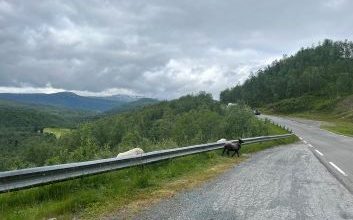
The road became narrower, quieter and more intimate. Instead of feeling as though we were simply travelling from one destination to another, we seemed to be entering a landscape that demanded our attention. Water appeared between the mountains, rocky slopes rose around us, and small islands and skerries created an ever-changing panorama.
It is difficult to explain the scenery in ordinary words. In Lofoten, the problem is not finding something beautiful to look at; the problem is deciding where to look first.
 Every bend seemed to offer another composition. The mountains had different shapes and colours depending on the direction from which we approached them, while the sea reflected the changing Arctic light. Even in summer, the landscape retained that unmistakable northern character: rugged, open and almost untouched.
There were several places along the road where we could stop, get out of the car and simply admire the surroundings. Naturally, we stopped more than once.
Photography becomes almost unavoidable in Lofoten. You may begin a journey telling yourself that you will not stop too often, but after the next bend appears another view that makes you change your mind.
The road itself also required some patience.
It was narrow in several places, but the road planners had thoughtfully provided small widened areas where vehicles could pull aside. Whenever an oncoming vehicle appeared, one could move into one of these spaces and allow it to pass.
This may sound like a small practical detail, but it reflected something we had repeatedly noticed in Scandinavia: infrastructure does not always need to be large or extravagant to work well. Sometimes a simple solution, carefully adapted to the landscape, is enough.
And perhaps that is exactly what Lofoten teaches its visitors. You do not conquer this landscape. You adapt to it.
 Henningsvær: A Village Scattered Across the Sea
Eventually, the mountains opened up, and Henningsvær appeared before us.
Henningsvær is one of Lofoten’s best-known fishing villages, located on several small islands off the southern coast of Austvågøya. Bridges connect the settlement with the main island, creating the impression that the village has been carefully placed among the sea and rocks.
Historically, Henningsvær developed as an important fishing community. Its location gave fishermen access to the rich waters around Lofoten, particularly during the seasonal cod fisheries that have shaped the economy and culture of the islands for centuries.
Today, fishing remains part of its identity, but tourism has transformed Henningsvær into one of Lofoten’s most popular destinations.
Its old wooden buildings, waterfronts, fishing boats, cafés, galleries and narrow streets attract visitors from all over the world.
Yet despite the tourists, it did not feel like a manufactured tourist resort.
There was still something authentic about it.
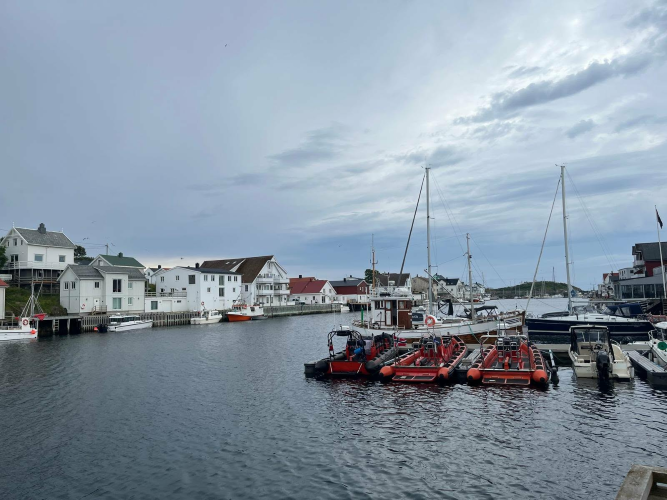
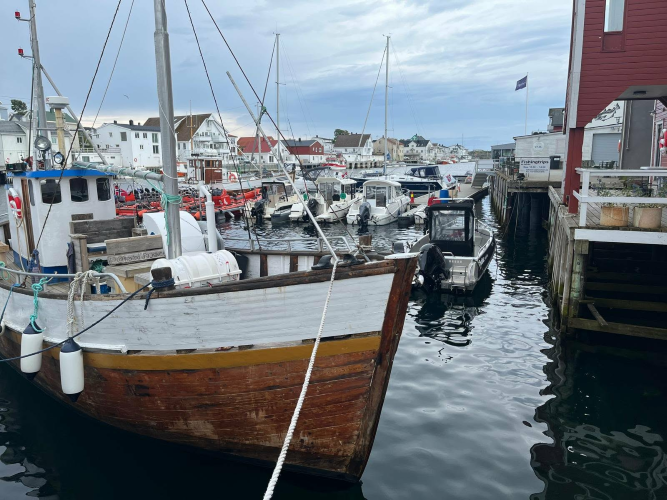
 Fishing boats and small yachts rested beside traditional wooden buildings. The water was never far away. Red, yellow and other colourful buildings stood against a backdrop of grey and green mountains. Everywhere, the relationship between the village and the sea was obvious.
Henningsvær seemed less like a town built beside the water and more like a town that had grown out of it.
The Search for Parking
Of course, every beautiful tourist destination comes with one modern challenge: parking.
Finding a parking space in Henningsvær was not particularly easy. The village is compact, and during July, the height of the tourist season, many visitors arrive by car.
 We drove around for a while before eventually managing to find a place to park, conveniently near the famous Henningsvær football stadium.
That turned out to be an excellent starting point for our exploration.
Before walking into the heart of the village, we already had one of Henningsvær’s most famous sights practically beside us.
But we decided to explore the town first.
 A Waterfront Full of Life
As we walked towards the centre, we immediately noticed how many tourists had gathered there.
People were walking along the waterfront, taking photographs, browsing shops, sitting outside cafés and simply enjoying the atmosphere. Some had arrived by car, others by boat, while several small yachts were anchored or parked near the wooden waterfront buildings.
The boats added another dimension to the scenery.
They were not merely transport. They belonged to the character of Henningsvær.
For centuries, boats have been essential to life in this part of Norway. Looking at the vessels beside the old wooden buildings, it was easy to imagine generations of fishermen returning from the sea.
Today, of course, some of those boats belong to a different era, while others serve tourism or recreation. But their presence continues to connect modern Henningsvær with its maritime past.
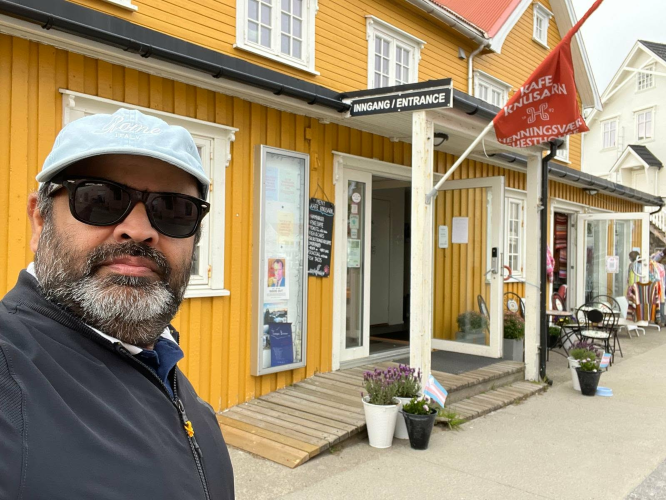
Among the buildings, one yellow wooden house particularly caught our attention.
 It was Knusarn, a café that appeared to be a popular stop for visitors. Its bright yellow exterior stood out against the more muted colours of the surrounding landscape.
The café looked almost as though it had been designed for photographs, although in a place like Henningsvær, it is difficult to tell whether something was designed to be beautiful or simply became beautiful because of where it was built.
Nearby, a souvenir shop was packed with tourists.
Inside were the kinds of objects that visitors naturally look for in places like Lofoten: small reminders of the Arctic islands, Norwegian culture and the fishing heritage of the region.
We did not spend too much time shopping. We were more interested in wandering through the streets and absorbing the atmosphere.
 Chairs Facing the Town
One small detail particularly amused me.
Near the waterfront, outside the modern art museum, there was a collection of colourful chairs arranged in the parking area.
At first, the location seemed slightly strange.
The chairs were close to the water, so naturally one might expect them to face the sea. But instead, they were positioned towards the town.
I wondered why.
Perhaps the arrangement was intentional, allowing people to sit and watch the activity of the village. Perhaps it was simply the way the chairs had been placed. Or perhaps there was some artistic explanation that we failed to understand.
Whatever the reason, they certainly attracted attention.
And then there were the benches.
 Henningsvær seemed to understand something that many busy tourist destinations forget: visitors need places to stop.
Beautiful benches were scattered throughout the village, providing opportunities to sit, rest, talk, watch the boats or eat something outdoors.
This may sound insignificant, but such details make a place more enjoyable.
Travel is not only about monuments and attractions. Sometimes the most memorable moments come when there is nowhere you need to go for ten minutes.
You simply sit. You watch. You breathe. And you allow the place to exist around you.
 The Famous Football Stadium
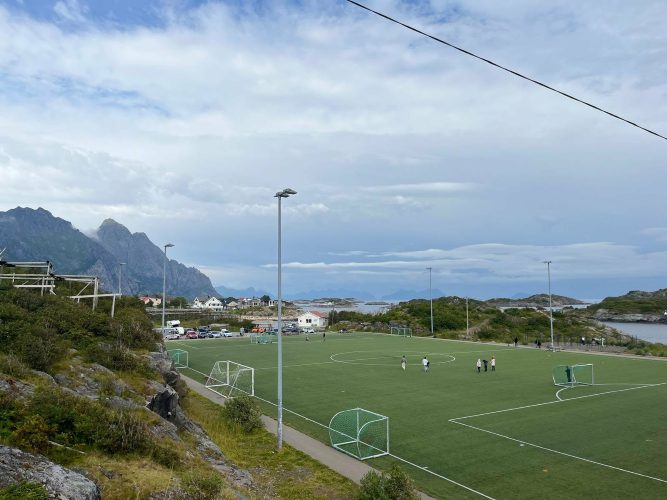
But the sight that has made Henningsvær famous far beyond Norway is its football field.
The Henningsvær football stadium, commonly known as Henningsvær Stadion, is unlike almost any football ground we have seen before.
It sits on a rocky island surrounded by the sea, with steep mountains rising dramatically behind it.
There are no vast suburbs surrounding it. No enormous parking complexes. No sprawling urban landscape.
Just a football pitch occupying a piece of land that, at first glance, seems almost too precious and limited for such a facility.
We walked towards it and gradually appreciated why photographs of the stadium have become so famous around the world.
From above, the pitch looks almost unreal.
A perfectly maintained green football field sits among bare rock, surrounded by the blue waters of the Norwegian Sea, with rugged Lofoten Mountains forming a dramatic backdrop.
It is the kind of place where football becomes secondary to the landscape.
Yet the more I thought about it, the more interesting the stadium became.
First, one might simply see it as a beautiful football field. But it also tells a story about community.
Henningsvær is a small settlement. Land is limited. Mountains, water, and rocky terrain leave very little room for conventional urban development.
And yet the community has a football field.
That says something important.
Physical activity and recreation are not necessarily luxuries reserved for large cities where land is plentiful. Even small and remote communities need places where children and adults can play, exercise, and gather.
Standing there, I found myself thinking about how different societies approach public facilities.
In a place like Henningsvær, where land is expensive and geography is challenging, there could easily have been an excuse not to build a sports facility.
There is not enough land. The terrain is difficult. The population is small. The weather is challenging.
But instead of allowing those limitations to become excuses, the community found a way.
The stadium seemed to represent a broader Scandinavian idea: public life should not disappear simply because a community is small or geographically isolated.
And perhaps that is why the field is more than a tourist attraction.
For photographers, it is spectacular. For football fans, it is fascinating.
But for us, it also became a symbol of how a community can make use of whatever space its environment allows.
 Walking Towards the Lighthouse
After exploring the stadium, we continued walking towards the hills.
The terrain became more rugged, and soon we were climbing over the rocky landscape.
Our reward was another wonderful feature of the town the lighthouse.
Lighthouses have always fascinated me because they represent the relationship between human beings and the sea in a particularly simple way.
They stand at the boundary between land and water, guiding vessels through darkness and difficult weather.
In a fishing community such as Henningsvær, such structures have an obvious historical significance.
From the higher ground, we could look back towards the settlement.
The village seemed even more compact from above.
The wooden buildings, waterfronts, boats and roads appeared to fit into tiny fragments of land surrounded by water.
Beyond them, mountains rose in almost every direction. We stopped several times along the way. There was no shortage of reasons.
The views kept changing as we moved higher. One moment the village dominated the scene; the next, the sea became the main attraction. Then a mountain ridge would appear behind us and demand another photograph.
Lofoten is particularly good at doing this.
You think you have already seen the best view of the day, and then the landscape quietly produces another.
 A Day Without Hurry
By this point, we had already spent much more time in Henningsvær than we had originally expected.
But neither of us felt any urgency to leave.
One of the pleasures of travelling with a good friend is that there is no need to fill every minute with scheduled attractions. Dr. Imran Jamali and I could walk, stop, photograph, discuss what we were seeing, sit for a while, and continue whenever we felt like it.
Henningsvær encouraged exactly that kind of travel.
It was not a place we wanted to rush through.
We had arrived intending to see a famous village and its football field. Instead, we discovered a settlement whose charm lay in the combination of many smaller things: the narrow approach road, the wooden houses, fishing boats, cafés, benches, colourful chairs, rocky hills, lighthouse and, of course, the extraordinary football stadium.
But perhaps the greatest attraction was the way all these things existed together.
Henningsvær did not separate nature from everyday life.
The mountains were not somewhere outside the town. The sea was not merely a scenic background. The football field was not hidden away in an industrial area. The fishing boats were not displayed as museum pieces. Everything was intertwined.
 Back to Kabelvåg
Eventually, the afternoon was slipping away, and we knew we had to return to our hotel in Kabelvåg.
We walked back towards our car, taking a final look at the waterfront.
The boats were still resting beside the wooden buildings. Tourists were still wandering through the streets. Cafés were still busy. The mountains remained exactly where they had been when we arrived.
Yet somehow, after several hours of walking around, the place felt different.
Perhaps it was not Henningsvær that had changed. Perhaps it was simply that we had begun to understand it.
We had come looking for a beautiful Lofoten village. We found that, certainly.
But we also found a place shaped by geography, fishing, community and an unusual determination to make life work within the limitations of a rugged Arctic environment.
The football field stayed particularly strong in my mind.
It seemed almost symbolic: a patch of green life carved out among rocks and water.
A reminder that even in places where nature appears overwhelmingly dominant, people still create spaces for sport, friendship, leisure and community.
As we drove back towards Kabelvåg, Road 816 once again unfolded before us.
The same mountains stood beside us. The same water appeared between the rocks. The same narrow road carried us away from Henningsvær.
But now we were leaving with something more than photographs.
We had experienced a small corner of Lofoten where the sea shapes daily life, where mountains determine where people can build, where fishing remains part of the identity, and where a football field has become an unlikely global symbol.
Henningsvær reminded us that a place does not need to be large to leave a lasting impression.
Sometimes, all it needs is a little land, a lot of character, and perhaps a football field surrounded by the Norwegian Sea of the Arctic Ocean.
Read: Where Tunnels Meet Bridges
_____________
Abdullah Soomro, penname Abdullah Usman Morai, hailing from Moro town of Sindh, province of Pakistan, is based in Stockholm Sweden. Currently he is working as Groundwater Engineer in Stockholm Sweden. He did BE (Agriculture) from Sindh Agriculture University Tando Jam and MSc water systems technology from KTH Stockholm Sweden as well as MSc Management from Stockholm University. Beside this he also did masters in journalism and economics from Shah Abdul Latif University Khairpur Mirs, Sindh. He is author of a travelogue book named ‘Musafatoon’. His second book is in process. He writes articles from time to time. A frequent traveler, he also does podcast on YouTube with channel name: VASJE Podcast.