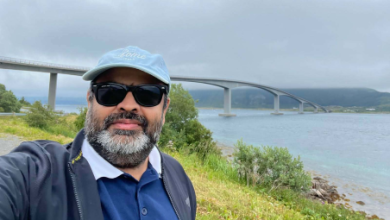
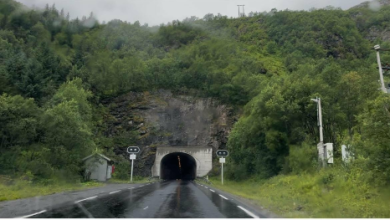
Norway’s Roads That Connect Mountains, Fjords and Hearts. Wherever we went, there was either a tunnel ahead of us or a bridge waiting to carry us across something.
By Abdullah Usman Morai | Sweden
There are some journeys in which the destination is the main attraction. Then there are journeys where the road itself becomes a story.
Our recent journey through Norway was one of the latter.
My friend Dr. Imran Jamali and I travelled through northern Norway, driving along roads where mountains rose dramatically on one side and deep blue water stretched endlessly on the other. We had expected spectacular scenery: fjords, snow-covered peaks, fishing villages and Arctic landscapes, but one thing repeatedly caught our attention: tunnels and bridges.
It seemed that wherever we went, there was either a tunnel ahead of us or a bridge waiting to carry us across something.
 A mountain stood in the way? Norway built a tunnel.
A fjord separated two communities? Norway built a bridge or operated a ferry until a permanent crossing could be constructed.
A river cut across the road? Another bridge appeared.
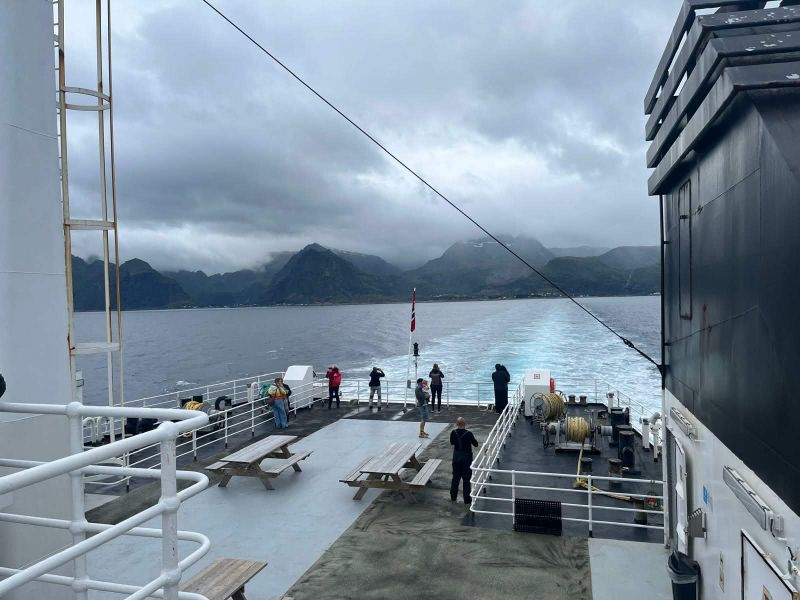
And when the sea itself became the obstacle, we sometimes drove our car onto a ferry, joined other vehicles, and waited while the vessel carried us across the water.
After several days on Norwegian roads, Dr. Imran and I began joking that travelling through Norway meant moving continuously between tunnels, bridges and ferries.
But behind that observation lies something much more profound. Norway’s tunnels and bridges are not simply engineering structures. They are part of a national effort to overcome geography, making mountains less distant, fjords less isolated, and communities more accessible.
A Country Shaped by Obstacles
Norway is a country where geography does not easily surrender to human movement.
The mountains are immense, the coastline is deeply indented, and thousands of islands and fjords divide communities from one another. In many places, a journey that looks short on a map can become surprisingly long because a mountain, fjord, or body of water stands between two points.
This is why Norwegian road engineering is so closely connected with the landscape.
Instead of forcing roads through unsuitable terrain, engineers have often taken the road through the mountain.
Instead of driving for hours around a fjord, they have built a bridge across it.
And where a bridge is impractical, or where the seafloor provides a better route, they have gone underwater.
The result is one of the world’s most remarkable road networks.
Norway has hundreds of road tunnels, and the country’s official road database maintains detailed information on them. Historically, many Norwegian tunnels have been relatively short; an earlier Norwegian road-tunnel study found that a large proportion were under 500 meters.
When we hear about Norway’s tunnels, we tend to think about record-breaking structures such as the Lærdal Tunnel. But the real story is much broader. There are thousands of ordinary-looking passages through rock that may only save motorists a few minutes each, but together they transform the country’s transport system.
 The World’s Longest Road Tunnel Is in Norway
One of the most extraordinary examples is the Lærdal Tunnel in western Norway.
At 24.5 kilometers, it is officially the world’s longest road tunnel. Opened in 2000, it connects Lærdal and Aurland and forms an important part of the E16 road connection.
Think about that for a moment. Twenty-four and a half kilometers inside a mountain.
For a traveller sitting behind the steering wheel, it may simply feel like a long drive through darkness. But behind that experience lies an enormous engineering achievement involving excavation, ventilation, lighting, safety systems, emergency facilities and geological challenges.
Interestingly, the Lærdal Tunnel does not feel like an ordinary endless tunnel. It contains large illuminated rock chambers designed partly to provide psychological relief to drivers. The tunnel is also being upgraded to modern safety standards, with work scheduled to begin in 2026 and continue into 2030/31.
Norway’s tunnel story therefore continues even after a tunnel has opened. Maintaining and modernizing these enormous structures is itself a major undertaking.
The Tunnel beneath the Sea
Norway’s ambition becomes even more impressive when mountains are no longer the only obstacle.
The country has developed a remarkable tradition of undersea road tunnels.
The Ryfylke Tunnel, for example, is around 14.5 kilometers long and descends roughly 292 meters below sea level. It is among Norway’s longest road tunnels and one of the country’s most remarkable subsea crossings.
But Norway is not stopping there.
The Rogfast project in Rogaland is being built to create what the Norwegian Public Roads Administration describes as the world’s longest and deepest subsea road tunnel. The project is expected to open in 2033 and will form part of the plan for a more ferry-free E39 along Norway’s western coast. The tunnel system will run beneath the sea and reach approximately 400 meters below sea level.
For us as travellers, this is fascinating because it demonstrates how Norway is gradually changing the relationship between road and sea.
Today, a ferry may be necessary. Tomorrow, the same journey may be made underneath the fjord.
From Darkness to Daylight: Norway’s Bridges
If tunnels demonstrate Norway’s ability to go through mountains and beneath water, bridges demonstrate its ability to go over obstacles.
During our drive, we repeatedly crossed bridges that seemed almost suspended between mountains and water.
Some were enormous. Others were modest structures crossing a small river or stream.
One of the country’s great bridge landmarks is the Hardanger Bridge.
The Hardanger Bridge is a 1,380-metre suspension bridge and is officially Norway’s longest suspension bridge. Its towers rise about 200 meters above the fjord, creating a dramatic meeting point between engineering and landscape. The bridge is also connected to substantial tunnel infrastructure on both sides.
Then there is the Hålogaland Bridge, particularly interesting to us because it is in northern Norway, close to Narvik.
The bridge is 1,533 meters long, with a main suspension span of 1,145 meters. It is Norway’s second-longest suspension bridge. The project also included several kilometers of road and tunnels, demonstrating something that became obvious during our journey: Norway rarely builds a bridge in isolation.
A bridge may require a tunnel before it. Another tunnel may follow it. Then a road may climb around the mountain.
Engineering projects in Norway often become a chain of interconnected solutions.
The Shortest Tunnels and Bridges Tell another Story
There is something else fascinating about Norwegian infrastructure.
Not every tunnel is a gigantic engineering wonder.
In fact, it is difficult to identify a single official “shortest road tunnel in Norway” because the national road database contains an enormous variety of structures, from major mountain and subsea tunnels to very short passages. Norway’s official tunnel dataset records road tunnels across the country but does not present a simple national ranking for the shortest tunnel.
There are, however, very short tunnel structures and tunnel-related passages.
For example, a current Norwegian road project includes a ventilation tunnel only about 30 meters long. Other road tunnels can be only a few hundred meters long. The Norwegian Public Roads Administration has also documented tunnels of roughly 200 meters.
The same principle applies to bridges.
There is no particularly meaningful national “shortest bridge” record because a bridge can be a tiny structure crossing a stream or drainage channel, while another may span an enormous fjord.
For perspective, the Norwegian Public Roads Administration describes the new Strømmen Bridge in Nordland as approximately 30 meters long; the old bridge was only about 15 meters.
A 15-metre bridge may sound insignificant compared with Hardangerbrua. But for the people who use it every day, its importance may be just as great.
That is one of the lessons we learned on our journey: size does not determine importance.
A 24.5-kilometre tunnel can be a national landmark, while a 30-metre bridge can be the structure that keeps a local community connected.
 Why Did Norwegian Tunnels Seem Narrower to Us?
During our journey, we also noticed something else.
Compared with tunnels we have driven through in Sweden, Norwegian road tunnels seemed narrower to us.
This was particularly noticeable in some of the mountainous areas. Of course, tunnel dimensions vary according to road classification, age, traffic levels, safety requirements and whether the tunnel has one or two tubes, so this is primarily an observation from our travels rather than a universal engineering rule.
But the landscape provides an obvious explanation for why Norwegian tunnel engineering can feel different.
In mountainous Norway, there may simply be very little space.
A road cannot always spread sideways. A steep mountain may rise directly from the fjord, while a village may occupy the narrow strip of usable land. A tunnel therefore becomes not merely an alternative; it can be the only practical way forward.
The narrower feeling of some Norwegian tunnels may therefore be closely related to the challenging terrain and the way roads have had to fit into the mountains.
Modern Norwegian tunnels are nevertheless designed with safety and traffic management in mind. The Lærdal Tunnel upgrade, for instance, includes emergency lay-bys, surveillance, improved lighting, communications, ventilation and emergency equipment.
What we see from behind the steering wheel the width of the road, lights on the walls, and signs above us is only the visible part of a much larger engineering system.
Ferries: The Old Solution Still Sailing
Despite all these tunnels and bridges, ferries remain an essential part of Norwegian travel.
And there is something charming about them.
We would drive onto a ferry with our vehicle, switch off the engine, and suddenly become passengers rather than drivers.
For a few minutes, the road disappeared beneath us.
The fjord or sea became the road.
Cars, buses, trucks, bicycles, and people shared the same floating platform. Then, after crossing the water, the ferry docked and everyone simply drove away, continuing the journey.
But Norway is gradually trying to replace some of these ferry crossings with fixed connections.
The Rogfast project is one example. It is explicitly part of Norway’s ambition to create a more continuous, ferry-free E39 along the western coast. According to the Norwegian Public Roads Administration, the project is expected to reduce travel time between Stavanger and Bergen by about 40 minutes.
This does not mean that ferries will suddenly disappear from Norway. The country’s geography is too complicated for that. But where economically and technically feasible, bridges and tunnels can provide faster, more predictable year-round connections.
 Infrastructure That Gives Time Back to People
This is where I believe Norwegian infrastructure deserves appreciation.
A tunnel is not only a hole through a mountain. A bridge is not simply steel and concrete. A ferry-free road is not merely a transportation project.
They are all ways of giving time back to people.
Imagine a person who lives on one side of a mountain and works on the other. Imagine a child travelling to school. Imagine an ambulance carrying a patient. Imagine a truck transporting food, medicine or industrial goods. Imagine families who want to visit relatives without having to wait for the next ferry.
Every minute saved on a journey eventually becomes part of someone’s life.
This is why I found these projects more meaningful than many of the spectacular monuments we see around the world.
They are not primarily built for tourists to photograph. They are built for ordinary people to use. They are infrastructure in the truest sense of the word.
Engineering against Isolation
Perhaps the most beautiful way to understand Norway’s tunnels and bridges is to see them as a response to isolation.
A fjord can divide two communities. A mountain can separate two valleys. An island can remain dependent on a ferry. A river can become an obstacle.
But a tunnel can pass through the mountain. A bridge can cross the river. A ferry can temporarily become a moving bridge. And eventually, another tunnel may go beneath the sea.
Every such structure reduces the power of geography to isolate people. That is why, during our journey, I began looking at these structures differently.
At first, I saw a tunnel simply as something we had to drive through. Gradually, I began seeing it as a connection between two places. A bridge was no longer simply something carrying our car across water. It became a connection between communities. And that, perhaps, is the real purpose of these structures: not merely to connect roads, but to bring people closer.
 Connecting Roads and Hearts
Norway’s mountains are magnificent, but mountains can also separate. Its fjords are breathtaking, but fjords can also divide. Its islands are beautiful, but islands can also isolate.
Human beings have responded to all of this with extraordinary ingenuity.
They have drilled through mountains, descended beneath seas, stretched bridges across fjords, and sailed ferries between shores.
In doing so, they have created something greater than a transport network.
A road allows a worker to reach a workplace. A bridge allows a family to visit relatives. A tunnel allows a patient to reach a hospital. A ferry allows a community to remain connected to the mainland. A modern road allows businesses to reach customers and goods to reach markets.
In this sense, Norway’s tunnels and bridges are connecting not only places, but people and perhaps even hearts.
As Dr. Imran and I continued our journey through Norway, passing from tunnel to bridge and from bridge to ferry, I increasingly felt that we were travelling through a living example of how engineering can serve humanity.
The mountains remain. The fjords remain. The rivers remain. The sea remains.
Norway has not defeated its geography, and perhaps it never intended to.
Instead, it has learned how to live with it.
Where nature creates a barrier, people create a connection. Where a mountain says “stop,” a tunnel says “continue.” Where a fjord says “you cannot cross,” a bridge says “come over.” And where the water is still too wide, a ferry says, “I will take you there.”
Perhaps that is the most beautiful story hidden inside Norway’s tunnels and bridges.
They do not merely take us from one side to another. They bring one side closer to the other.
And in the end, that is what good infrastructure should always do: not simply shorten distances on a map, but shorten the distance between human beings.
Read: Reflections on Travelling Without Hurry
_____________________
 Abdullah Soomro, penname Abdullah Usman Morai, hailing from Moro town of Sindh, province of Pakistan, is based in Stockholm Sweden. Currently he is working as Groundwater Engineer in Stockholm Sweden. He did BE (Agriculture) from Sindh Agriculture University Tando Jam and MSc water systems technology from KTH Stockholm Sweden as well as MSc Management from Stockholm University. Beside this he also did masters in journalism and economics from Shah Abdul Latif University Khairpur Mirs, Sindh. He is author of a travelogue book named ‘Musafatoon’. His second book is in process. He writes articles from time to time. A frequent traveler, he also does podcast on YouTube with channel name: VASJE Podcast.