An Unhurried Day across Austvågøya and Gimsøya Islands of Lofoten, Norway
The author and his friend spent an early July day wandering without a rigid schedule. By letting curiosity guide their route, they discovered that the truest destinations are often the unexpected stops along the way.
By Abdullah Usman Morai | Sweden
It was still the first week of July 2026, and my friend Dr. Imran Jamali and I were somewhere between roads, mountains, islands, and the sea, wandering through the extraordinary landscape of Lofoten in northern Norway.
By then, we had already begun to understand something important about travelling in Lofoten: the destination is not always the place marked on the map. Sometimes, the real destination is a bend in the road, a small village you had never heard of, a café you discover by chance, a bridge stretching across a narrow sea channel, or simply a viewpoint that makes you stop the car without saying a word.
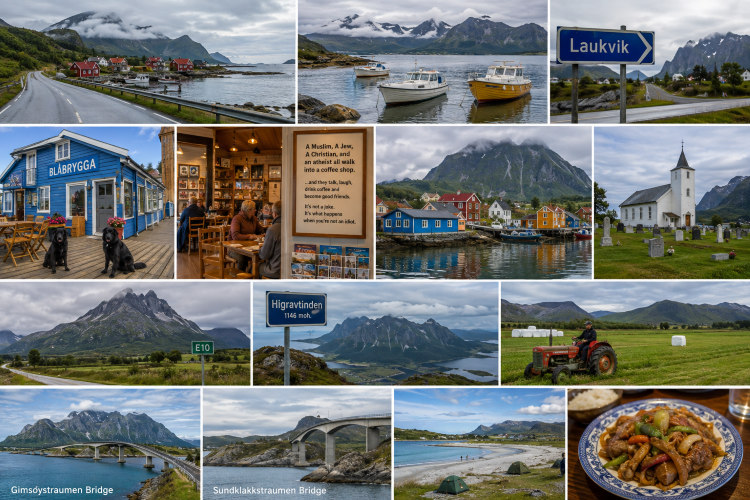 That morning, after breakfast at Sommerhotell og Vandrerhjem, we decided not to make any ambitious plans. We had asked the local tourist office in Svolvær for suggestions, and they had pointed us towards two islands, Austvågøya and Gimsøya.
The plan was simple: drive, explore, stop wherever we liked, take photographs, admire the scenery and return whenever we felt like it.
There was no timetable to chase. No train to catch. No museum closing time hanging over our heads. Just two friends, a car, a winding road and the spectacular landscape of Lofoten. And that, perhaps, is one of the greatest luxuries of travel.
A Morning on Austvågøya
 The weather was typically Lofoten, changeable, moody, and wonderfully unpredictable.
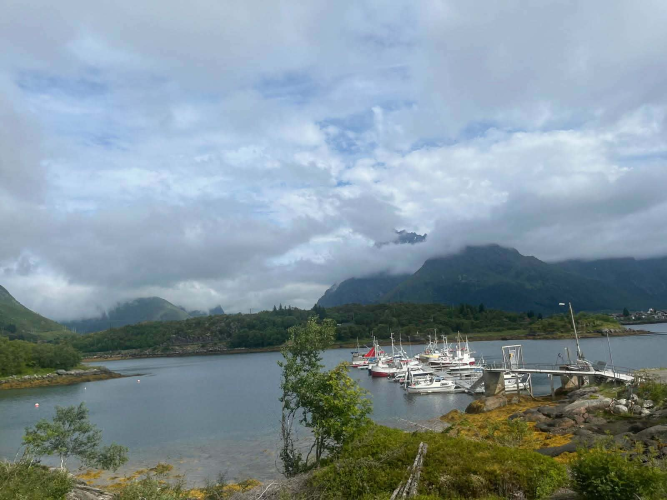
The sky was mostly cloudy, but now and then the sun shyly appeared through a gap in the clouds, illuminating the landscape for a few precious moments. Then came a little rain, followed by brighter patches again. The mountains seemed to have their own relationship with the clouds; some peaks appeared clearly while others disappeared into mist as if someone had drawn a curtain across them.
We started on the E10, the famous road that connects much of the Lofoten archipelago. Soon, however, we left the main route and turned onto the quieter Midnattsolveien, also known as FV888.
Immediately, the character of the journey changed.
The traffic became lighter. The road became quieter. And the landscape seemed to open itself to us.
Austvågøya is one of the principal islands of Lofoten and the largest of the main islands in the archipelago. It rises dramatically from the sea, with sharp mountains, narrow fjords, sheltered bays and small settlements scattered along the coastal areas. Its highest summit, Higravtindan, reaches about 1,146 meters and is the highest mountain on Austvågøya.
 But statistics cannot really explain Austvågøya. You have to drive through it. You have to watch the mountains emerge from the clouds. You have to see the sea appearing beside you, sometimes calm and sometimes restless.
And you have to experience the peculiar sensation of driving on a road where, within a few meters, the landscape can change from mountain to meadow, from meadow to sea, and from sea back to mountain.
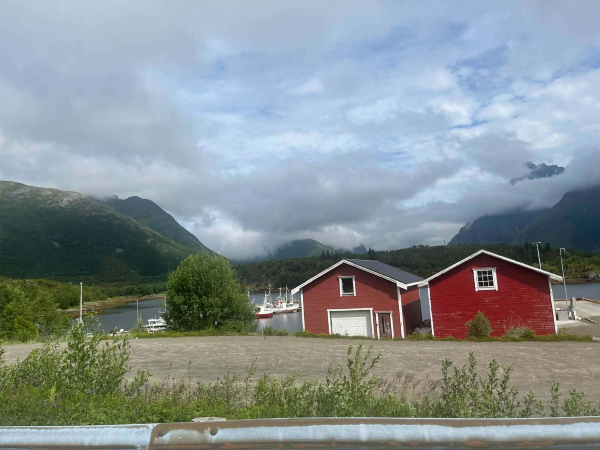
On one side of the road, there were hills and rocky slopes. On the other, stretches of water opened towards the sea. Small boats rested quietly near the shore, their colours contrasting with the subdued tones of the landscape.
Here and there stood small guest houses and hotels, many with the traditional red-painted wooden exteriors so characteristic of coastal Norway.
The red buildings looked almost theatrical against the grey-green mountains and silver-blue water.
Some of the mountain tops were completely hidden inside clouds. It was difficult to tell where the mountain ended and the sky began.
 The landscape seemed unfinished, and that was precisely what made it beautiful.
At certain points, we could see snow or remnants of ice high in the mountains, while thin waterfalls descended from rocky slopes. July had arrived, yet the Arctic landscape still carried reminders of winter.
That contrast fascinated us.
Down below, summer had brought green grass, flowers, and agricultural activity. High above, winter seemed reluctant to leave.
When Curiosity Changes the Route
Our original intention was to continue along the road and eventually reconnect with E10.
But then something very ordinary happened- something that has probably changed the plans of travellers since the beginning of travel itself.
We saw a sign. The sign pointed towards a small place called Laukvik.
We looked at each other. “Shall we go?” Why not?
There are moments when a journey becomes memorable simply because you decide to follow your curiosity. So we turned towards Laukvik.
And that small decision became one of the highlights of our entire day.
 Laukvik: A Little Village by the Norwegian Sea
Laukvik is the kind of place that does not need to advertise itself. It does not shout for attention.
It simply sits quietly beside the Norwegian Sea, surrounded by water, islands, mountains, and the atmosphere of a traditional coastal settlement.
As we entered the village, the first thing that struck us was its calmness.
There were colourful wooden houses blue, red, and yellow- standing close to the water. Small boats were moored nearby. Everything seemed slower here.
Laukvik is associated with the old coastal life of Lofoten, where fishing and the sea have traditionally shaped the rhythm of local communities. Today, it remains a small settlement, but its location and atmosphere make it an attractive stop for travellers exploring the quieter side of Austvågøya.
And then we noticed a blue building. It was Blåbrygga Café.
The name itself seemed appropriate. Blå means blue in Norwegian, and the café stood like a bright blue little landmark beside the harbour.
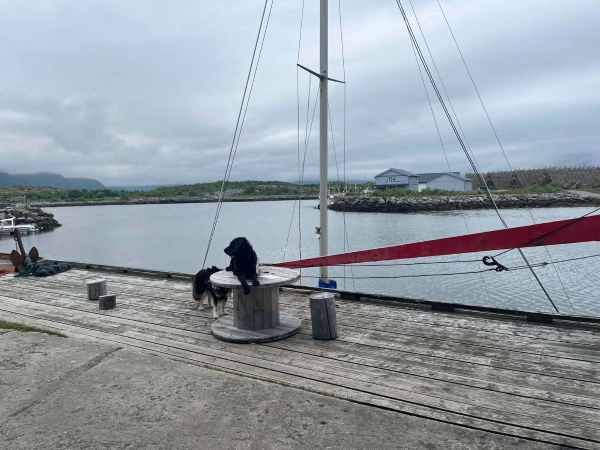
We parked the car and walked towards it. Two black dogs were sitting outside.
They were perhaps the calmest dogs we had encountered during our travels. They were simply sitting there, quietly waiting for their owner. No barking, no jumping, no dramatic welcome. Just two dogs observing the world. We smiled.
The waterfront seating made the place even more inviting. Wooden tables and chairs stood outside, close to the water, giving visitors the chance to sit with a cup of coffee or tea while looking across the harbour.
The idea of having coffee/tea beside the Norwegian Sea sounded considerably better than rushing back onto the road, so we went inside.
Coffee, Cakes and a Message Larger Than the Café
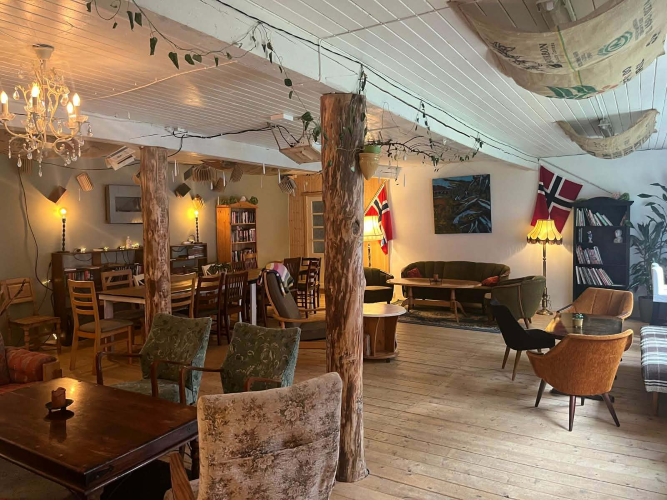
 Inside, Blåbrygga was warm and cosy.
The atmosphere was completely different from the grey weather outside. Several customers were sitting around, enjoying coffee, food and conversation. The aroma of freshly prepared drinks and food filled the small interior.
There were cakes, sandwiches and other simple café offerings. And then there were souvenirs and small items for visitors to browse.
 But what caught our attention most was not the food. It was a picture. On it was a sentence that immediately made us stop:
“A Muslim, a Jew, a Christian, and an atheist all walk into a coffee shop…”
There was more to the message, but the opening alone was enough to make us pause.
Here we were, two travellers from far away, sitting in a tiny café in a small Norwegian coastal settlement, reading a message about people of different beliefs walking into the same coffee shop. It felt strangely appropriate.
A coffee shop is, after all, one of those places where differences can become less important. People sit around the same tables. They drink the same coffee. They share the same warmth when the weather outside is cold and wet.
Religion, nationality, language and background may differ, but the simple human desire for companionship, hospitality and conversation is remarkably universal.
For us, the picture became part of the memory of Laukvik. It was not simply a café stop. It was one of those unexpected encounters that give a journey another layer. We had come looking for a road. Instead, we found a village. We had followed a sign. Instead, we found a story. And sometimes that is exactly why one should leave a little space in a travel plan for the unexpected.
We eventually stepped outside again. The two dogs were still there. The sea was still calm. The colourful houses were still standing quietly around the harbour.
Nothing dramatic had happened. Yet somehow, we felt that we had discovered something.
 The Beauty of Taking the Wrong Turn
We drove back towards the main route with smiles on our faces. Our detour to Laukvik had taken some time, but we did not regret a single minute. In fact, it reminded us of something easy to forget in modern travel.
We often travel with a list. A list of places. A list of attractions. A list of photographs we want to take. A list of things we must see before returning home. But sometimes the best travel experiences happen when the list is interrupted. A sign catches your eye. A road looks interesting. A village appears on the map. And suddenly you say: “Let’s see what’s there.” That was Laukvik for us.
A place we had not planned to visit became one of the places we would remember most.
Back Through the Coastal Landscape
We returned to our route and continued our drive. The road passed through a series of small settlements and coastal landscapes, Grunnfor, Sanden, Morfjord, Stronstad and Fiskebøl among them. The journey itself was the attraction.
At several points, the road appeared to have been built by reclaiming land close to the sea. It was fascinating to see how human engineering had created a narrow ribbon of asphalt between land and water.
This is one of the remarkable characteristics of travelling through the Norwegian coastal landscape. The mountains leave little room. The sea takes up enormous space. And the road has to find its way between them.
Sometimes it crosses a narrow causeway. Sometimes it climbs around a mountain. Sometimes it runs almost directly beside the water.
The result is a road trip where even an ordinary stretch of road can become a scenic viewpoint. As we drove, the weather continued its performance.
Clouds gathered over the mountains. Then a little sunlight appeared. Rain returned. Then disappeared. The mountains remained partly hidden.
We could see waterfalls running down the rocky slopes, carrying meltwater from the higher elevations. Here and there, traces of snow or ice remained in the mountain landscape.
There was no need for entertainment. The scenery itself was enough. Eventually, we joined E10 again via Road 82. And then came another memorable mountain encounter.
Somewhere between Higrav and Laupstad, we could see Higravtindan, the great mountain massif of Austvågøya.
At around 1,146 metres, Higravtindan is the highest point on Austvågøya and one of the defining mountain landmarks of the island. Small glaciers remain on its eastern side.
We did not need to climb it. We were perfectly happy simply looking at it. The mountain stood there like a giant guardian over the landscape. Its upper sections seemed almost lost in the clouds. For a moment, the drive became very quiet.
We simply looked. There are landscapes where words become unnecessary. This was one of them.
 Crossing Towards Gimsøya
After exploring Austvågøya, we continued towards another island, Gimsøya.
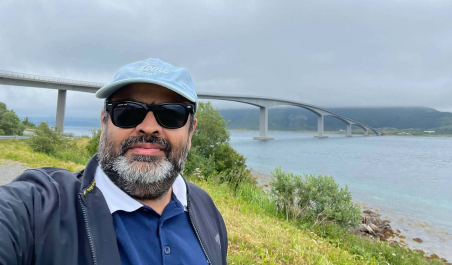
The road itself became part of the adventure. Soon we reached the Gimsøystraumen Bridge, one of the striking bridges that connect the islands of Lofoten.
The bridge crosses the Gimsøystraumen strait between Austvågøya and Gimsøya. It is about 839 metres long and forms part of the E10 route linking the islands.
As soon as we saw the bridge and the surrounding landscape, we knew we had to stop. We pulled over and got out. The weather was still the same mixture of clouds, occasional sunlight, and rain. But somehow, it was perfect.
The bridge stretched across the water while mountains rose around it. The sea below looked calm from our viewpoint, though the channels between the Lofoten islands are known for strong tidal currents.
We took photographs from different angles. One photograph was never enough. The landscape kept changing with the movement of the clouds.
A few minutes later, we continued. Further ahead was the Sundklakkstraumen Bridge, which connects Gimsøya with Vestvågøya. The bridge crosses the Sundklakkstraumen strait and is about 271 meters long.
Instead of continuing straight across, we decided to explore the surrounding area.
We turned onto FV861. Again, the journey slowed down. And again, we were reminded that in Lofoten, the road itself can be the destination.
Gimsøya: A Different Face of Lofoten
Gimsøya felt different from Austvågøya. Austvågøya had impressed us with dramatic mountains rising steeply from the sea. Gimsøya felt more open.
The island lies between Austvågøya and Vestvågøya and covers about 46.4 square kilometres. Much of its landscape is characterized by lower, more open terrain, wetlands, agricultural areas and mountains concentrated in parts of the island.
The island is also known for its protected natural areas and rich birdlife. Its landscape includes marshes and cultivated land, creating an interesting combination of wilderness and agriculture.
We drove without any particular hurry. The same weather accompanied us. The clouds moved slowly above the landscape. The sea remained nearby.
And occasionally, we would stop simply because something looked beautiful. Eventually, we reached the area around Saupstad and Gimsøya Beach. The beach and its surroundings had a peaceful summer atmosphere.
There were tents nearby, suggesting that other travellers had also decided that this was a place worth spending time in rather than merely passing through.
We understood them. There was something deeply relaxing about the scene.
No city noise. No crowds. No urgency. Just a beach, open landscape, mountains, sea, and the enormous northern sky.
 A White Church in the Middle of the Landscape
From there, we turned right onto Barstrandveien, or Fv861 road. Later, we noticed another smaller road leading towards the beach. Naturally, curiosity won again. We followed it, and soon we came across a white building surrounded by a cemetery.
It was Gimsøy Church, Gimsøy kirke. The simple white church looked beautifully placed within the rural landscape. Nearby, a local farmer was working in an agricultural field with a small tractor.
The scene felt almost timeless. A white church. A quiet cemetery. Green fields. A farmer working his land. Mountains in the distance. Clouds moving slowly overhead. And somewhere beyond all of it, the sea.
This was another side of Lofoten that we had not expected to encounter so vividly. People often imagine Lofoten only as a place of dramatic mountains, fishing villages and beaches. But there is another Lofoten. There is an agricultural Lofoten. There are fields, farms, churches, and ordinary daily routines. Gimsøya especially reveals that quieter side.
The island’s central and southern areas include cultivated land and grazing areas, with parts of its wetlands protected for their natural value. Watching the farmer working in his field, we were reminded that landscapes are not merely beautiful photographs. They are also living places.
People work here. Families live here. Farmers cultivate the land. Fishermen use the sea. Children grow up surrounded by these mountains, and travellers like us arrive for a few hours, fascinated by a world that is home to others. That thought made the landscape feel even more meaningful.
Back to the Bridge
After exploring the quiet roads of Gimsøya, we eventually completed our little island journey and returned towards the Gimsøystraumen Bridge.
We joined E10 again, this time heading back towards Svolvær and Kabelvåg.
The day was moving towards evening, although in Lofoten during summer, “evening” does not necessarily mean darkness in the way it does elsewhere.
The Arctic summer has its own rhythm. The light lingers. The sky remains bright and the day seems reluctant to end.
By then, we had spent almost the entire day driving. Yet it did not feel exhausting. Perhaps because there had been no pressure. We had not been racing from one attraction to another. We had simply been moving, stopping, looking, photographing, talking, and occasionally changing direction.
Dinner in Svolvær
Before returning to our hotel in Kabelvåg, we drove into Svolvær to buy some food for dinner.
After a full day outdoors, we wanted something warm, satisfying, and easy. So we chose Chinese food. It turned out to be an excellent decision.
The food was delicious, and after hours of driving through mountains, islands and coastal roads, sitting down for a good meal felt like the perfect conclusion to the day.
We were tired, but it was the pleasant kind of tiredness that comes after a day well spent. As we looked back on the day’s journey, we realized how much had happened.
We had explored Austvågøya. We had followed an unexpected road to Laukvik. We had discovered Blåbrygga Café. We had sat beside the Norwegian Sea. We had watched two remarkably calm dogs waiting outside. We had read a message about Muslims, Jews, Christians and atheists sharing a coffee shop. We had driven through small settlements.
We had watched mountains disappear into clouds. We had seen waterfalls and traces of snow and ice. We had admired Higravtindan. We had crossed bridges connecting the islands. We had explored Gimsøya. We had visited Gimsøy Church. We had watched a farmer working in his field. We had stood beside a beach where travellers had pitched their tents. And finally, we had returned to Svolvær for dinner.
It had been an entire day of discovery without ever feeling like a tightly organized excursion.
 The Joy of Travelling Without Hurry
Perhaps that was the real lesson of the day. Travel does not always need a complicated itinerary. Sometimes the best journeys are the ones where you leave enough room for curiosity. A road sign can become an invitation. A small village can become a memory. A café can become part of a story. A bridge can become a viewpoint. A farmer in a field can become a reminder of how people live in places that tourists visit.
And a mountain half-hidden by clouds can stay in your mind longer than a perfectly clear panoramic view. Lofoten had already shown us its famous side: the spectacular mountains, the fishing villages, the beaches and the dramatic coastal scenery.
But on this day, Austvågøya and Gimsøya showed us something quieter. They showed us that beauty does not always arrive with a grand entrance. Sometimes it waits beside a small road. Sometimes it hides behind a sign pointing towards a village you had never planned to visit. Sometimes it is sitting in a blue café beside the sea. And sometimes it is simply a farmer driving a small tractor through a green field beneath mountains wrapped in clouds.
When we finally returned towards Kabelvåg, Dr. Imran and I were tired, but our faces carried the kind of smiles that come only after a day when everything seems to have gone right.
We had not merely visited places. We had experienced them. We had discovered new landscapes, new roads, new ideas and small glimpses of everyday life.
And perhaps that is why the most memorable journeys are not necessarily the ones with the longest list of attractions.
They are the ones that leave us with stories. That day in Lofoten had given us plenty. Two islands. One unexpected detour. A blue café. A couple of quiet dogs. Cloud-covered mountains. A white church. A farmer in a field. Bridges over restless Arctic waters. And countless moments when we simply stopped and said:
“Look at that.”
Sometimes, that is all a traveller really needs. And sometimes, that is enough to make an ordinary day on the road unforgettable.
Read: Where Mountains Meet the Sea
_________________
Abdullah Soomro, penname Abdullah Usman Morai, hailing from Moro town of Sindh, province of Pakistan, is based in Stockholm Sweden. Currently he is working as Groundwater Engineer in Stockholm Sweden. He did BE (Agriculture) from Sindh Agriculture University Tando Jam and MSc water systems technology from KTH Stockholm Sweden as well as MSc Management from Stockholm University. Beside this he also did masters in journalism and economics from Shah Abdul Latif University Khairpur Mirs, Sindh. He is author of a travelogue book named ‘Musafatoon’. His second book is in process. He writes articles from time to time. A frequent traveler, he also does podcast on YouTube with channel name: VASJE Podcast.