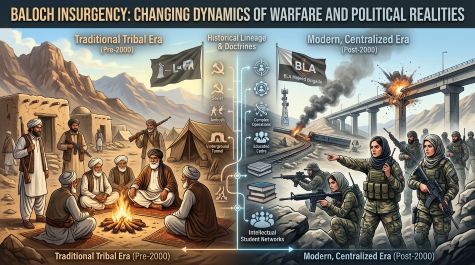
Unlike the uprisings of 1958, 1962, and 1973—which were driven by tribal levies and led by feudal elites—the post-2000 movement is directed by educated, modern-minded youth.
Noor Muhammed Marri Advocate | Islamabad
The analytical observations of journalist and political commentator Abdul Hayee Kakkar illuminate a profound structural and strategic shift within South Asian regional security. The contemporary Baloch movement has fundamentally overhauled its organizational apparatus and operational doctrine. Tracing this evolution, Kakkar highlights how the Baloch Liberation Army (BLA) and its allies have systematically dismantled their reliance on traditional tribal sardars and completely bypassed parliamentary politicians, opting instead for a centralized, highly disciplined strategy that distinguishes the current insurgency from all historical precedents.
A pivotal insight in Kakkar’s analysis is the BLA’s adoption of complex martyrdom operations through the Majeed Brigade—a tactical shift he compares to the Tamil Tigers (LTTE). While the LTTE pioneered political suicide tactics between 1987 and 2009, the BLA’s Majeed Brigade has achieved rapid operational escalation in just four years. By deploying educated cadres—most notably women—against high-value targets, the movement has shattered the traditional framework of secular guerrilla warfare in the region.
On the tactical landscape, these insurgent units have introduced dynamic maneuvers that continually disrupt state security protocols. Moving away from static conventional engagements, they employ high-visibility blockades and snap checkpoints designed to draw security forces into prepared ambushes. Concurrently, utilizing heavy machinery and explosives, they target critical infrastructure—demolishing bridges, rail lines, and communications networks to isolate entire districts and paralyze military logistics.
Understanding this modern doctrine requires examining its deep historical lineage. Following General Zia-ul-Haq’s 1977 coup, a general amnesty was declared for political prisoners and insurgents involved in the 1973–1977 Baloch conflict. While mainstream political figures such as Khan Abdul Wali Khan, Mir Ghaus Bakhsh Bizenjo, and Sardar Ataullah Mengal accepted political compromise and re-entered parliament, Nawab Khair Bakhsh Marri (Baba Marri) and his cadre rejected reconciliation, choosing self-imposed exile in Afghanistan.
During their exile amid the Cold War, these leaders and cadres synthesized three major geopolitical military doctrines: Soviet statecraft provided strict institutional discipline and organizational structure; the Afghan-Soviet War offered mastery of asymmetrical warfare, ambush mechanics, and countering heavy armor; and the Vietnam War demonstrated underground organizational survivability under extreme operational pressure.
These experiences elevated the struggle from localized tribal skirmishes to a modern, ideologically grounded guerrilla framework. Following the collapse of the Soviet Union in the 1990s, this body of strategic knowledge retreated underground, preserved and refined within university study circles and intellectual student networks.
This dormant framework re-emerged forcefully in 2000 following the arrest of Nawab Khair Bakhsh Marri in connection with the murder of Justice Nawaz Marri. As the sole historical leader to stand firm, Marri’s arrest served as the catalyst that transformed subterranean intellectual circles into a re-energized, armed resistance movement.
The defining turning point of this new era is the prominent inclusion of educated women within the insurgent vanguard, particularly in the Majeed Brigade. The active role of female fighters has dismantled long-standing societal paradigms: gender boundaries have dissolved as women serve on the frontlines of combat in a deeply conservative society; class dynamics have shifted as leadership transitioned from hereditary tribal elites to educated middle-class youth, teachers, and university graduates; and tribal fragmentation has been overcome by cadres operating under a unified national identity rather than specific clans or sardars.
Unlike the uprisings of 1958, 1962, and 1973—which were driven by tribal levies and led by feudal elites—the post-2000 movement is directed by educated, modern-minded youth. Consequently, mainstream parliamentary figures like Dr. Abdul Malik Baloch and Akhtar Mengal have seen their political relevance severely eroded, as the insurgent wing views parliamentary participation as an ineffective compromise with the status quo.
In contrast to Sindhi nationalism—which post-G.M. Syed fragmented into splinter groups, non-governmental organizations, and parliamentary alliances—the Baloch movement has maintained an uncompromising operational stance. State-backed local militias, death squads, and local patronage networks have been rendered largely ineffective through systemic boycotts. The movement operates under a cohesive, centralized command, creating a security environment that UN reports acknowledge poses significant challenges to regional connectivity and infrastructure projects.
Given that this fifth iteration of the Baloch conflict is structurally distinct, highly organized, and militarily adaptive, purely kinetic or heavy-handed military approaches have proven counterproductive. Over-reliance on force deepens political alienation and fuels recruitment for underground factions. The only viable path forward requires stepping back from military containment in favor of transparent, meaningful political engagement aimed at addressing the root socio-political grievances of the region.
Read: Sindh – The Lawless State!
___________________
 Noor Muhammad, Advocate and Mediator, Islamabad