

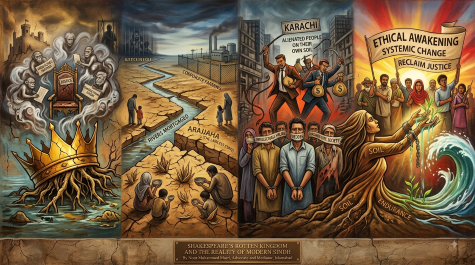
Justice in Sindh today lives in forced exile, while the metaphorical “apes” of classic allegory occupy the chairs of law and governance.
Shakespeare’s Totten Kingdom and the reality of Modern Sindh
By Noor Muhammed Marri Advocate | Islamabad
When William Shakespeare set out to paint the collapse of a nation in Hamlet and Richard II, he was not merely writing fiction—he was drafting an enduring anatomical chart of political decay. In Hamlet, the famous declaration that “something is rotten in the state of Denmark” captured a society poisoned from its very head. In Richard II, Shakespeare depicted a ruler who converted his own motherland into a leased commodity, turning a sovereign realm into a traded landlord’s estate. Today, this literary mirror reflects the lived reality of Sindh—a modern land where the ancient Sanskrit warning of Arajaka (the lawless state) meets Shakespearean tragedy.
Justice in Sindh today lives in forced exile, while the metaphorical “apes” of classic allegory occupy the chairs of law and governance. Unqualified appointees hold the reins of public institutions, driving the qualified and principled into the margins. The most capable scholars and upright civil servants find their names relegated to the obscurity of OSD (Officer on Special Duty) posts simply because they refuse to bow before systemic rot. Meanwhile, sycophants and bootlickers fly high on currents of unearned authority, proving that merit has been replaced by a transactional open market where every office, posting, and favor carries a price.
This governance crisis manifests directly upon the soil itself. Just as King Richard II “leased out” England’s estates for quick gain, the agricultural foundation of Sindh has been bartered away under the banner of corporate farming. The ancient canal system, built to nourish generations of agrarian families, stands cracked and dry because the rivers themselves have been mortgaged away from the small landholder. Despair becomes the primary harvest, driving impoverished parents to the ultimate, silent tragedy of suicide when they can no longer feed their starving children.
The tragedy extends to the intellectual and civic defenders of the realm. The writers, poets, and intellectuals—who ought to serve as the conscience of the people—have largely yielded their pens to become spokesmen for the ruling elite. Civil society, fractured by opportunism, leaves the public vulnerable to a apparatus that governs strictly through the carrot or the sword.
The deepest grievance, however, remains the alienation of the people on their own soil. Karachi, the historic capital and economic heart of Sindh, feels increasingly severed and snatched from its indigenous inhabitants. Citizens find themselves restricted and marginalized upon the very land where their ancestors are buried.
When a motherland is carved up and its own children are locked outside its gates, where do the people share their grief? No savior will descend from the clouds to resolve this tragic script. The resolution cannot be imported; it must emerge from within the broken society itself. From the grief of stolen lands and dry canals, an ethical awakening must rise from the soil—a movement born of endurance that will finally restore justice, reclaim the institutions, and unfurl the flag of systemic change across Sindh.
Read: Understanding Armed Struggle in Balochistan
__________________
 Noor Muhammad, Advocate and Mediator, Islamabad


