No matter how dark the night becomes,
Keep a lamp burning in your window!
Nisar Banbhan
 Hailing from Village Mir Muhammad Banbhan, Taluka Mirwah, District Khapurpur and based in Karachi, the capital of Sindh, Nisar Banbhan is a seasoned professional with nearly 25 years of multifaceted experience, encompassing 3 years in journalism and over two decades of service in a public sector organization. His extensive expertise spans content creation, scriptwriting, screenwriting, lyrics, poetry, and storytelling across multiple languages, including Sindhi, Urdu, and English. Nisar has honed his skills in writing articles, columns, and short stories, contributing to various national and regional media outlets. Additionally, he brings a deep understanding of program development, educational advocacy, and strategic planning, having led initiatives that promote quality education and foster community empowerment. His passion for literature and education merges seamlessly, enabling him to craft impactful narratives that resonate with diverse audiences while driving meaningful change in society.
There Is a Lamp Within Every Human Being
Hunger is a strange teacher.
It teaches a person patience,
teaches them to divide their desires
into little pieces of bread.
But sometimes, while trying to silence
the fire inside an empty stomach,
a person ends up leaving their dignity behind.
The aroma rising from a pot
placed over the fire of hunger
contains every flavour in the world.
Separation, after all,
can still pass a night
holding the hand of someone’s memory.
But on a night of hunger,
a child keeps crying somewhere
deep inside the stomach.
Some people sell their dreams for bread,
while others remain hungry all their lives
just to keep their dreams alive.
Often, there is not enough oil
to light a lamp in their homes,
yet a small flame of hope
continues to tremble in their eyes.
How strange this world is!
When someone opens their heart before you,
do not read it like a newspaper.
Do not search for headlines.
Become an ocean;
let their sorrow sink into your depths.
For not every secret is news,
and not every tear is meant for publication.
Some sorrows do not need ears to hear them;
they need a heart that knows how to shine.
If someone entrusts their darkness to you,
do not turn it into a spectacle.
Simply place a lamp beside them.
Sometimes the State resembles
a palace whose walls are built
with the people’s taxes,
yet whose doors remain forbidden
to the very people who built it.
In its grand chambers,
decisions are written in the name of the nation,
while in the streets,
the nation wanders about
asking what its own name means.
The State declares:
I am your protector.
I am the State.
I am the nation itself!
But a State is an arrangement;
a nation is a feeling.
The State possesses maps,
the nation possesses memories.
The State has borders,
the nation has graves, settlements,
mothers’ prayers
and dreams passed down through generations.
When the State begins to mistake itself for the nation,
dissent starts looking like treason,
questions begin to sound like rebellion,
and the person who speaks the truth
becomes a threat in its eyes.
Words are then placed under guard,
pages of memory are torn away,
and history’s forehead is inscribed
with whatever version power chooses to write.
Sometimes a person is forced
to prove their own suffering,
to produce evidence of their innocence,
and to stand amid the ruins of their own home
just to establish
that a wall had indeed collapsed.
But the State forgets
that a nation cannot be built on slogans alone.
It needs bread, justice, dignity
and its rightful share of freedom.
The day a citizen begins to read the faces around them
before speaking their own language,
know that the lamps are not going out
in homes alone;
they are beginning to die
inside people as well.
Extinguishing lamps does not end the night;
it only makes the paths disappear.
A dawn always remains alive
somewhere within a nation.
It rises on the day
an ordinary person can question without fear,
speak of their rights,
and no longer has to explain
their very existence in their own homeland.
Our wishes, too, are remarkably modest.
We do not want to occupy anyone’s dreams.
We only ask for enough freedom
to open the window of our room
without someone demanding
an account of our breathing.
Sometimes,
being alone with oneself
is a form of salvation.
When a person escapes the noise of the world
and returns to their own depths,
they discover a little lamp,
covered in the dust of time.
They wipe it clean
and, for the first time,
recognise their own face.
Hypocrites are such skilled actors.
Their eyes grow moist
while listening to your sorrow,
yet in another gathering
they turn your wounds into a joke.
They are not interested in your pain;
they are fascinated by the spectacle
of what happened to you.
Some people have no heart,
only ears,
and behind those ears
lives an entire audience
waiting for someone else’s misfortune.
Keeping your mind free
is itself an act of rebellion.
For slavery does not always arrive in chains.
Sometimes it dresses itself as belief,
sometimes it becomes tradition,
and sometimes it takes the shape
of our own fears.
Open the doors of your thoughts yourself.
Do not place the lamp within you
in someone else’s hands.
There are many who can change the direction of the wind,
but the direction of your light
must be yours to choose.
And whenever you break,
do not ask everyone to explain your sorrow.
People rarely descend into your depths
to feel your pain.
They only want to know
what happened to you,
who did it,
and how long you kept crying.
Keep some sorrows to yourself,
some tears behind your eyelids,
some words in the silent rooms within you.
Not every knock requires you to open the door.
Perhaps life
is not the name of some great victory.
Perhaps it is simply this:
that when a city is burning,
you manage to save
a little bird’s nest
within the shelter of your palms.
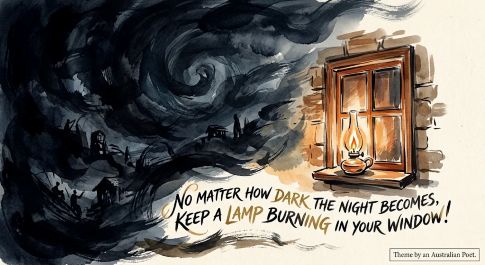
No matter how dark the night becomes,
keep a lamp burning in your window.
Plant a seed of hope
in an abandoned courtyard,
and if you meet a weary traveller,
show them where your shade begins.
We all carry broken seasons within us.
Some have a dried-up river
in their share of life;
some have a home without a lamp;
and in some eyes,
a morning still waits
that has yet to arrive.
So, do not let the soil within you
turn barren.
Catch a falling dream
in the palm of your hand,
and give a little of your sunlight
to someone who lives without shade.
For being human
means keeping a lamp alive within yourself;
a lamp whose flame does not tremble
in the storms of hunger,
does not surrender to the winds of loneliness,
and continues to illuminate
the path of thought
through the darkness of mental slavery.
We are all travellers
through our own darkness.
If you pass someone along the way,
do not turn their darkness into a spectacle.
Leave a little of your lamp’s light
upon their path.
Who knows?
Perhaps your tiny flame
will awaken within someone
the belief that morning is still possible.
And when the final evening of life descends,
may our hands be empty,
but may the fragrance of someone’s prayer remain.
May no hungry soul ever leave our doorstep
empty-handed,
and may no lonely heart
have to hide its tears
in our presence.
For a human being is made of dust.
One day, that dust will return to dust.
But the light of the lamp burning within
can enter another heart
and remain alive there
for a lifetime.
Perhaps this is the truest identity of being human:
to walk through darkness oneself,
yet leave behind a little light
for others.
____________
Read: From the Dust of Pain, Rebellion Shall Rise