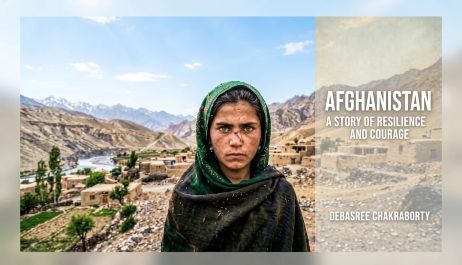
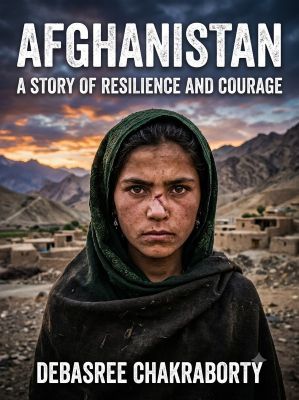
After twenty years in American newsrooms, Afghan-born journalist Nadia steps off the plane in Kabul with a single, urgent mission: to uncover the untold stories of her homeland’s forgotten daughters. Traversing a landscape of scarred palaces, dried rivers, and veiled shadows, her journey leads directly to the formidable walls of Badam Bagh Women’s Prison. There, amid the dust of a broken past, she prepares to face the raw, unyielding reality of the women left behind.
A Novel by Debasree Chakraborti
[Author’s note: The very mention of Afghanistan evokes a profound sense of wonder, intrigue and adventure. It is a country about which we know remarkably little, despite its immense historical, cultural and civilizational significance. For much of the world, Afghanistan is synonymous with war, conflict and the rule of the Taliban. Yet, beyond these familiar narratives lies a far more complex and largely unexplored world, concealing countless untold stories, forgotten histories and deeply human struggles.
Through this novel, I have attempted to present a continuous and evolving portrait of Afghanistan, tracing the rise of the Taliban and exploring the country’s transformation through to the present day. My endeavour has been to look beyond the conventional political narrative and delve into the realities of Afghan society, particularly the harrowing circumstances of women and children, examining their lives within the framework of deeply entrenched customs, traditions and prevailing social structures.
When human beings are pushed to the very edge of endurance, when every avenue of escape is sealed and every possibility of survival seems exhausted, something extraordinary begins to emerge within them: the courage to resist. It is this spirit of defiance, especially among the younger generation of Afghanistan that I have sought to bring to life through the voices of my characters. Their resistance, anguish, aspirations and determination form the emotional and ideological core of this work.
To the best of my knowledge, Bengali literature has rarely witnessed a work on Afghanistan of this breadth, one so extensively woven with historical information, documented events, social realities and diverse human experiences. The novel seeks to portray the extraordinary diversity of Afghanistan’s ethnic communities, their distinct ways of life, cultural identities, traditions and social relationships, offering readers a glimpse into a world that remains largely unfamiliar to Bengali readers.
Every character in this novel is rooted in reality. The narrative has been meticulously developed through extensive engagement with documentaries, books, historical records, official documents, testimonies and interviews. Rather than relying upon imagination alone, I have endeavoured to construct a narrative grounded in documented realities and authentic human experiences.
Ultimately, this is not merely a novel about Afghanistan, its wars or its political upheavals. It is an attempt to understand a nation through its people — their suffering, resilience, silences and resistance. It is about those whose stories seldom find their way into the pages of history, and whose voices deserve to be heard.]
Part-3 of the Chapter-1
 In Tahir, a village under the shadow of the Taliban, a great love story had begun to take shape—not in words spoken aloud, but in verses and music. Two human hearts were slowly binding themselves to the strings of the rubab. When one end of a string trembled, the other answered with the same vibration, as though neither could remain untouched by the other’s longing.
In that Taliban-dominated village, where a girl’s writing of Pashto poetry was considered a gunah, a sin, I—a young woman—had begun to write poetry in the name of my love for Noor Mohammad.
Oh, Allah! Those days can never be forgotten. So many years have passed, and yet that melody continues to play within me, as though the night in which it was first born has never truly ended.”
Nadia noticed that Adira’s eyes had suddenly begun to glow. In the darkness, they seemed almost ablaze, as though tears were gathering there, shimmering like falling stars.
The little boy had long since fallen asleep, his hunger finally quieted by the milk. Adira gently laid him down, uncovered her head, and let the scarf fall away. Then, releasing a long, weary sigh, she leaned back against the wall.
Nadia looked at Adira, her voice filled with tenderness and apprehension.
“Adira, tell me… how did you end up here? How did your life bring you within these prison walls?”
Adira drew a slow breath before beginning.
“And so the days continued to pass. One evening, just as on every other day, I was sitting with Noor Mohammad, taking my lessons in the Quran. Suddenly, the sound of gunfire erupted outside our house. There was shouting and commotion in the village. Hearing the disturbance, Noor told me to go inside. I obeyed and withdrew into the inner quarters.
A little while later, my father and my two brothers stormed into the house. With them was Mohammad Bashir, a man from our village.
My father turned to my mother and announced that he had lost a game of gambling to Bashir that evening. He had no money with which to repay his debt. Therefore, he said, our eldest sister, Karima, would have to be given in nikah to Bashir.
I stood there, utterly bewildered. What astonished me most was my mother’s silence. She stood motionless, not uttering a single word of protest. From the inner quarters came the sound of women weeping and wailing. When Karima heard that she was to be married to Bashir, she collapsed in a faint.
My father began shouting at the women of the household, ordering them to prepare Karima for the marriage. Everyone stood paralyzed by fear and helplessness.
And then, through that suffocating silence, I heard Noor Mohammad’s voice.
He confronted my father.
‘Islam regards gambling as a sin. Then how can you gamble in the first place? And because you have lost a game, how can you hand over your own daughter to this old man?’
The moment Noor called Bashir an old man, the latter flew into a rage. Like a wild beast, he sprang upon Noor. Bashir’s sons—men old enough to be my father’s contemporaries—came rushing forward with guns in their hands and surrounded Noor.
My father somehow managed to pull Noor away from Bashir and drag him into an inner room. He locked the door from the outside and left him there.
And so, because my father had lost a game of gambling, he surrendered his eldest daughter, Karima, into the hands of that old man.
That night, the village mullah was summoned to solemnize the marriage. Karima was unconscious throughout the nikah. She had no knowledge of what was being done to her. In order to free my father from the burden of his gambling debt, my mother answered ‘Qubool’—‘I accept’—on Karima’s behalf.
That night, they lifted Karima into Bashir’s horse-drawn carriage and took her away.
No one in the house wept that night. No one raised a voice. The carriage slowly disappeared into the darkness, leaving behind only the sound of the horse’s hooves echoing through the night:
That sound has never left me.
Even after all these years, I still carry within me the dreadful rhythm of those hooves—the sound that became, for me, the eternal emblem of a woman’s helplessness, of a life bartered away, and of the terrible oppression inflicted upon us.”
“The morning after Karima was taken away, nothing about the house seemed to have changed. The day began as it always had. The familiar routines resumed; the household moved through its accustomed motions. Yet, amidst all that apparent normality, Karima was nowhere to be found.
Her departure in such a manner seemed to me more terrible than death itself. The dead, at least, are remembered. People speak their names, recall their faces, and mourn their absence. But Karima’s very existence was erased from our household, as though she had never been born, as though she had never lived among us.
My second elder sister, Rashida, and I began to pass our days in a state of constant dread. My father and brothers, however, did not abandon gambling. Every evening, as dusk descended, they would leave the house for their games. And we would tremble like sacrificial goats awaiting the knife, never knowing whose turn might come next.
Every evening, as they prepared to leave, Rashida would whisper the same desperate prayer:
‘Oh Allah… protect me. Keep me safe.’
After that terrible night, Noor Mohammad did not speak a single word to my father.
He once told me, with bitter indignation, that these men claimed to be establishing the rule of Sharia.
‘Disgraceful!’ he exclaimed. ‘They wish to impose religious law upon others, yet they themselves sanction gambling. A man loses a game of cards and hands over his own daughter to a human predator as payment for his debt—and this is the Sharia they wish to establish?’
It was Noor who first made me question everything I had been taught about religion. He placed the Quran in my hands and told me that the book these men followed was not the true Quran. They had fashioned a religious text of their own, he said, reshaping its teachings to serve their interests. According to him, this was not something confined to Islam; throughout history, people in different religions had manipulated sacred teachings for their own purposes.
He spoke of Christianity, too. He claimed that much of what appeared in the New Testament had been written in the period after Constantine by his followers, who had used the name of Christ to advance their own interpretations. Jesus, he insisted, had never uttered many of those words. He also claimed that the Gospels written by Jesus had been concealed in a sealed chamber within Vatican City.
‘This is how religious teachers and preachers are used,’ Noor would say. ‘If you wish to understand the Quran, read it in English. Do not read the books written by the Taliban.’
The more I came to know Noor, the more astonished I became. How different he was from every other man I had ever encountered! I had never known a man like him before—someone who did not drink, did not gamble, and did not abuse women.
The other men in our household were accustomed to speaking to us in raised, commanding voices, as though we were creatures without feelings or dignity. But whenever Noor Mohammad addressed the women of the household… “Whenever Noor Mohammad spoke to the women of our household, his voice would soften, almost instinctively. There was such gentleness in the way he spoke to us. He would lower his head out of respect, choosing his words with a tenderness I had never encountered in any other man. It was a kind of courtesy that seemed almost unimaginable in the world in which we lived.
Rashida, meanwhile, seemed perpetually braced for some approaching catastrophe. She was always on guard, as though she knew that, sooner or later, she would be the next sacrificial offering. She understood that after Karima, her turn would come.
She did not have to wait very long.
While Rashida and I trembled like sacrificial goats, never knowing when the knife would fall, my father brought a man named Mohammad Rasul into our house one night.
‘You must have heard of Mohammad Rasul, haven’t you?’ Adira asked.
Nadia nodded. ‘Yes. Who doesn’t know him? He was a Taliban leader.’
‘Exactly. At that time, his word governed the lives of everyone in Tahir—from newborn infants to the elderly standing at death’s door. If the dust from Mohammad Rasul’s feet settled upon the threshold of a village household, that family was suddenly elevated in the eyes of society. His presence alone was considered an honor.
That night, I learnt that my elder brothers were joining the Taliban. But there was something else I learnt, something far more terrifying: our family was about to enter into a close and binding relationship with Mohammad Rasul.
Whatever was discussed outside never reached the inner quarters. We knew nothing of the arrangements being made. After some time, my mother came inside and informed Rashida that she was to be married that very night to Mohammad Rasul.
Rashida said nothing.
Like an obedient daughter, she began preparing herself for the wedding. When the mullah arrived, she submitted to the nikah, uttered the customary words of acceptance, and was taken away to Mohammad Rasul’s quarters.
The following morning, everything appeared to proceed as it always had. The household went about its usual business. But as the day wore on, disturbing news began to spread: Rashida could not be found.
Mohammad Rasul’s men searched the entire house before leaving. Yet our greatest fear was not simply that Rashida had disappeared. It was the terrible fate that might await our family if she could not be found.
Our visits to the madrasa were stopped. People became afraid to venture out onto the roads, for armed men patrolled the streets with their guns. A relentless search operation began, spreading through our village and the neighboring settlements. Every corner was searched; every hiding place was examined.
At last, Rashida was discovered in a thicket beside the Hari River.
After that, the Taliban convened a tribunal in the village. Rashida was brought before them and accused of being a woman of loose character, of having maintained relationships with other men before her marriage.
No one came forward to testify in her defense that day.
Not a single person stood beside my sister.”
“No one thought it necessary to investigate whether Rashida had actually been involved with any man. The entire village knew that when she was found, she had been alone in the thicket beside the Hari River. No one needed to ask why she had fled on the very night of her nikah. Everyone understood.
Before Rashida, almost every household in the village had already suffered the consequences of Mohammad Rasul’s merciless campaign of sexual jihad. The daughters of countless families had fallen victim to his brutality. Some had vanished so completely that not even a strand of their hair could ever be found.
But Rashida’s fate took a slightly different course.
The day after the tribunal delivered its judgement, she was taken to the banks of the Hari River and shot dead.
No one from our household went to collect her body.
On the very day Rashida was murdered, my two brothers formally joined the Taliban. Much later, I heard something that has haunted me ever since: my eldest brother, Umar, had fired the first bullet at Rashida.
After my sister’s death, remaining in that village became unbearable. I could not bring myself to endure even another day. The very next night, after my father and brothers had left for their usual card games, I went to Noor Mohammad.
‘Noor, save me,’ I begged him. ‘Take me away from here. Let us go somewhere, anywhere. I cannot live here any longer. They will subject me to the same injustice. I know what awaits me.’
Noor looked at me and asked, ‘Can you leave this house with me right now, wearing nothing but what you have on? Can you abandon everything and come away with me?’
‘Yes,’ I answered. ‘I can.’
Without telling my mother, we slipped out of the house and disappeared into the night. We had no idea where we were going. We had no plans, no certainty, no understanding of what the future might hold. We did not even stop to consider what awaited us beyond the village. We simply held each other’s hands and walked away, sustained by the strength of our love.
The darkness of the night wrapped itself around us like an enormous shroud.
At that time, American troops were beginning to enter Afghanistan, little by little. Along the way, an American military truck came upon us and rescued us, taking us to Kabul.
There, we began our life together.
In time, we became acquainted with a few people who, upon learning that neither of us was married, suggested that we should solemnize our relationship through a nikah. We agreed, and were married.
The days in Kabul were, for a while, gentle and peaceful. Noor Mohammad began teaching the local children to recite the Holy Quran. Whatever little he earned from those lessons was enough for us to build a modest but beautiful life together… “For a while, our little household continued to survive. But how long can happiness possibly remain with someone as unfortunate as me? It never stays. Not for long.
At last, one day, my father arrived with the police. We were arrested. Noor was taken away to a men’s prison, while I was sent to a women’s prison. Our crime was that we had fled without informing our families and solemnized our marriage of our own accord. For that, we were sentenced to six years’ imprisonment.
It was only after I came here that I discovered I was pregnant. I was carrying Noor’s child.
It was within these prison walls that I gave birth to my son. This is where he has been growing up. Two years have already passed. The remaining four will pass before I even realize it. Somehow, I shall endure them too.”
Adira released a long, exhausted sigh.
Nadia could no longer see the fire in her eyes. It seemed to have gone out. Perhaps, after so many years of carrying her sorrow in silence, the act of finally speaking had allowed some of that accumulated anguish to escape. Perhaps the burden upon her heart had grown a little lighter.
Nadia switched off the voice recorder and rose from her seat. She walked over to Adira, bent down and gently kissed her cheek. Wishing her good night, she turned to leave.
But just then, something made Nadia stop.
She turned around and looked back at Adira. For a few moments, she stood watching her. Adira was still seated in exactly the same position, motionless in the darkness. Yet Nadia could no longer read her eyes.
Then she asked, almost in a whisper,
“Adira, do you still love Noor Mohammad?”
For a few moments, the room remained utterly silent.
And then, in the darkness, Adira’s eyes suddenly blazed into life.
Nadia had found her answer.
Without another word, she stepped out of the room.
She had been sitting in one position for so long that her legs had begun to ache. Moving slowly along the dark corridor, she made her way towards her own room.
At night, this silent prison assumed an entirely different character. From behind the doors of different cells came different sounds: the desperate crying of a child, the lamentations of women, the muffled groans of those writhing in pain. Under the cover of darkness, it seemed as though the locked chambers of the human soul were being thrown open, one after another, releasing all the anguish that daylight had kept concealed.
From that night onwards, securing justice for Adira and Noor Mohammad became the central purpose of Nadia’s life. This was precisely why she had returned after twenty years—to stand beside women like Adira, to bring their silenced suffering before the world, and to fight for the justice that had so long been denied to them.
Nadia reached the door of her room and turned the handle. As she pushed it open, the door gave a long, creaking groan.
It seemed that the door had remained shut for a very long time. Perhaps no one had entered this room in ages; perhaps its hinges had grown stiff with disuse. The sound would gradually disappear. The door would loosen. In time, everything would fall into place.
Everything would be all right.
The bedside lamp was still burning. Its light cast Nadia’s elongated shadow upon the wall. The glow of the bulb formed an oddly circular shape, almost like the dark imprint of a bullet hole.
Nadia slipped off her slippers, climbed into bed and drew the quilt over herself. Then she reached out, switched off the lamp and closed her eyes.
But in the darkness of her room, one image continued to float before her:
Adira’s two luminous eyes.
Eyes that, even though the deepest darkness, seemed capable of carrying a message of love across the distance to Noor Mohammad—a message that no prison wall, no separation, and no passage of time could ever silence. (Continues)
_________________

Debasree Chakraborty is a renowned novel writer of Bengali language. Based in Kolkata, West Bengal, India, she has done Master’s in Modern History from the Kolkata University, and authored some thirty books, mostly the novels, with historical perspective and themes. Her novel is ‘Maharaja Dahir’ that covers the history of Sindh from 662, the year of first attack on Sindh by the Arab armies till date, was published last year and translated by Nasir Aijaz into Sindhi language. Her new novel “The Last People of Mohenjo Daro” in Bengali language, has recently been published.