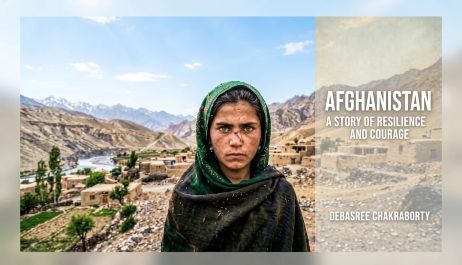
“There are two hundred and thirty incarcerated women in this facility,” she began. “And there are seventy children here as well, all under the age of four. We are all born free. Yet, the moment an Afghan girl enters this world, invisible shackles are fastened around her feet. From that day onwards, her freedom is taken away, piece by piece. Tell me, what difference remains between the life of an animal and the life of an Afghan woman when neither is allowed the freedom to determine its own existence?”
A Novel by Debasree Chakraborti
[Author’s note: The very mention of Afghanistan evokes a profound sense of wonder, intrigue and adventure. It is a country about which we know remarkably little, despite its immense historical, cultural and civilizational significance. For much of the world, Afghanistan is synonymous with war, conflict and the rule of the Taliban. Yet, beyond these familiar narratives lies a far more complex and largely unexplored world, concealing countless untold stories, forgotten histories and deeply human struggles.
Through this novel, I have attempted to present a continuous and evolving portrait of Afghanistan, tracing the rise of the Taliban and exploring the country’s transformation through to the present day. My endeavour has been to look beyond the conventional political narrative and delve into the realities of Afghan society, particularly the harrowing circumstances of women and children, examining their lives within the framework of deeply entrenched customs, traditions and prevailing social structures.
When human beings are pushed to the very edge of endurance, when every avenue of escape is sealed and every possibility of survival seems exhausted, something extraordinary begins to emerge within them: the courage to resist. It is this spirit of defiance, especially among the younger generation of Afghanistan that I have sought to bring to life through the voices of my characters. Their resistance, anguish, aspirations and determination form the emotional and ideological core of this work.
To the best of my knowledge, Bengali literature has rarely witnessed a work on Afghanistan of this breadth, one so extensively woven with historical information, documented events, social realities and diverse human experiences. The novel seeks to portray the extraordinary diversity of Afghanistan’s ethnic communities, their distinct ways of life, cultural identities, traditions and social relationships, offering readers a glimpse into a world that remains largely unfamiliar to Bengali readers.
Every character in this novel is rooted in reality. The narrative has been meticulously developed through extensive engagement with documentaries, books, historical records, official documents, testimonies and interviews. Rather than relying upon imagination alone, I have endeavoured to construct a narrative grounded in documented realities and authentic human experiences.
Ultimately, this is not merely a novel about Afghanistan, its wars or its political upheavals. It is an attempt to understand a nation through its people — their suffering, resilience, silences and resistance. It is about those whose stories seldom find their way into the pages of history, and whose voices deserve to be heard.]
Part-2 of the Chapter-1
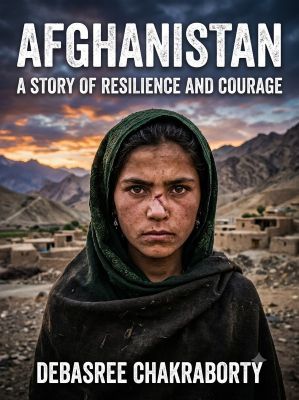 They were profoundly deep, a striking shade of blue, and carried an unmistakable expression of self-assurance. There was something resolute in that gaze, something that suggested a woman who had learnt to stand her ground in circumstances where surrender was often the only choice offered to others.
Afroz had been working at the correctional facility for eight years.
As they sat together, sipping freshly brewed hot coffee, Afroz offered Nadia a faint, almost melancholy smile.
“There are two hundred and thirty incarcerated women in this facility,” she began. “And there are seventy children here as well, all under the age of four.”
She paused for a moment before continuing.
“We are all born free. Yet, the moment an Afghan girl enters this world, invisible shackles are fastened around her feet. From that day onwards, her freedom is taken away, piece by piece. Tell me, what difference remains between the life of an animal and the life of an Afghan woman when neither is allowed the freedom to determine its own existence?”
Afroz placed her coffee cup on the table and gestured towards the surrounding walls.
“You see this prison? Strangely enough, some of these women experience a measure of freedom only after coming here. Within these walls, they can speak openly. They can share their thoughts, their grief, their fears and their secrets with one another. For the first time, some of them find people who will listen without immediately judging them.”
Her voice grew quieter.
“Within their own families, their lives often become an unending ordeal. From birth until death, they remain trapped in a cycle of oppression, humiliation and suffering. And society calls it tradition.”
Nadia listened intently.
As an Afghan woman herself, none of these revelations was entirely unfamiliar to her. She knew the invisible boundaries that governed women’s lives in her homeland. She knew how easily a woman’s wishes could be dismissed, how readily her silence could be mistaken for consent, and how often her suffering was concealed beneath the respectable appearance of family honor.
Afroz looked at her thoughtfully.
“What would you like to know? Every woman in this place has a story of her own. And believe me, not a single one of those stories is ordinary.”
By the time Afroz finished speaking, Nadia had drained her coffee.
She lowered her eyes towards the empty cup. Tiny grains of coffee residue clung to its inner walls, forming irregular patterns against the porcelain. For a brief moment, she found herself staring at them, as though even those scattered remnants had something to reveal.
Then she looked up.
“Shall we go and meet the women?”
Afroz nodded and led her deeper into the facility.
Inside, Nadia discovered a series of small, neatly arranged rooms. Each room contained three or four beds, placed close together to accommodate the women who lived there. Three or four inmates shared a room, and their children lived alongside them.
It was a strange world within a world—a place where motherhood and imprisonment had become inseparable.
Soon, the women gathered in the common room to meet Nadia. Some came alone; others carried little children in their arms. A few children clung to their mothers’ clothes, looking at the unfamiliar visitor with wide, curious eyes.
Nadia approached one of the young women.
“Was your child born here?”
The woman nodded.
“Yes. Many women have given birth here. My child is one of them.”
Nadia looked at the little one before turning towards the mother.
“How long have you been sentenced to prison?”
“Six years,” the woman replied.
Nadia stared at her in disbelief.
Six years?
She looked at the young woman’s face. It was extraordinarily beautiful, delicate as a flower, with the freshness and innocence of a rose in full bloom. It seemed almost impossible that a face so gentle could belong to someone condemned to spend six years behind prison walls.
“What happened?” Nadia asked softly. “What crime did you commit? How did you receive a sentence of six years?”
The young woman lowered her head.
For a few moments, she remained silent. Then tears began to trickle down her cheeks, tracing their way over the soft contours of her face like drops of rain falling upon rose petals.
Afroz intervened.
“She was married when she was only nine years old—to a man of sixty. For four years, she lived with him. Eventually, she fell in love with another man. Unable to endure her former life any longer, she left the old man and married the person she loved through a nikah ceremony. But the elderly husband accused her of marrying again without obtaining a formal divorce. That accusation brought her here.”
Nadia was stunned.
Before she could respond, the young woman suddenly raised her head.
The transformation was astonishing.
Until that moment, she had appeared gentle, almost painfully fragile. But now, a fierce and defiant anger rose within her. Her voice, once subdued by tears, suddenly erupted with the force of a tigress defending her cubs.
She looked directly at Nadia.
“For four years, I satisfied the hunger of a savage beast!” she cried. “I could endure it no longer. If being raped night after night by a beast is considered a virtue, then I want no share in such virtue!”
Her voice trembled, but she did not look away.
“Before Aban entered my life, I did not even know what love meant. I had never known that a human being could be loved without being treated as an object, that a woman’s heart could be cherished rather than possessed.”
She paused, struggling to contain the storm of emotions rising within her.
“Like a cold winter wind, I was slowly drying up. I was losing every trace of life within me. Then Aban came into my world like an angel. He brought me the tenderness of tulips—their delicate fragrance, their quiet beauty, and the promise that even after the harshest winter, something beautiful could still bloom.”
Nadia stood speechless.
Before her was a woman who had been married at nine, denied the right to choose her own life, subjected to years of sexual violence, and finally imprisoned for daring to seek love.
The young woman’s tears had not dried. Yet, beneath those tears, Nadia could now see something else.
Defiance.
It was the defiance of a woman who had lost almost everything, but had refused to surrender her right to feel, to love, and to belong to herself.
And somewhere within the walls of Badam Bagh, beneath the weight of iron gates and inherited prejudices, a tulip had bloomed.
A fragile tulip.
A forbidden tulip.
But a tulip all the same.
Nadia listened to the young woman’s words and realized that she was speaking under the spell of an overwhelming emotional storm. She was passionately, almost irrationally, in love with Aban. His presence in her life had awakened feelings she had never before been permitted to experience.
Several other women gathered around them and began to speak.
“According to Islamic law, if she agrees to return to her first husband, her sentence may be reduced,” one of them remarked.
Nadia turned towards them, bewildered.
“But why should she return to that old man?” another woman protested. “Does her own happiness mean nothing? Does she have no right to decide whom she wishes to live with? Is a woman’s desire always the first thing that society must sacrifice?”
Before Nadia could respond, another inmate began to recount her own story.
“My husband subjected me to terrible abuse,” she said, her voice breaking. “He would bring other men into our house and order me to spend time with them. Tell me, how could I possibly live like that? How could I surrender myself to strangers simply because my husband demanded it?”
Her eyes filled with tears.
“Eventually, I fled and returned to my brothers, believing that my own family would protect me. But they called the police instead. And the police brought me here.”
She broke down completely.
Nadia looked around the room. The women sat with their children, their faces bearing the marks of suffering that words could scarcely express. It was becoming increasingly evident that, beneath the individual circumstances of their imprisonment, their stories shared a common thread of abandonment, coercion and injustice.
In Badam Bagh, every woman seemed to carry a history of her own. Yet the wounds that had brought them there were painfully alike.
Afroz had been sitting quietly in a corner, listening to the women’s accounts. Without interrupting them, she picked up her mobile phone and called out to Hamida Banu.
“Please bring me the case file.”
Then, turning towards Nadia, she began to explain.
“There was a time when male and female prisoners were kept in the same prison. The women had to endure unimaginable conditions there.”
One of the inmates immediately interrupted her.
“Unimaginable? We were being sexually assaulted almost every moment of the day! That is why a separate prison was eventually established for women.”
Afroz nodded gravely.
“Many women came here from that prison already carrying unwanted pregnancies. Some had been violated repeatedly before they could be transferred here.”
Nadia fell silent.
She continued her inspection of the facility, observing the rooms, the common areas and the everyday lives of the inmates. Gradually, another disturbing reality began to emerge.
Although all the women lived within the same institution, they did not enjoy the same standard of living.
Money continued to determine the quality of existence even behind prison walls. Women from wealthier backgrounds had access to various comforts and privileges, while those from impoverished families struggled with the most elementary necessities. For the poorer inmates, even adequate winter clothing was a luxury. Some did not possess a decent blanket with which to cover themselves against the bitter Afghan cold.
The prison, Nadia realized, had its own hierarchy of privilege.
By the time the sun began to set, she had spent almost the entire day inside Badam Bagh. And as daylight slowly receded, the true face of the institution began to reveal itself.
From different corners of the prison came the cries of children and the anguished voices of women.
Nadia walked along a dimly illuminated corridor, where fading light and encroaching darkness mingled in unsettling patterns. The scene was almost identical in every room.
Mothers were desperately trying to hold their little ones against their bodies, wrapping their arms around them in an effort to transfer whatever warmth they could. Their children were pressed against their breasts and chests, their tiny limbs trembling in the cold. But the winter was merciless, and the inadequate clothing offered little protection.
The children’s cries continued.
No amount of maternal tenderness could entirely compensate for the absence of warmth.
Nadia moved slowly through the corridor, listening to the helpless sobbing that rose and fell behind every doorway. She felt as though she were walking through an immense chamber of collective sorrow, where motherhood itself had been imprisoned.
Then she noticed something unusual.
At the far end of the corridor stood a tall, elongated shadow. Projected upon the wall, it resembled a long piece of timber, except that it seemed to move its head as though engaged in conversation.
Intrigued, Nadia began walking towards it.
As she approached, she could hear faint voices. Someone was speaking in an extremely low whisper, but the words were too indistinct for her to comprehend.
At that very moment, the call to prayer began to rise from the direction of Shah-Do Shamshira Mosque.
Nadia adjusted the scarf around her head and moved a little closer.
Then she recognized the figure.
It was Afroz.
Standing before her were six young women, carefully dressed and adorned. Afroz appeared to be giving them instructions. The moment they noticed Nadia approaching, the girls looked startled. Afroz made a brief gesture towards them, accompanied by a few quiet words, and the six women hurried down the staircase.
Nadia watched them disappear.
Afroz turned towards her and studied her face for a moment.
“Come,” she said at last. “I would like you to meet someone. She sings Pashto folk songs beautifully. The sorrow she carries within her heart finds its way out through her music. It is almost as though she pours the contents of her wounded soul into every song.”
Nadia was about to ask something when she heard the sound of the main gate opening.
A vehicle had arrived.
Its headlights swept across the veranda, briefly illuminating the darkened corridor.
And then Nadia met Adira.
The moment she saw her, Nadia experienced an inexplicable sense of spiritual kinship, as though some invisible bond had connected their souls long before they had ever met.
Adira was sitting in a darkened room, holding her little son in her arms. It was the hour of prayer, and she had covered her head with a scarf. Even in the darkness, her two eyes shone with extraordinary brilliance.
There was something arresting about them.
Nadia entered quietly and looked at the young mother.
“She has been sentenced to imprisonment for violating religious law?” she asked, her voice reflecting a mixture of disbelief and sorrow.
Afroz answered before Adira could speak.
“Every woman you see here has, in one way or another, been accused of violating Sharia law. But I will tell you something. Most of these women have already lost faith in the idea that Allah has their welfare in mind. There is little point in wasting time calling upon a God whom they feel has abandoned them.”
Her words were blunt, almost confrontational.
Just then, Adira’s little boy stirred in his sleep and began to cry.
Without a moment’s hesitation, she brought him to her breast and began nursing him. In the half-light of the room, Nadia could see the little one’s head moving gently as he suckled, instinctively seeking the nourishment and comfort that only his mother’s body could provide.
Nadia approached and sat down in front of Adira.
The young woman’s eyes were extraordinary—luminous, deep and strangely captivating. Even in the darkness, they seemed to possess a light of their own.
Afroz smiled faintly.
“Adira, why don’t you sing a Pashto song for our journalist guest? She has come all the way from America. She would love to hear you sing in your own language.”
Adira looked at Nadia for a moment.
Then, in the stillness of the dimly lit room, she began to sing.
Her voice was soft, almost fragile, yet it carried an extraordinary depth of feeling. The melody rose slowly, filling the silence around them. It was not merely a song; it seemed to be the expression of everything she had been unable to say aloud.
The Pashto words floated through the room:
“Oh ayala tasbir na ayarelaga,
Za Khushal Kamraza na yam che ba dar kam.”
Nadia listened without moving.
Outside, the evening prayer continued to drift across the prison walls. Inside, a mother held her child close to her breast, while her voice carried the sorrow of a life that had known far too little tenderness.
For a moment, the boundaries between the journalist and the prisoner, the visitor and the captive, seemed to disappear.
There was only a woman singing to another woman.
And in that song, Nadia sensed an entire world of grief—an Afghanistan that could not be captured in official reports, political declarations or newspaper headlines.
It was an Afghanistan that lived in the voices of its women.
As Nadia listened to the young woman sing, an ache began to gather deep within her heart. There was something in Adira’s voice that seemed to reach beyond the boundaries of melody, touching a place where sorrow had long lain buried. Nadia noticed that, as the song unfolded, Adira’s eyes grew strangely brighter—as though the act of singing had kindled a hidden flame within them, illuminating the grief she could not otherwise bring herself to speak of.
When the final note faded into silence, Nadia turned towards her.
“You are carrying some terrible sorrow deep within your heart,” she said gently. “A sorrow you have kept hidden from the world. I want to know your story.”
Adira began to speak, but her voice was scarcely more than a whisper. Her words dissolved into the stillness of the room, so faint that Nadia could not make them out at first.
Leaning closer, Nadia spoke again, her voice tender with compassion.
“I want to hear you, Adira. I want to listen to your story. Will you tell me? Will you let me know what lies buried in your heart?”
Afroz spoke softly, with the quiet conviction of someone who had witnessed too much suffering to be surprised by it any longer.
“All these women have stories of their own, stories they long to tell. But there is no one willing to listen. If you truly wish to know, Adira will open her heart and tell you everything.”
Nadia turned towards Adira. “I want to hear the answer from you, Adira. Will you tell me your story? I will carry your voice to people across the world. I will let them hear the anguish buried within you—the terrible sorrow that has been gnawing at your heart, like a woodworm slowly devouring the very core of a tree.”
Adira remained silent for a while. Then she murmured something, so faintly that Nadia could scarcely distinguish a single word.
“I couldn’t hear you,” Nadia said gently. “Just nod your head and tell me—yes or no. Are you willing to speak?”
Adira slowly nodded. It was her consent. She wanted to tell Nadia everything.
Overcome with affection, Nadia hurried forward and planted a kiss on Adira’s cheek. Then she rushed back to her room to fetch her voice recorder.
Years of enforced silence had almost extinguished the women’s voices. Their throats had grown unused to speech; though the fire of protest still burned somewhere within their hearts, they had forgotten how to give it the force of a cry. Their voices, like their lives, had been subdued for far too long.
The night grew deeper, its darkness spreading like a vast black burqa over the entire valley. An extraordinary stillness descended upon Badam Bagh Women’s Prison. Even nature seemed to have fallen silent, as though the night itself had withdrawn to make room for Adira’s story.
Gradually, Adira’s voice became clearer to Nadia. There was a strange rhythm to the prison nights: when the rest of the world slept, women like Adira seemed to awaken. And it was then, in those secret hours between darkness and dawn, that their buried words finally found their way out.
“Beside the Hari River lies our little village, Tahir. The blue waters of the Hari flow along the feet of the golden mountains. I was born into the family of Haji Mohammad, a man of the Pashtun tribe. When I was three years old, my marriage was arranged—with one of my father’s friends.”
Nadia looked at her in astonishment.
“Your family arranged your marriage when you were only three?”
Adira’s expression did not change.
“Three is already quite old,” she replied quietly. “For many girls, their marriages are arranged when they are barely a year old. I grew up in Tahir, a village under the shadow of the Taliban…”
“…where people awaken in the morning to the sound of gunfire, and go to sleep at night with a heart full of foreboding.
There were three of us sisters. We attended a madrasa for girls, where we studied the Holy Quran. From our earliest childhood, we had been raised, little by little, in the teachings of the Quran. Even amid those terrible circumstances, we clung to the Holy Book as though it were the one sanctuary left to us. Our faith in Allah and His Messenger was absolute, rooted deep in our hearts. Our teachers sat behind a curtain and taught us to recite the Quran, never appearing before us.
To preserve our modesty and purity, we concealed ourselves within black burqas. We would return home together from the madrasa, walking in little groups. Every joy, every affection, every tender pleasure in our young lives revolved around the Quran. And so the days passed, one after another, within the narrow boundaries of that sheltered existence.
Then, one evening, as I sat with my sisters reciting the Quran, Noor Mohammad arrived at our house. He was the son of my father’s elder brother—my cousin.
We were forbidden to appear before men. So I saw Noor Mohammad for the first time through a narrow opening in the curtain. The flickering light of a hurricane lantern fell upon his face. And at that very first glimpse, something stirred within me. I found myself drawn to him.
The men I had known all my life had never looked like him. His face was different from theirs—there was something in it that seemed to resemble the countenance of a truly devout Muslim. My heart trembled. A strange thought took hold of me: perhaps I had been waiting for him all my life. Perhaps Allah had sent Noor Mohammad to rescue me.
I forgot that, according to the laws imposed upon us, going against one’s family was a sin. I forgot that my brothers’ guns could tear my breast apart. Everything else faded from my mind. Only one name became etched upon my heart, in letters too deep ever to be erased:
Noor Mohammad.
It was as though the hot blood within me had suddenly begun to flow anew. For the first time in my life, I smiled. Tears of happiness streamed from my eyes.
That was how it began.
Whenever my father and brothers went out, I would deliberately find reasons to appear before Noor Mohammad. Behind the veils of our burqas, our eyes began to meet. A silent exchange of glances grew between us, each look carrying words neither of us dared to speak aloud.
Noor Mohammad used to teach my younger brothers and sisters. One day, when the house was empty, the familiar evening routine unfolded. As dusk descended, my father and brothers would leave to join their gatherings of cards. But Noor Mohammad never went anywhere. During those hours, he stayed behind to teach my siblings the Quran.
One day, my elder sisters turned to me and said, “Adira, go and take Noor some sherbet…”
“‘Go and bring him some sherbet.”
In those days, it was usually my mother who took Noor his sherbet. My mother was a gentle, unassuming woman, one who kept to herself and never meddled in anyone’s affairs. She had no way of knowing what was stirring inside my heart. So, with the innocence of someone who suspects nothing, she simply placed the glass of sherbet in my hands.
That evening, with no other men in the house, I deliberately dressed for the occasion. I covered my head with a pink scarf and put on a pink salwar kameez. Then I went to take the sherbet to Noor Mohammad.
It was the first time he had truly looked at me. Not merely glanced at me, but seen me—with his eyes, his heart, his whole being. And from the expression in his eyes, I understood that he had fallen in love with me.
When he had finished drinking the sherbet, he suggested that I should come to him for lessons in the Quran. I had never imagined that everything would begin so soon. Yet I agreed.
Thus began my Quran lessons with Noor Mohammad.
Whenever my father and brothers left for their card games, I would hurry to my Noor for lessons. Slowly, almost imperceptibly, we began to draw closer to one another, even as we remained surrounded by my mother, my brothers and sisters. In the midst of their ordinary presence, a secret world was quietly taking shape between us.
The slightest touch of Noor’s hand would set my thoughts trembling and send me searching for words. I began writing Pashto poetry. During our Quran lessons, I would quietly slip the little folded pieces of paper into his hand. Whatever feelings had stirred within me the previous night and compelled me to write, I would pour into those verses and entrust them to him. Every unspoken emotion, every longing that had no place in the world around me, found its way onto those pages.
And so it continued.
Noor Mohammad was a gifted rubab player. Deep into the night, when he played his instrument, I would light a tiny lamp in my darkened room and write Pashto poetry. The plaintive music of his rubab seemed to travel across the darkness, reaching the waters of the Hari River and raising ripples of melody upon its surface. (Continues)
Read: Part-1,
__________________

Debasree Chakraborty is a renowned novel writer of Bengali language. Based in Kolkata, West Bengal, India, she has done Master’s in Modern History from the Kolkata University, and authored some thirty books, mostly the novels, with historical perspective and themes. Her novel is ‘Maharaja Dahir’ that covers the history of Sindh from 662, the year of first attack on Sindh by the Arab armies till date, was published last year and translated by Nasir Aijaz into Sindhi language. Her new novel “The Last People of Mohenjo Daro” in Bengali language, has recently been published.