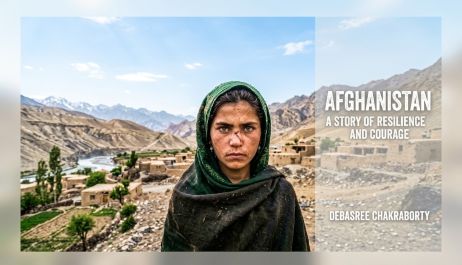
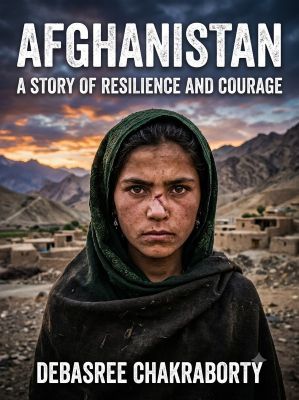
After twenty years in American newsrooms, Afghan-born journalist Nadia steps off the plane in Kabul with a single, urgent mission: to uncover the untold stories of her homeland’s forgotten daughters. Traversing a landscape of scarred palaces, dried rivers, and veiled shadows, her journey leads directly to the formidable walls of Badam Bagh Women’s Prison. There, amid the dust of a broken past, she prepares to face the raw, unyielding reality of the women left behind.
A Novel By Debasree Chakraborti
Part-1 of the Chapter-1
The Return of a Daughter
Another day was awakening to the music of a new dawn.
The heavens seemed to have been washed in liquid gold. As the first rays of the rising sun touched the clouds, they scattered into a magnificent aureole of golden light, sending a thousand shades and colors shimmering across the vast expanse of the sky. It was as though Allah and His Messenger, with invisible pens fashioned from the finest reeds, were engaged in composing yet another imperishable masterpiece upon the canvas of creation.
Far away, a solitary white cloud drifted across the heavens. It resembled a little lamb, lost in the boundless blue.
 As the first light of morning descended upon the desert, the golden landscape seemed to come alive. The little lamb appeared to be racing across the sunlit wilderness, and behind it ran a twelve-year-old girl, her laughter mingling with the breath of the morning wind. In the unrestrained exuberance of childhood, two innocent souls seemed to illuminate the entire wilderness with their radiant vitality. Their laughter rippled across the barren expanse, bringing a sudden tide of life to a land otherwise surrendered to silence.
But not far from that enchanted landscape lay a crimson abyss.
A bloodstained corpse rested in the heart of the desert—a silent, horrifying testimony to a violence that had shattered the innocence of the earth itself.
The little girl closed her eyes.
A moment later, an announcement echoed through the aircraft, instructing passengers to fasten their seat belts in preparation for landing.
She felt the aircraft descending, its movement trembling through every fiber of her being. Slowly, she opened her eyes and looked through the oval window. Beneath her stretched an endless expanse of golden desert, its familiar hues emerging from the haze of memory.
And then, somewhere deep within her, she heard the sweetest melody of her Rubab.
For a fleeting moment, she felt as though, after twenty long years of exile, she was returning to her mother’s embrace—not merely to a geographical homeland, but to the very womb of her existence.
Her name was Nadia.
By birth, she was an Afghan; by profession, an American journalist. For years, she had worked in the United States, carrying the stories of distant lands to the world’s most powerful newsrooms. Yet, beneath her professional identity, there had always remained an Afghan daughter, haunted by the suffering of the women of her homeland.
Now, after two decades, she was returning—not as a tourist, nor as a nostalgic traveller, but as a witness.
She had come to tell the world the untold stories of the women of Afghanistan: their silenced voices, their stolen dreams, their unbearable humiliation, and their struggle to preserve the last fragments of their humanity in a society that had increasingly denied them the right to exist on their own terms.
The aircraft finally touched the runway of Hamid Karzai International Airport.
Nadia had come home.
Or perhaps, she had come to confront the ruins of everything she had once called home.
After collecting her luggage, she hired a taxi from the airport. Her destination was Badam Bagh Women’s Prison.
As the car moved towards the city, Nadia gazed through the window, trying to reconcile the Kabul of her childhood with the city unfolding before her eyes. Twenty years had passed. Two decades of war, devastation, political upheaval and human suffering had left their indelible scars upon the landscape.
The city had changed beyond recognition.
Dust rose in swirling clouds as the taxi sped along the battered roads. Buildings stood like wounded survivors of an unending war. Here and there, the remnants of destruction bore mute testimony to the violence that had repeatedly swept across the country. Kabul seemed to carry the burden of a thousand unspoken tragedies.
Yet what struck Nadia most profoundly was the absence of women.
There were hardly any women on the streets. Those few she could see were almost entirely concealed beneath black burqas, their faces and bodies swallowed by layers of dark fabric. From a distance, they resembled a flock of black crows moving silently along the roadside, their heads bowed, their identities dissolved into the monotonous darkness of their garments.
Nadia watched them intently from inside the taxi.
She tried to see their faces, to discover whether there was a pair of familiar eyes beneath those veils, whether there remained a spark of defiance, a fragment of hope, or even the faintest remembrance of the lives they had once lived.
Who were these women?
What dreams had they buried beneath those black coverings? What stories were imprisoned behind their silence? Were they mothers, daughters, teachers, poets, students—or simply women who had once dared to imagine a different future?
The taxi continued its journey, raising clouds of dust behind it.
And Nadia kept looking.
Somewhere beyond those veiled faces, she knew, lay the Afghanistan she had returned to find. But she was beginning to understand that the country she remembered and the country she had come to investigate might no longer be the same.
Ahead lay Badam Bagh Women’s Prison.
And beyond its walls, perhaps, waited the stories that the world had long refused to hear.
Nadia tried to catch a glimpse of the women’s faces, but there was nothing to be seen. Only their eyes remained visible. Even those eyes seemed imprisoned behind an intricate mesh of fabric, a delicate yet terrifying lattice—more suffocating, perhaps, than the iron bars of a prison cell. Through that narrow web, the beautiful world outside must have appeared colorless, distorted, almost devoid of life. Nadia wondered what it meant to behold the world every day and yet be denied the freedom to experience its colors.
The taxi continued along the dusty highway.
Rows of houses stood in orderly succession against the backdrop of yellow mountains. Far away, upon the summit of a distant hill, the Afghan national flag fluttered in the wind. Beyond the ochre slopes rose another mountain, its summit draped in a pristine mantle of white snow. The contrast was breathtaking—the golden barrenness of the lower landscape meeting the immaculate whiteness of the distant peaks, as though nature itself had painted two opposing destinies upon the same canvas.
In the aftermath of war, reconstruction was slowly gathering momentum. With assistance from allied nations, roads were being repaired, damaged infrastructure was being restored, and towering buildings were beginning to pierce the skyline. Broad asphalt highways stretched across the dusty terrain, flanked on either side by rows of skeletal trees.
The trees, however, seemed to have surrendered to a different kind of devastation.
Years of bombardment, environmental contamination and the lingering consequences of war had left their mark upon the vegetation. Not a single leaf adorned their branches. Their bare, withered limbs reached towards the heavens like the outstretched arms of forgotten souls. They stood along the roadsides, frail and desolate, their exhausted bodies bearing silent witness to the ecological tragedy of Afghanistan. In their nakedness, they seemed to embody the present condition of the country’s wounded landscape.
As the taxi travelled farther from the city, another sight emerged upon the grey horizon.
Darul Aman Palace.
The magnificent structure stood in the distance, its once-proud silhouette now reduced to the appearance of a wounded giant. It had once symbolized the dream of a modern Afghanistan—a nation aspiring to embrace progress, dignity and a new political destiny. But the devastation that followed decades of conflict had stripped it of much of its former grandeur.
Nadia’s eyes remained fixed upon the palace.
The memory of the devastating Taliban assault of 15 April 2012 returned to her with startling intensity. The sight of the battered monument sent a shudder through her very soul. It was difficult to reconcile the ruins before her with the magnificent architectural vision that had once embodied the aspirations of an emerging nation.
The nearby Tajbeg Palace, with its extraordinary architectural elegance, evoked the grandeur of a European royal residence. Its imposing façade and majestic proportions had once stood proudly as a symbol of Afghan magnificence. Yet now, even that architectural splendour seemed condemned to an uncertain existence, as though the palace itself lived beneath the perpetual shadow of an approaching death.
Nadia turned towards the driver.
“Could you please take me closer to Darul Aman Palace?”
The driver nodded and steered the taxi towards the ruined monument.
A few moments later, Nadia stepped out of the car.
She walked slowly towards the palace.
The closer she approached, the more devastating the sight became. The roof had disappeared, leaving the upper structure exposed to the open sky. The walls, once adorned with the refined elegance of Victorian-inspired architecture, had crumbled in several places. Massive fragments of masonry lay scattered across the grounds, forming heaps of broken stone and shattered dreams.
And yet, amidst all that destruction, something remained.
Along the two sides of the vast central corridor stood a series of elongated pillars. Damaged, weather-beaten and visibly exhausted, they continued to bear the weight of whatever remained of the structure. They seemed to be making one final, desperate attempt to preserve the dignity of the palace—to hold together, if only for a little longer, the dream of a modern Afghanistan.
Nadia climbed towards the upper floor.
Standing between two pillars of the second-floor balcony, she looked out at her country.
Before her stretched a vast panorama of yellow, barren terrain. A serpentine road wound its way through the desert, disappearing into the distant mountains. Along that road, vehicles moved in endless lines, appearing from above like tiny wood-boring insects crawling across the wounded body of the earth.
The image struck her with unbearable force.
Her motherland seemed to have become a gigantic body, ravaged by the relentless bites of countless invisible worms. The wounds inflicted upon its flesh had accumulated over generations. On either side of the highway, heaps of rubble and broken masonry lay piled like yellow mountains, the remains of a civilization repeatedly crushed beneath the weight of war.
Nadia stood motionless.
The palace behind her was wounded. The trees beside the highway were lifeless. The mountains carried the silence of centuries, while the roads bore the restless movement of a nation struggling to survive.
She had returned to Afghanistan after twenty years, hoping to rediscover the country of her childhood.
But what stood before her was not merely a country scarred by war.
It was a motherland whose memories had been demolished, whose daughters had been silenced, whose natural beauty had been ravaged, and whose dreams of modernity lay scattered beneath the dust of history.
And Nadia, standing amidst the ruins of Darul Aman, suddenly realized that the greatest tragedy of Afghanistan was not that its palaces had fallen.
It was that an entire generation had grown up without ever knowing what it meant to live freely beneath an open sky.
The palace, its walls peeling and flaking like the weathered skin of an ancient monarch, lay stretched upon its final bed, much like a wounded king who had fought a thousand battles and at last surrendered to the silence of death. Yet, even in its ruin, it seemed to gaze upon the Afghanistan it had once cherished with such boundless affection. From its broken chambers, it appeared to be watching over the land that had been its pride, its passion, and its enduring dream.
The first rays of the morning sun were spreading across the horizon. White pigeons circled freely in the open sky, while somewhere in the distance the melancholic strains of a rubab floated upon the morning air.
A faint light of hope began to stir within Nadia.
She approached the fallen monument, bent down, and gathered a little dust from the feet of her prostrate father. Gently, she touched the dust to her forehead, as though receiving the final blessing of a dying patriarch. Then she closed her eyes and whispered something under her breath.
No one could tell what she had said.
Perhaps it was a prayer. Perhaps a promise. Or perhaps it was a daughter’s silent assurance to her wounded fatherland that she had not forgotten it.
A moment later, she turned away and walked out of the palace.
Getting into the taxi, she addressed the driver.
“Please take me to Badam Bagh Women’s Correctional Facility.”
The vehicle moved forward, and before long, the Kabul River came into view.
But the river Nadia remembered seemed to have disappeared.
The once-vibrant watercourse, which had served as the lifeblood of Kabul, now appeared to be dying a slow and miserable death. It seemed to have lost its very course, its identity, its ancient rhythm. The refuse of an entire city had accumulated within its weary embrace. What had once nourished the city and given it life had become a repository for everything that the inhabitants no longer wished to keep.
The river lay almost motionless beneath the burden of human indifference, as though it had forgotten the exuberance with which it had once flowed through the heart of Kabul.
Beside its banks stood a two-story mosque built of yellow stone—the Shah-Do Shamshira Mosque. The morning sun illuminated its distinctive architecture, casting a gentle radiance upon its walls. Nearby, undisturbed by the turmoil of the living world, lay the tomb of Chin Timur, the brother of the Mughal emperor Babur.
Nadia carefully adjusted her green scarf, wrapping it more securely around her head.
Her thoughts wandered towards Chin Timur.
Had the horrors of these wars never disturbed his sleep? Had the relentless violence, the destruction of his beloved city, and the suffering of generations never penetrated the stillness of his grave? Was he truly resting in peace beneath the soil of a country that had known so little peace among the living?
The taxi continued along the banks of the Kabul River.
To call it a river now seemed almost an act of exaggeration. Indeed, even comparing it to a canal might have been an injustice to the dignity of canals. Its waters had receded, leaving stretches of exposed sediment and sandbanks across its once-flowing bed.
Amid the heaps of accumulated rubbish, the dispossessed and the destitute were searching for their precious little treasures—objects discarded by others but perhaps still capable of sustaining a fragment of their own existence. Bent over the refuse, they sifted through the debris with the desperate patience of those who had long ago ceased to expect anything from life, yet could not afford to abandon hope altogether.
The taxi sped onwards.
Nadia had hardly slept throughout the night aboard the aircraft. The exhaustion of the journey was beginning to weigh upon her. Her eyelids grew heavy, and she gradually drifted into a light, uneasy slumber.
Then the driver’s voice interrupted her thoughts.
“We have arrived.”
Nadia opened her eyes.
Before her stood Badam Bagh Women’s Correctional Facility—a fortress-like establishment surrounded by towering walls and coils of barbed wire. Its imposing exterior seemed designed to keep an entire world imprisoned within its boundaries, separating those inside from the freedom of the world outside.
Nadia stepped out of the taxi and walked towards the entrance.
From the gate, she could see a balcony where garments of various colors hung in the morning breeze. Kurtas, pyjamas and scarves of different shades swayed gently beside the tiny clothes of children—little shirts and dresses, delicate reminders of childhood suspended between the prison walls and the open sky.
She stopped.
For a long moment, Nadia stood motionless before the gate.
The scene unfolded before her eyes like a living canvas. An array of colorful garments fluttered in the breeze, their colors dancing against the somber backdrop of the prison walls. There was something profoundly moving about the sight. Within that fortress of confinement, those little pieces of clothing seemed to carry the fragrance of ordinary domestic life—the warmth of mothers, the innocence of children, and the fragile continuance of human affection.
Nadia drew a deep breath.
She imagined the scent of Afghan mothers and their children—the intimate, unmistakable fragrance of motherhood, childhood and home. For a moment, she seemed to breathe in not merely the air of the prison courtyard, but the very essence of the Afghan household: a mother’s embrace, a child’s laughter, the warmth of a family, and the tenderness of lives struggling to survive behind walls of confinement.
Then another image rose before her inner eye.
She saw a cluster of tiny saplings, fragile and tender, standing upon the earth beneath the morning sun. Their slender stems trembled in the gentle breeze, yet they continued to grow. Slowly, almost imperceptibly, they stretched towards the light, gathering strength from the warmth of the sun.
Nadia watched those imagined saplings in silence.
Perhaps those little garments belonged to the children whose mothers were imprisoned within these walls. Perhaps those mothers, despite everything that had been taken away from them, were still nurturing the smallest, most precious fragments of life.
And perhaps, like those young saplings, the children of Afghanistan would one day grow beyond the shadows of these walls.
The morning sun continued to shine.
Even here, behind iron gates and coils of barbed wire, life had not entirely surrendered.
A child’s sudden cry broke the silence.
Nadia turned towards the sound and caught sight of a newborn tulip bud, its delicate petals seemingly pierced by the cruel embrace of barbed wire. The tiny flower appeared impossibly fragile, yet it had somehow found the courage to bloom amidst a world of iron barriers and human suffering.
It was an image Nadia would not easily forget.
As she approached the entrance, the guard rose to his feet. Nadia reached into her side bag, took out her identification papers and presented them to him. After a brief examination, the great gate of the correctional facility swung open.
She stepped inside.
Her first encounter was with a woman named Afroz.
Upon receiving Nadia’s introduction, Afroz welcomed her and escorted her to her office.
At first glance, Afroz hardly resembled the stereotypical image of an Afghan woman. Her hair was cropped short, almost in a masculine fashion. She wore a pair of green trousers and a matching shirt. There was not the slightest trace of a hijab. Her hands and feet appeared unusually sturdy, with a ruggedness more commonly associated with men. Her complexion was fair, though years of exposure to the harsh Afghan sun had lent it a deep, burnished, coppery hue.
But it was her eyes that held Nadia’s attention. (Continues)
Read: Two Shores of the Same River
____________

Debasree Chakraborty is a renowned novel writer of Bengali language. Based in Kolkata, West Bengal, India, she has done Master’s in Modern History from the Kolkata University, and authored some thirty books, mostly the novels, with historical perspective and themes. Her novel is ‘Maharaja Dahir’ that covers the history of Sindh from 662, the year of first attack on Sindh by the Arab armies till date, was published last year and translated by Nasir Aijaz into Sindhi language. Her new novel “The Last People of Mohenjo Daro” in Bengali language, has recently been published.