
Kolkata-based historical fiction author Debasree Chaktaborti on the shared heartbeat and intertwined destinies of Bengal and Sindh
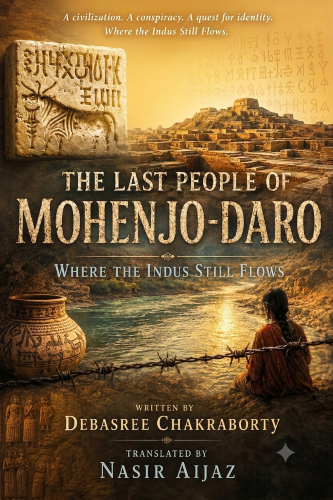
An interview with the author of the celebrated novel Maharaja Dahir on her new creation, The Last Man of Mohenjo Daro — Where the River Indus Still Flows. Discover Debasree Ji’s spiritual and literary journey into ancient Meluhha, and how a Kolkata writer became a voice for ancient Sindh.
Debasree Chakraborty is a renowned novel writer of Bengali language. Based in Kolkata, West Bengal, India, she has done Master’s in Modern History from the Kolkata University, and authored some thirty books, mostly the novels, with historical perspective and themes. Her novel is ‘Maharaja Dahir’ that covers the history of Sindh from 662, the year of first attack on Sindh by the Arab armies till date, was published last year and translated by Nasir Aijaz into Sindhi language.
{In this evocative interview, Kolkata-based historical fiction author Debasree Chakraborty discusses her latest novel, The Last Man of Mohenjo Daro, exploring the profound civilizational ties that bind the riverine cultures of Bengal and Sindh. Driven by a lifelong fascination with the Indus Valley and guided by cultural mentors across borders, she discusses why she views the Indus River not just as a setting, but as the true, living protagonist of her narrative. Ultimately, Debasree Ji offers a poignant meditation on environmental decay, internal unity, and the urgent moral covenant modern societies hold with their ancestral roots. }
 Interviewed by: Sindh Courier
Your previous novel deeply explored the life and era of Maharaja Dahir, which resonated so strongly that it was translated and celebrated in Sindh. What drew you from the medieval history of Sindh back into its deepest ancient roots for The Last Man of Mohenjo Daro?
Ever since I became aware of the world around me, I have been irresistibly drawn to Mohenjo-daro and the entire Indus Valley Civilization. From my earliest years, I felt as though that distant past was silently calling me. It was my longing to see Mohenjo-daro with my own eyes that inspired me to study history. I often dreamed of standing amid its ancient ruins as an archaeologist, carefully uncovering the forgotten layers of a civilization that had lain buried for thousands of years.
Later, my novel Maharaja Dahir Sen forged a profound spiritual and literary bond between me and the readers of Sindh. That connection deepened my long-cherished dream, my emotions, and my sense of belonging to the land that had fascinated me for so long. It was then that I realized Mohenjo-daro was no longer merely an archaeological site to me—it had become an inseparable part of my literary journey.
The direct inspiration to write Mohenjo-daro came from the esteemed Nasir Aijaz. His unwavering faith in me, his indomitable spirit, his constant encouragement, and his generous blessings gave me the strength to embark on this challenging literary endeavor. Without his inspiration and support, this novel would never have come into being.
As a writer based in Kolkata, you have developed a profound literary bond with the history and soul of Sindh. How do you perceive the cultural and emotional connection between Bengali literature and the heritage of the Indus Valley?
 Bengal and Sindh may be separated by geography, yet they share the same heartbeat. For the people of both lands, rivers and the sea are far more than natural landscapes; they are the lifeblood that shapes their history, culture, economy, and collective consciousness. The ceaseless flow of water not only carves the land but also moulds the emotions, dreams, resilience, and identity of those who inhabit it. It is this intimate relationship with water that has created a remarkable affinity between the people of Bengal and Sindh.
On a deeply personal level, I have come to realize that these two communities possess an extraordinary resemblance in their emotional sensibilities, their collective psyche, and the very essence of their character. That shared spirit finds its most profound expression in literature. In both Bengali and Sindhi literary traditions, one encounters the same recurring themes—love for the land, the eternal presence of rivers, the pain of separation, the dignity of resistance, the quest for identity, and an unwavering faith in humanity.
Like the Bengalis, the Sindhis are a people distinguished by their secular outlook, intellectual curiosity, cultural refinement, and profound respect for learning. History, however, has dealt harshly with both communities. Each has endured its own share of exploitation, displacement, marginalization, and the painful struggle to preserve its cultural identity. The unfulfilled aspirations, the quiet anguish of deprivation, and the enduring resilience born of adversity have left an indelible imprint on the literature of both peoples.
Perhaps this is why I have never regarded Sindh as a land separate from Bengal. To me, they are two shores of the same river of civilization—bound together by a shared historical consciousness, a common humanism, and an enduring cultural legacy. Borders may divide nations, and languages may differ, but the geography of the human heart recognizes no frontiers.
It is with this conviction that I have sought, through my writing, to build a bridge between Bengal and Sindh. For me, literature is not merely an artistic pursuit; it is a timeless bridge that unites cultures, languages, and people through empathy, memory, and shared humanity.
At the heart of this journey stands one individual whose inspiration has been immeasurable—Nasir Aijaz. He taught me to see Sindh not merely as a subject of historical inquiry, but as a living emotional landscape that could be experienced, understood, and embraced through literature. His unwavering faith in my vision, his generous encouragement, and his enduring support gave me the courage to forge this profound literary and spiritual connection with Sindh. Whatever I have been able to achieve in bringing Bengal and Sindh closer through literature owes an immeasurable debt to his inspiration.
“Nasir Ji and this novel, ‘The Last Man of Mohenjo Daro’, are one and the same to me. I have dedicated this novel to him. In fact, ‘Kama’, the main character of the novel, is none other than Nasir Ji himself.”
The subtitle of your new novel is “Where the River Indus Still Flows.” The Indus (Sindhu) is not just a geographic entity but a living cultural consciousness. How does the river function as a character or a continuous thread in your narrative?
The Indus is far more than a river; it is the spiritual current of one of the world’s oldest civilizations. Within its timeless flow resides an ancient consciousness that, thousands of years ago, nurtured the rise of an extraordinarily advanced civilization—one that laid the foundations of social order, political thought, economic organization, artistic expression, and philosophical inquiry. Kingdoms have risen and fallen, cities have crumbled into dust, and empires have vanished into history, yet the soul of that civilization has never been extinguished. Like the river itself, it continues to flow across the ages, carrying the memory of an enduring human legacy.
For millennia, the Indus has stood as a silent witness to the destiny of Sindh and its people. It has watched generations emerge and disappear; it has borne witness to triumph and tragedy, love and loss, conquest and resistance, exile and homecoming. Every ripple of its waters echoes with the stories of a land whose history has never ceased to evolve.
In this novel, therefore, the true protagonist is not an individual but the Indus River itself. As the eternal witness and silent narrator, the river guides the reader on a sweeping journey from the ancient world of Meluhha to the present day, tracing the continuous evolution of the people of Sindh across thousands of years. This is not merely a historical narrative; it is an epic meditation on memory, identity, resilience, and the unbroken continuity of civilization—a testament to the enduring dialogue between humanity and the river that has shaped its destiny since the dawn of history.
The title evokes a powerful, poignant image. Without giving away too many spoilers, who is this “Last Man,” and what does he symbolize in the context of a civilization known for its collective urban harmony rather than individual rulers?
 You are the last people of Mohenjo-daro—one of the few who still remain. Your numbers can now be counted on the fingers of a hand, yet you continue to carry an unwavering love for Sindh and its ancient soul. In that sense, you are not merely people of the present; you are the living echoes of another age.
There were men and women like you in ancient Meluhha. When the civilization stood on the brink of collapse, they chose to remain steadfast, striving until their very last breath to protect their homeland from both foreign invaders and the enemies who had emerged from within. History has taught us that civilizations rarely perish by external conquest alone; they are first weakened by betrayal from within. Those who conspire against their own roots, their own heritage, and their own people often prove far more destructive than any foreign adversary.
Even today, there are those within Sindh who, knowingly or unknowingly, seek to erase the memory of their own civilization and sever themselves from the very roots that gave them identity. Such forces are, perhaps, more perilous than any external enemy, for they wage war not merely against a land, but against its collective memory.
Yet, just as there were a handful of guardians in the twilight of Meluhha, there remain a handful today. You are their spiritual heirs—the last people of Mohenjo-daro, entrusted with preserving a civilization whose heartbeat still echoes beneath the dust of forgotten cities and within the eternal waters of the Indus.
But history is merciless. The wheel of time never ceases to turn. The day may come when even these last guardians will disappear, leaving only silence where living memory once stood. And yet, perhaps that is the eternal paradox of civilization: those who seem to belong to the present are often the rebirth of souls from the distant past, returning across the centuries to keep alive the flame that history could never entirely extinguish.
Reconstructing Mohenjo Daro requires balancing archaeological data with literary imagination, especially since the Indus script remains undeciphered. How did you navigate the lack of written records to give these ancient people their distinct voices, emotions, and dialogues?
I have always believed, profoundly and unreservedly, in the existence of a spiritual consciousness that transcends the limits of ordinary perception. I believe that when our connection with a person, a place, or an idea is deep enough, physical distance and the absence of direct contact cease to be barriers. Even if someone or something remains beyond my sight, beyond my reach, and beyond all conventional means of discovery, I trust that an unwavering force of intention has the power to guide me toward the knowledge I seek. In its own mysterious way, nature has often answered that faith, placing before me the people, books, and ideas that have illuminated my path.
Throughout the writing of this novel, I encountered a number of remarkable works that became invaluable reference texts. Several of them explore intriguing correspondences between the undeciphered script of the Indus Civilization and the writing traditions preserved among certain Indigenous communities of India. Within some of these communities lives a deeply cherished belief that they are descendants of the ancient people of Meluhha. According to their oral traditions, when that great civilization entered its final period of decline, some of their ancestors sought refuge in remote forests and mountain regions, carrying fragments of their cultural memory with them across generations.
Today, a number of dedicated researchers from these communities continue their efforts to understand and interpret the Indus script. Whether viewed through the lens of history, anthropology, or cultural memory, their work offered me invaluable perspectives and helped me imagine the world of ancient Meluhha with greater depth and sensitivity.
This novel also owes an immense intellectual debt to the scholarly works of my deeply respected teacher, Professor Shereen Ratnagar, whose research on the Indus Civilization has been an enduring source of inspiration. Equally indispensable were the pioneering excavation reports of Rakhaldas Bandyopadhyay on Mohenjo-daro, along with numerous historical and archaeological studies that enabled me to engage more meaningfully with the world I sought to recreate.
While this is ultimately a work of historical fiction, it has been shaped by a continuous dialogue between scholarship, cultural memory, and an enduring spiritual quest to understand one of humanity’s oldest civilizations. Every page of this novel is, in many ways, the meeting point of historical research, imagination, and an unwavering search for the soul of ancient Meluhha.
Historians and scientists still debate what caused the decline of the Indus Valley Civilization—whether it was shifting rivers, climate change, or socio-economic collapse. Which perspective does your novel lean toward, and how do your characters experience the twilight of their world?
In this novel, I have placed greater emphasis on the corrosive power of internal decay than on the threat posed by foreign invasion. History repeatedly reminds us that civilizations seldom collapse solely because of external enemies; they first become vulnerable when unity is fractured from within. Internal divisions, betrayal, exploitation, and the erosion of collective responsibility often prepare the ground upon which outside forces eventually prevail. Without solidarity, a society inevitably creates opportunities for others to exploit its weaknesses.
I have also explored the role of environmental change in the decline of ancient Meluhha. While climate undoubtedly played a significant part, I believe that human actions may also have contributed to accelerating that transformation. One of the most devastating examples is the relentless destruction of forests. I still remember hearing Nasir Ji recount an incident during his journey back from Hyderabad, when he witnessed truckloads of felled trees being transported away. His words stayed with me, for they seemed to echo a tragedy that has unfolded across centuries.
Sindh is, by its very nature, a land of fragile ecological balance. To witness the gradual destruction of the Karoonjhar Hills is to be reminded that civilizations do not perish only through war—they can also be undone by the slow and irreversible devastation of the landscapes that sustain them. When we look carefully at the environmental and social realities of present-day Sindh, we begin to glimpse reflections of the forces that may once have hastened the decline of Meluhha.
The past and the present often mirror one another in unsettling ways. Perhaps that is history’s quiet warning to every civilization.
As for the rest… I shall leave it to the mystery that unfolds within the pages of the novel.
The ancient Indus people were pioneers in urban planning, sustainability, and peaceful coexistence. What lessons do you think The Last Man of Mohenjo Daro offers to our modern, fractured world, particularly regarding our relationship with nature and rivers?
Mohenjo-daro stands before the present generation as a timeless mirror of civilization—a silent teacher whose lessons have lost none of their relevance. Its ruins remind us that when humanity wages war against nature, nature ultimately responds with a force capable of bringing even the greatest civilizations to their knees. They also teach us that unity is the strongest foundation of a nation; when a people stand together, no foreign power can easily conquer or destroy them. At the same time, history reminds us that peace must be safeguarded by strength. A civilization that neglects its capacity for self-defence risks becoming vulnerable to those who possess superior military power.
Yet this is only one side of the story.
Mohenjo-daro, whose extraordinary urban planning, sophisticated trade networks, engineering brilliance, and social organization continue to astonish the world after more than four millennia, now stands in painful contrast to the condition of the present. The descendants of the land that once gave birth to one of humanity’s greatest urban civilizations have allowed many aspects of Sindh’s urban planning, commerce, civic life, and social fabric to deteriorate. This decline is not merely a political or economic failure; it is a profound historical irony and a source of collective shame.
For this reason, I believe that the time has come to look once again toward Mohenjo-daro—not merely as an archaeological site, but as a living classroom. Its silent ruins still speak. They urge us to respect nature, preserve unity, build resilient institutions, value knowledge, and protect the foundations of civilization. If we fail to learn from its enduring lessons, we risk repeating the very mistakes that consigned one of the world’s greatest civilizations to history.
Writing about these shared historical roots reminds readers of a civilizational legacy that transcends modern borders. Do you hope this book, like Maharaja Dahir, will find its way to readers across the border in Sindh and Pakistan?
I believe this novel will find a special place in the hearts of the people of Sindh, for although I was not born on its soil, I wrote it with the soul of a Sindhi. Every page was shaped by an intimate emotional communion with the people of Sindh—their history, their longing, their resilience, their grief, and their undying love for their homeland. I did not merely narrate their story; I sought to inhabit their collective memory and breathe with the rhythm of their emotions.
What flows through this novel is not simply admiration, but an abiding and deeply personal affection—a love that transcends geography, language, and bloodlines. Such a bond cannot be measured by reason or explained through history alone. It belongs to the realm of literature, where the human heart finds its truest voice. Only literature possesses the power to transform empathy into belonging and to make the pain and dreams of another people feel profoundly one’s own.
While researching and writing this book, did you discover any surprising parallels between ancient Bengali riverine cultures and the ancient lifestyle along the Indus?
 As I mentioned at the very beginning, Bengal and Sindh share an extraordinary and deeply evocative kinship. Despite the geographical distance that separates them, the two regions seem to echo one another in remarkable ways. Over the past few years, archaeological discoveries from the Sundarbans and other parts of Bengal have revealed traces that suggest ancient links with the civilization of Mohenjo-daro, reminding us that these lands may once have been connected through networks of culture, commerce, and human exchange.
Beyond archaeology, the parallels are even more profound. The people of Bengal and Sindh share striking similarities in their relationship with rivers, in their culinary traditions, in aspects of their social character, and in the historical experiences that have shaped their collective identities. These are not merely coincidences; they are echoes of a shared civilizational memory that continues to resonate across time.
Perhaps the deepest connection I have felt lies in the tragedies that scarred the histories of both lands. The Arab conquest of Sindh under Muhammad bin Qasim and the conquest of Bengal by Ikhtiyar al-Din Bakhtiyar Khalji are separated by time, yet they evoke the same haunting sense of loss and historical rupture. As I immersed myself in these histories, I could not help but feel that the sorrow of Sindh and the sorrow of Bengal speak the same language. The anguish of conquest, the resilience of a people, and the struggle to preserve memory against the currents of history are emotions that unite these two regions in a way that transcends geography.
It is this profound emotional and historical affinity between Bengal and Sindh that has inspired my writing. In exploring the story of Mohenjo-daro, I was not writing about a distant civilization alone; I was also listening to the echoes of my own homeland, discovering that the destinies of these two ancient lands have been intertwined in ways both visible and unseen.
When readers turn the final page of The Last Man of Mohenjo Daro, what is the core emotion or realization you hope lingers in their minds about the endurance of the Indus civilization?
When a reader turns the final page of this novel and gently closes the book, I hope they will pause in silence, draw a long breath, and reflect—not merely on the story they have read, but on the destiny of their own land and people.
More than anything, I hope they will arrive at one profound realization: that beyond the divisions of religion, caste, or ideology, there is a greater identity that binds them together—they are Sindhis. That shared identity carries with it a sacred responsibility: to protect the land of Sindh, to safeguard its rivers and landscapes, to preserve its cultural inheritance, and to stand beside its people.
No civilization is destroyed overnight. It is slowly eroded from within—by corruption, indifference, greed, and the abandonment of collective responsibility. If these forces continue unchecked, there may come a day when not only the glory of Sindh, but even the very identity of the Sindhi people, is reduced to a memory.
The roots of the Sindhi nation reach deep into the soil of Mohenjo-daro. Much of that magnificent civilization has already been lost to time, and what has vanished can never be reclaimed. What still remains, however, is infinitely precious. Preserving Mohenjo-daro is therefore not merely an archaeological obligation; it is a moral covenant with history, a tribute to the ancestors who built one of humanity’s greatest civilizations, and a solemn duty owed to future generations.
If this novel can inspire even a handful of readers to see Mohenjo-daro not simply as a collection of ancient ruins, but as the living soul of Sindh and the enduring foundation of the Sindhi identity, then I will feel that its true purpose has been fulfilled.
Read: Save Mohenjo-Daro Before It Fades
__________________