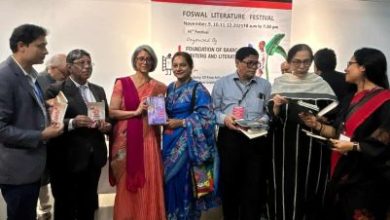
The book “Conversations with the Infinite”, authored by Dr. Jernail Singh Anand, serves as a vital compass for navigation by holding up a mirror to our daily lives and forcing us to confront uncomfortable truths.
A Foreword by Dr. Vinod Asudani
Sahitya Akademi Awardee, Author, and Professor
The Meeting Ground: Sitting Down for Evening Tea
It is both a profound honor and a deeply personal joy to write this Foreword for Dr. Jernail Singh Anand’s remarkable collection, Conversations with the Infinite: Thoughts that travel beyond boundaries; Questions that touch Eternity. When one opens a work of modern philosophy, the mind usually braces itself for an arduous trek through dense thickets of academic jargon, dry abstractions, and clinical detachment. We have been conditioned to believe that serious thought must be esoteric, wrapped in impenetrable vocabulary, and housed safely away on dusty library shelves, far removed from the pulse of everyday human experience.
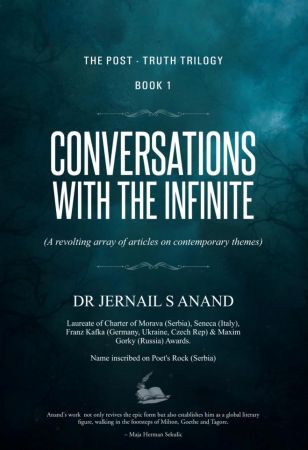 Dr. Jernail Singh Anand shatters this elitist paradigm. As he disarmingly announces in his preface, this book offers “No intellectual stuff: Only a conversation over evening tea”. In an age characterized by chaotic fragmentation, noise, and hyper-specialization, Dr. Anand invites us to sit down, slow our breath, and engage in a warm, intimate dialogue about the most pressing existential questions of our epoch.
Yet, do not let the simplicity of his tone fool you. Beneath this accessible, highly communicable prose lies the formidable intellect of a contemporary philosopher-poet—a thinker who stands in the great continuum of Indian philosophical humanism alongside figures like Mahatma Gandhi, Rabindranath Tagore, and Sri Aurobindo. Dr. Anand’s vast body of work—comprising over 200 books, including 20 epics—reflects a rare, seamless synthesis of Eastern wisdom traditions (Sarbat da Bhala, Vedic metaphysics, Sikh ethics) and Western critical and literary frameworks. He is a visionary who diagnoses the spiritual and ethical pathology of our times with unsparing realism, yet never abandons us to despair.
In Conversations with the Infinite, Dr. Anand lays bare the “rotten era syndrome”—the moral erosion, ecological devastation, corporate tyranny, and technological hubris that threaten the very core of our humanity. But he does so not as a distant prophet shouting from a mountaintop, but as a compassionate companion sharing a warm cup of tea.
Critical Analysis of the Essays: Unpacking the Infinite
To truly appreciate the architecture of Dr. Anand’s thought, we must closely analyze the seventeen essays that comprise this volume. Each chapter functions as a targeted diagnostic probe into the soul of 21st-century civilization, exposing where we have strayed and how we might reclaim our lost dignity.
The Digital Trap and the Neo-Feudal Order
In Chapter 1 (The Technological Invasion: A Tear for the Neo-Slaves of the Corporate Era) and Chapter 2 (Technology’s Invasion: Laptopicarians as Neo-Slaves), Dr. Anand traces a chilling historical regression. Humanity painstakingly evolved from the total servility of ancient feudal subjects under absolute monarchs to citizens endowed with democratic rights and dignity. In the 20th century, labor movements institutionalized fixed working hours, healthcare, leave, and the right to protest. However, the rapid onset of the digital revolution has subtly dismantled these hard-won protections. We have birthed a new class of workers: the Laptopicarians. Hiding behind the illusion of modern flexibility, these digital workers are shackled to screens and smartphones 24/7. Corporate masters sitting in far-off time zones demand relentless target achievement, dissolving the boundaries between school/office hours and personal home life. Even teachers—traditionally the moral custodians of society—have been reduced to day-and-night electronic slaves, mentally stressed and drained of creative initiative. Dr. Anand sheds a compassionate tear for this expanding lower-middle-class workforce, stripped of service security, leisure, and self-respect, and calls for a new rights movement to restore dignity to the digital workforce.
The Moral Vacuum and Literature’s Abdication
In Chapter 3 (Ethical Neutrality &The Fall from Human Graces), Dr. Anand identifies a second catastrophic fall of man. While the first fall in Eden yielded the pursuit of knowledge, our contemporary fall is a fall from human graces—an emotional disintegration masked by physical comfort and technological luxury. Crucially, Dr. Anand critiques the contemporary literary landscape. Unlike the morally intense masterpieces of Shakespeare, Milton, or Wordsworth, modern literature has embraced “ethical neutrality” and aesthetic ambiguity. Fearing accusations of preaching or pontificating, modern authors refrain from taking clear moral stances. Dr. Anand passionately argues for etiquettes—demanding that creative and critical works explicitly embody a cosmic responsibility to promote ethical living, lest our moral ambiguity accelerate civilizational anarchy.
Cosmic Metaphysics and Human Finitude
Chapter 4 (Kaal and Mahakaal: A Vision of Time and the Timeless) provides the cosmic framework necessary to understand human action. Kaal represents temporal, finite time—the mortal realm where all created entities grow, decline, and disappear. Modern humans live uninstructed and uninitiated, blissfully unaware that their brief stay on Earth is governed on a short visa. They obsess over smartness, wealth, and temporal success. Yet, overlapping Kaal is Maha-Kaal—SuperTime, the Lord of Eternity, Immortality, and Deathlessness. Symbolic of Lord Shiva, Maha-Kaal acts as an omniscient cosmic agency that monitors human thoughts and deeds across incarnations, evaluating them through the lens of Karma and DNA rather than superficial earthly evidence. Dr. Anand reminds us that failing to align our temporal lives with this cosmic gaze leads to existential tragedy.
The Architecture of the Self
Chapter 5 (The Digestive Tract) probes the layered nature of human consciousness. Blood, Dr. Anand reminds us, is not merely a biological liquid; it is a repository of ancestral memories, reflexes, and cosmic continuity. Within our minds, a destructive division exists between the upper, formal layer (the social self that play-acts, fakes emotions, and satisfies societal norms) and the underpass (the real self that inwardly protests against these fabrications). The “Digestive Tract” is that deep, internal sanctuary where formal pretense and personal truth meet in raw nakedness. Here, before leaving the world, man sits in judgment of his own lifework, incinerating hypocrisy in ordealic fires and passing the ashes into the Ganges of consciousness. Unlike nature, which possesses serene, unpartitioned wisdom, man’s divided self generates internal turmoil and external destruction.
Crisis in Pedagogy and Institutionalized Formalism
In Chapter 6 (Digitalization and Reworking Educational Paradigms) and Chapter 8 (The Bottling Plant Syndrome: Looking for the Lost Space for Freedom and Creative Imagination in Educational Institutions), Dr. Anand launches a blistering critique against modern education. Designed in an era when time moved on the backs of camels, our educational structures still force bright, digitally adept students through rigid, year-by-year annual slabs. He advocates for flexible, pace-based learning (mirroring ancient Vedic Gurukula traditions where a disciple graduated as soon as mastery was achieved) and commends China’s recent move to replace traditional doctoral thesis requirements with real-world technological innovation.
In The Bottling Plant Syndrome, he exposes how commercialized education has sacrificed moral quotient and “vacant time”—the unstructured moments of contemplation that birthed creative giants like Dr. APJ Abdul Kalam. Today, universities function like industrial bottling plants, churning out standardized, price-tagged products equipped for market competition but utterly vacant of moral anchors. Character-building has been replaced by “smartness”—a euphemism for deceit and flexible honesty—while teachers are buried under administrative paperwork, NAAC compliance, and bureaucratic formalism.
Mastering the AI Jinn: An Ethical Imperative
Chapter 7 (AI – The Ultra Culture: The ‘Jinn’ from Aladdin’s Lamp) stands out as a masterwork of socio-technological philosophy. Framing Artificial Intelligence as a 21st-century Jinn released from the lamp of the human brain, Dr. Anand notes that the issue is not whether the Jinn exists, but whether humanity (Aladdin) possesses the moral maturity to command it wisely. He draws a crucial distinction between assistance (tools that liberate us for higher pursuits) and abdication (systems that infantilize us by taking over human agency). Dr. Anand warns against the “Fake Factory” of deepfakes and simulated realities that erode the ontological foundations of trust. Rejecting the myth of scientific ethical neutrality, he proposes Three Ethical Commands to redirect AI from profit-driven entertainment to public service: the Ecological Command to heal rivers and eliminate agricultural stubble burning, the Social Command to reskill labor and provide rural healthcare, and the Existential Command to invent clean propulsion and zero-fossil-fuel energy systems.
Reclaiming Morality, Art, and Cosmic Connection
The final chapters of the collection synthesize Dr. Anand’s vision for civilizational renewal. In Chapter 9 (Fighting Moral Inertia), he differentiates between superficial religiosity and genuine ethicality, calling on younger generations to reject transactional deals and return to kindness as daily practice. Chapter 10 (Wisdom Farming: Back to Rishis, Rivers and Mounts) contrasts lower, utilitarian knowledge with true wisdom embodied by forests, rivers, and the natural world. In Chapter 11 (Unpoetic Thoughts), he lambasts postmodern literary trends that reduce poetry to narcissistic confessions, asserting that true literature must whisper to the soul and serve a transformative moral purpose.
Chapter 12 (Happiness: A Social Construct, Not a Personal Affair) debunks the hyper-individualistic myth of happiness, showing that joy flows naturally when we share resources and align with cosmic harmony. Finally, Chapter 13 (O That Macbeth Had Read a Poem!) and Chapter 14 (The Laundry Junction of Time &The Underbelly of Human Existence) propose that evil is merely a frozen layer of dust obscuring the inherently divine, shining consciousness of human beings. Through the transformative power of art and cosmic self-realization, humanity can scrape away this toxic accumulation and live as conscious stewards of the universe.
Significance for the Readers: Why This Book Matters Today
The significance of Conversations with the Infinite for the modern reader cannot be overstated. We are living through an unprecedented epoch characterized by what Dr. Anand aptly terms the “rotten era syndrome”—a time when rapid technological advancement is paradoxically accompanied by deep moral confusion, psychological alienation, and ecological fragility. Modern society faces a deep existential crisis where hyper-connectivity and AI collide with digital slavery, loss of vacant space, and spiritual drift. Dr. Anand responds with a prescriptive synthesis that integrates Eastern wisdom (Sarbat da Bhala) with modern science, re-anchors education in character, and redirects AI toward ecological, social, and existential healing.
This book serves as a vital compass for navigation by holding up a mirror to our daily lives and forcing us to confront uncomfortable truths. It exposes how our uncritical adoption of digital gadgets has turned us into “Laptopicarians” who have bartered away peace and dignity for corporate targets. It challenges our educational institutions, revealing how the relentless pursuit of “smartness” has hollowed out character, creativity, and wisdom. It unmasks the illusion of ethical neutrality in science and literature, demanding that authors and scholars take active responsibility for the wellbeing of the cosmic order. Most importantly, Dr. Anand’s ultimate vision is deeply hopeful, providing a clear roadmap for individual and collective renewal through concepts like Maha-Kaal, the Bio-Text, and the Three Ethical Commands for AI.
Transformative Benefits: How Reading This Book Will Change You
Engaging with Conversations with the Infinite is not a passive intellectual exercise; it is a transformative experience that yields immediate and lasting personal benefits across all walks of life. For digital workers and professionals, reading this book provides a powerful antidote to burnout and corporate alienation, empowering them to establish healthier personal boundaries and reclaim “vacant space” for reflection. For educators, students, and parents, Dr. Anand’s critique of the “Bottling Plant Syndrome” offers a liberating alternative to exam-obsessed education by prioritizing character, wisdom, and creative thinking.
For technologists and scientists, the essay on AI serves as an essential ethical primer that equips those working at the frontiers of technology with a social conscience to harness AI for ecological healing and social upliftment. For writers, artists, and cultural workers, this volume is a clarion call to restore moral intensity to creative work and embrace ethiquettes to repair the fractured moral fabric of society. For the general reader seeking peace, Dr. Anand gently redirects attention away from personal wealth and toward the true sources of joy: humane conduct, mutual respect, environmental harmony, and selfless service (Sarbat da Bhala). Reading these essays brings a deep sense of clarity, inner stillness, and cosmic re-alignment, leaving you wiser, kinder, and more conscious.
Conclusion: An Invitation to the Infinite
Dr. Jernail Singh Anand has gifted us a work of enduring brilliance—a literary and philosophical bridge connecting the ancient wisdom of our rishis with the turbulent realities of the digital era. Conversations with the Infinite proves that philosophy need not be locked away in academic towers; it can flourish wherever human beings gather to seek truth, share a cup of tea, and contemplate eternity. As you step across the threshold of these pages, open your heart and mind to the gentle, piercing wisdom of a master philosopher-poet, and let these conversations stir your conscience, ignite your creative imagination, and guide you back to the shining essence of your own humanity.
Read: A Kaleidoscopic View of Life
_________________
 Dr. Vinod Asudani is an Associate Professor Department of Humanities, Ramdeobaba University, Nagpur, India. He is a distinguished academician, researcher, poet, writer, psychologist, counselor, HRD trainer, public speaker, social activist, and quantum spiritual practitioner. Despite being visually challenged since birth, he has built an inspiring career spanning over 26 years as Associate Professor in the Department of Humanities at Shri Ramdeobaba College of Engineering and Management, Nagpur. He is a multilingual author writing in English, Hindi, Sindhi, and Urdu, with 21 authored books, 18 translations, more than 30 research papers, and over 100 conference presentations. A recognized Ph.D. supervisor, he has guided research in English and Psychology. Dr. Asudani has trained over 60,000 students and professionals through HRD, soft skills, motivation, and personality development programs. His literary excellence earned him the prestigious Sahitya Akademi Award (2023), making him the first visually challenged recipient across India’s 24 recognized languages. He has also received numerous national and international honors for literature, education, and social service. His work promotes disability empowerment, Sindhi language and culture, and holistic human development. He regularly shares literary discussions and motivational talks through digital platforms, inspiring audiences worldwide.