

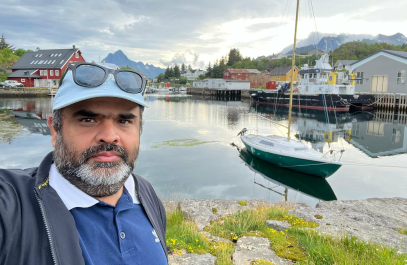
The first week of July 2026 brought us to one of those rare corners of Europe where nature seems to have been given complete freedom to express itself.
By Abdullah Usman Morai | Sweden
After a long road journey from Luleå in northern Sweden to Svolvær in Norway, my friend Dr. Imran Jamali and I finally had the opportunity to sleep properly at our Sommerhotell og Vandrerhjem in the Lofoten Islands. The previous day had been filled with long hours on the road, changing landscapes, mountains, forests and the excitement of crossing into Norway. Now, after a peaceful night’s sleep, we woke up ready to begin exploring Lofoten.
Outside, the weather was typically northern: cloudy, cool and slightly chilly. But the clouds did not make the landscape gloomy. On the contrary, they seemed to add another layer of beauty to the already dramatic scenery.
Lofoten looked as though someone had painted mountains, sea, fishing villages and clouds on a giant canvas.
 A Breakfast Full of Travellers
We headed towards the breakfast hall, which was included in our room reservation. The hall was simple but attractive, with a warm and welcoming atmosphere. Many guests were already enjoying their breakfast, while others were preparing themselves for another day on the road.
What caught our attention immediately was the variety of travellers.
There were biker couples dressed in their riding gear, single travellers, women travelling independently, and families with children. Some were clearly preparing for long motorcycle journeys through northern Norway, while others appeared to be tourists who had come to experience Lofoten’s mountains and sea.
For us, breakfast became an experience in itself.
There was so much delicious food that it was genuinely difficult to decide what to eat first. Breads, cheese, eggs, fruits, cereals and other breakfast items competed for attention. And, naturally, being in Lofoten, Norwegian fish was also part of the spread. We could not resist tasting it.

A journey through Lofoten, we quickly realized, was going to involve not only beautiful landscapes but also an introduction to the food traditions of the far north.
The accommodation itself was much more than simply a place to sleep. In a nearby building there was a large, fully equipped kitchen where guests could prepare their own food whenever convenient. There was also a separate television room, a library and even a sauna.
As we looked around, we began wondering about the history of the building. Perhaps it was a school during the academic year and transformed into accommodation during the summer holidays. It seemed like a clever Scandinavian idea: make practical use of the building while providing affordable accommodation for travellers during the busy summer season.
Whatever its original purpose, it had created a wonderful international atmosphere.
Our First Map of Lofoten
After breakfast, we went to reception and collected maps of the area. The receptionist was extremely helpful. We explained the places we were hoping to explore during our stay, and she marked several locations on the map.
Holding that map in our hands was exciting.
Until then, Lofoten had been an idea, a destination we had read about and seen in photographs. Now the map showed us the actual geography of the islands, the roads, villages, mountains and coastlines that we were about to experience.
Our first destination was nearby Kabelvåg.
But before driving there, we stepped outside and discovered a scene that immediately made us stop.
 A Picture-Postcard by the Water
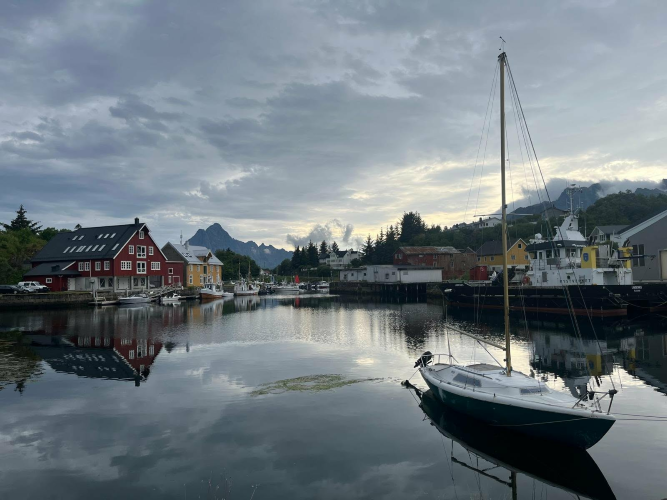
Not far from our accommodation was a beautiful body of water forming part of the Norwegian Sea. The view was almost impossible to describe.
The water was calm, reflecting the buildings, mountains and clouds around it. Small boats were resting quietly on the surface. Behind them, mountain peaks rose dramatically, while clouds moved slowly across the sky.
Everything appeared twice, once in reality and once in the water.
Buildings stood beside their reflections. Mountains seemed to continue beneath the surface. Clouds floated above us and appeared again below.
For a moment, the entire landscape looked like a giant picture postcard.
One could almost doubt whether the scene was real.
This is perhaps the special magic of Lofoten. Its beauty does not always arrive with dramatic weather or spectacular sunsets. Sometimes it simply sits quietly in front of you: a boat, a mountain, a red wooden building and a patch of calm water and somehow becomes unforgettable.
Kabelvåg: Where Lofoten’s Story Began
We drove towards Kabelvåg, one of the historic settlements of Lofoten.
According to Visit Lofoten, today, Kabelvåg is a relatively small and peaceful community, but its history is enormous. The area is regarded as the birthplace of the Lofoten cod fishery, with roots stretching back more than a thousand years. During the Viking Age and Middle Ages, the settlement then known as Vágar became an important center for fishing and the stockfish trade.
It was fascinating to think that the quiet streets we were travelling through had once been connected to a major northern trading center.
The cod that arrived in these waters was not merely food. It became an economic force. It supported fishermen, traders, boat builders and communities, and eventually connected these remote Arctic islands with markets far beyond Norway.
That history is still visible today.
 The Lofoten Cathedral
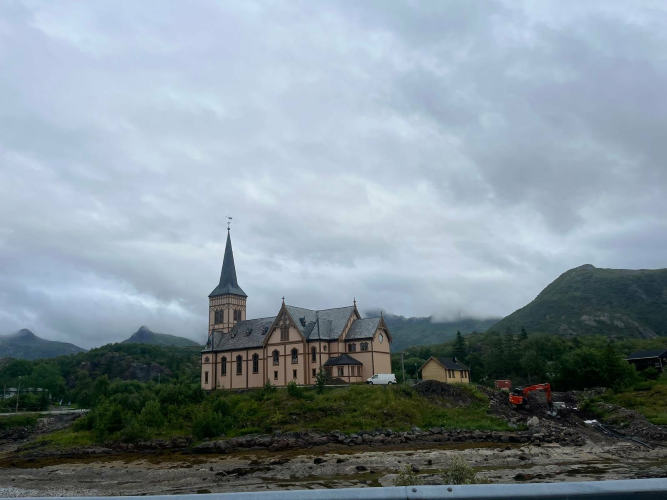
One of the most impressive landmarks of Kabelvåg is Vågan Church, popularly known as the Lofoten Cathedral.
According to Visit Lofoten, the first church at this site dates back to the early 12th century, traditionally associated with King Øystein. The present wooden church was built in 1898, largely because the annual Lofoten fishery brought huge numbers of fishermen to the area. With around 1,200 seats, it is one of the largest wooden churches in Norway and the largest church in Northern Norway.
Behind the church were the enormous mountains of Lofoten. In front of us stood a great wooden structure built by human hands more than a century ago.
The church seemed almost like a bridge between two worlds: the spiritual life of the fishermen and the unpredictable Arctic sea on which their livelihoods depended.
For generations, fishermen came here before facing the waters. They knew that the sea could provide everything, but they also knew that it could take everything away.
The church therefore was not simply a building. It was part of the emotional and cultural landscape of Lofoten.
 Svolvær: The Living Heart of Lofoten
From Kabelvåg, we continued towards Svolvær, the main town and an important centre of eastern Lofoten.
Our first stop was the tourist information office, where we collected additional information about the region and discussed places we could visit during the coming days. The tourist office is centrally located in Svolvær and serves visitors looking for information about the entire Lofoten archipelago.
But Svolvær itself required no brochure to impress us.
It was the kind of town where mountains seemed to rise directly from the sea.
Fishing boats, wooden houses, red fishing cabins, harbours and dramatic peaks came together in a remarkably compact landscape. The famous mountain formation Svolværgeita could be seen among the surrounding peaks, reminding us that this was not an ordinary coastal town.
Tourists were everywhere.
Many were waiting near the harbour to board boats for excursions and sea adventures. We noticed a particularly large number of Asian visitors, apparently from countries such as China and Japan. Interestingly, we did not encounter the same number of Indian tourists that one often sees in major Central European destinations.
The atmosphere was international, but the town itself remained unmistakably Norwegian.
Along the waterfront, wooden platforms provided places where visitors could simply sit and enjoy the surroundings. We did exactly that.
Sometimes travelling does not require movement.
We sat by the water and looked at the mountains, boats and reflections. There was something deeply peaceful about it. The temptation was to forget the clock completely.
Nearby, tourists were preparing for kayaking. Others were gathering for boat trips. Some were taking photographs, while others simply stood quietly, absorbing the view.
Svolvær seemed to offer different ways of experiencing the same landscape: from the water, from a kayak, from a fishing boat, from the harbour or simply from a wooden bench.
 The Silent Architecture of Stockfish
One of the most distinctive sights of Lofoten was the traditional wooden structure used for drying fish.
According to Visit Lofoten, Stockfish is not merely a food product here; it is part of the identity and history of Lofoten. The annual cod fishery has shaped the region for centuries. Migrating Arctic cod, known as skrei, travel from the Barents Sea towards Lofoten to spawn, creating the foundation for the region’s historic fishery.
The fish are traditionally hung on large wooden racks and left to dry naturally in the cold, windy Arctic climate.
Standing beside one of these structures, we could almost imagine the generations of fishermen who had depended upon this simple process.
No complicated factory was required; nature itself became the drying machine, and wind, temperature, and time did the work.
The fish hanging from the wooden racks also served as a reminder that Lofoten’s breathtaking scenery is not merely something to be photographed. For centuries, these mountains and seas have been workplaces, sources of food and foundations of entire communities.
The Fisherman’s Wife: Waiting by the Sea
Later, we drove towards the area near the famous Fisherman’s Wife, locally known as Fiskerkona or Feskarkjerringa. We parked nearby and continued on foot.
The walk itself became part of the experience.
The route leads towards the breakwater, where the mountains and open sea create a dramatic backdrop. The walk is considered easy, and along the way visitors encounter traces of Svolvær’s fishing and cultural history, including fish-drying racks.
And then we saw her.
The Fisherman’s Wife stands at the end of the pier, looking out towards the sea.
According to Visit Lofoten, created by Norwegian sculptor Per Ung, the statue is about 4.5 metres high. Her posture conveys a powerful and timeless story: a woman standing by the sea, waiting for her fisherman husband to return.
We stood there for a while without saying much.
The statue seemed to represent far more than one woman.
She represented the wives, mothers and families who spent generations waiting for fishermen to return from dangerous waters. Behind her was the enormous Norwegian Sea, the same sea that had provided Lofoten with prosperity and had also demanded courage from those who depended upon it.
Looking at her against the open horizon, the meaning became even more powerful.
The mountains behind us were solid and permanent. The sea before us was restless and unpredictable. And between the two stood a woman waiting.
Perhaps that is why the statue leaves such a strong impression.
I thought about Shah Abdul Latif Bhittai’s Sur Samondi there and smiled.
 A Day That Became a Beginning
By the end of that day, we had not travelled an enormous distance. We had simply explored the surroundings of our base, visited Kabelvåg and Svolvær, spoken to local people, studied maps and wandered beside the sea.
Yet it felt as though we had travelled through centuries.
From the ancient fishing traditions of Kabelvåg to the wooden walls of the Lofoten Cathedral; from the busy harbour of Svolvær to the silent stockfish racks; from modern tourists preparing for kayaking to the Fisherman’s Wife standing eternally at the end of the pier, the day had introduced us to many different faces of Lofoten.
We had arrived expecting mountains and sea. Instead, we discovered a living story.
A story written by fishermen, travellers, churches, boats, wooden houses, Arctic winds and the endless movement of the sea.
And as we looked at the mountains disappearing into the evening clouds, one thought became clear: Our journey through Lofoten had only just begun.
Read: Crossing Borders into Norway’s Wild Beauty
___________________
Abdullah Soomro, penname Abdullah Usman Morai, hailing from Moro town of Sindh, province of Pakistan, is based in Stockholm Sweden. Currently he is working as Groundwater Engineer in Stockholm Sweden. He did BE (Agriculture) from Sindh Agriculture University Tando Jam and MSc water systems technology from KTH Stockholm Sweden as well as MSc Management from Stockholm University. Beside this he also did masters in journalism and economics from Shah Abdul Latif University Khairpur Mirs, Sindh. He is author of a travelogue book named ‘Musafatoon’. His second book is in process. He writes articles from time to time. A frequent traveler, he also does podcast on YouTube with channel name: VASJE Podcast.


Great
A restful appealing information
Abdullah Morae Saheb enjoying physically and designing our day dreams.
I like such article and travel lover….