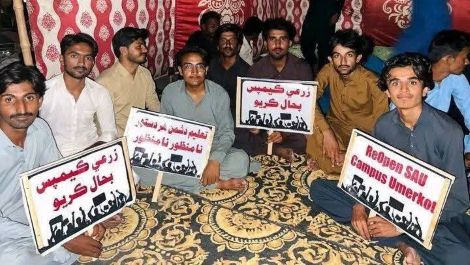
The sudden closure of Sindh Agriculture University’s Umerkot Campus on July 15, 2026, has left over 1,200 students facing uncertain futures despite having already paid their semester fees.
Protesting locally, students alongside faculty—who face 15 months of unpaid salaries—are calling on authorities to resolve the financial crisis, restore academic activities, and support vital agricultural research in this agrarian region.
Ali Nawaz Rahimoo
Sindh Agriculture University Tandojam has reportedly closed its sub-campus in Umerkot, leading to ongoing protests by enrolled students for the past several days. The closure of this campus should not be viewed merely as administrative mismanagement; it represents a major policy failure that deprives the youth of Umerkot and adjacent districts of their fundamental right to higher education.
The regions surrounding Umerkot are predominantly dependent on agriculture and livestock. Local farmers face an uncertain future driven by severe water shortages, soil infertility, low crop productivity, limited technological integration, erratic weather, and shifting rainfall patterns. It is troubling that higher education in the very field sustaining this population is being abandoned and rendered unviable locally.
Students from the Umerkot Campus have staged protests at the local press club, demanding the immediate reopening of their institution. Having already deposited their semester fees, hundreds of students are deeply concerned about their academic futures due to the university administration’s sudden decision. Umerkot suffers from a critical shortage of higher education facilities, making this campus indispensable for local youth.
Shutting down a university campus after enrolling students and collecting their fees lacks justification. The university administration must clarify its reasons and ensure that students’ academic goals are not compromised. The campus holds the potential to serve a vast rural population that cannot afford the living, food, hostel, and transportation expenses required to relocate to Hyderabad, Tandojam, Karachi, or other distant cities. For working-class families, local access to higher education is essential to prevent capable young individuals from abandoning their studies. While government officials frequently highlight youth empowerment, job creation, climate resilience, and agricultural development, grass-root public institutions continue to lack essential support.
 Faculty and staff at the Umerkot Campus are also severely affected, facing 15 months of unpaid salaries alongside continuous uncertainty regarding student admissions, according to lecturer Zulfiqar Mari. He urged relevant authorities to intervene proactively by coordinating with key stakeholders to clear pending salaries, resume classes, reinstate admissions, and formulate a sustainable financial strategy for the campus.
Umerkot requires dedicated agricultural research even more than central hubs like Hyderabad or Tandojam. The campus could serve as an essential research center for drought-resistant crops, water-efficient irrigation, organic farming, bio-fertilizer production, kitchen gardening, animal husbandry, climate-smart agriculture, seed development, ecosystem restoration, and renewable energy solutions. If an agriculture campus cannot operate in a primary agricultural district, its viability anywhere else remains questionable.
The Sindh Agriculture University Umerkot Campus initially launched classes in January 2018 within the Vocational Training Centre for Boys in Umerkot. In March 2022, it relocated to the Public School building in Vehro, where academic programs continued. However, physical operations ceased on July 15, 2026, creating widespread confusion regarding the university’s future and its 1,200 enrolled students—including approximately 450 female and 750 male students. The campus allowed these young individuals to pursue higher education without leaving their home district. Concerns have intensified following the university administration’s decision to exclude the Umerkot Campus from the admission plan for the 2027 academic year, leaving students, faculty, and community members uncertain about its operational status.
When local institutions in underdeveloped districts are neglected or abandoned, youth are deprived of quality higher education. The administration of Sindh Agriculture University Tandojam must address the reported closure transparently and outline clear pathways for students and staff. If the campus suffers from underfunding or staffing shortages, these challenges should be rectified without shutting down the facility.
The campus requires an adequate, well-qualified faculty along with essential infrastructure, including laboratories, reliable water supply, internet connectivity, transportation, and an uninterrupted power supply. Students must not be left uninformed, and a long-term strategic direction for the campus must be established without compromise. Establishing research stations, demonstration farms, and collaborative faculty-student initiatives can transform the institution from a degree-granting entity into a driver of rural progress.
The announcement regarding the closure of the Umerkot Campus should serve as an urgent call for authorities to increase educational budgets, ensure institutional transparency, and restore public centers of learning. Sustainable regional development requires providing agricultural districts with the academic faculties, research facilities, and laboratories necessary to excel and contribute to the nation’s agricultural sector.
Read: Chaunra – Resilient Thar Desert Homes
_________________
 Ali Nawaz Rahimoo, based in Umerkot, Sindh is a social development professional. He can be contacted on anrahimoo@gmail.com