Destruction of Malir’s Ancient Goths
Malir Expressway (Shahrah-e-Bhutto): Development or Forced Displacement?

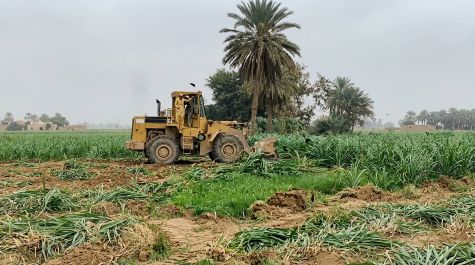
The Malir Expressway project in Karachi—renamed Shahrah-e-Bhutto—presents a critical conflict between infrastructure expansion and community survival.
Framed as a symbol of economic progress, it has drawn heavy criticism for displacing indigenous villagers, destroying ancient green belts, and operating with questionable legal, environmental, and financial transparency.
By Noor Zaheer
The Malir Expressway has been presented as a development project intended to improve connectivity and bring economic benefits to Karachi. But for many people living in Malir’s ancient villages, the project has also come to represent the continuing loss of land, agricultural fields, greenery, historic trees and a way of life that has existed for generations.
From the beginning, many local residents opposed the project because they feared that development would come at the cost of their homes, livelihoods and land. Families who have lived in these areas for centuries are now being asked to bear the consequences of a form of development they say they did not choose. The question is simple: when development takes away the land and security of people who have lived there for generations, can it still be called development without considering its human and environmental cost?
 Malir has already witnessed the transformation of large areas through projects associated with Bahria Town and DHA. Local communities and environmental activists have repeatedly raised concerns about the loss of agricultural land and green areas, including parts of the Kathore green belt and surrounding landscapes.
Large plots and new developments may bring investment, but for local residents the price can be the loss of homes, farmland, trees and the security that comes from owning and working their land.
Education City is another major development issue in Malir that deserves separate discussion. Across these projects, however, one concern keeps returning: what happens to the communities that already live on the land? Development should not be measured only by roads, buildings and investment. It should also be measured by whether local people can remain secure in their homes and whether the natural environment survives.
The Malir Expressway controversy has also involved questions about financing and environmental safeguards. The Asian Development Bank (ADB) was associated with the project during an earlier stage and environmental and social assessment material was prepared. ADB later decided not to finance the Malir Expressway and the project was no longer an ADB-assisted project. Yet the project continued. This raises an important public question: what safeguards were followed after ADB’s withdrawal, and how were the concerns of affected communities addressed?
Today, the environmental cost is visible on the ground. Green areas have been cleared, agricultural land has been disturbed and trees that have stood in Malir for generations have disappeared. These old trees are not simply vegetation. They have provided shade, shelter and an important part of the landscape for local communities. Once such trees and agricultural spaces are destroyed, they cannot easily be replaced.
Azeem Dhakan was also arrested a few days ago. According to him, he is being forcibly evicted from his land. He says that the purpose of his third arrest was also related to his refusal to agree to a deal concerning his land. According to Dhakan, he had not been willing from the first day to make a deal regarding his land.
The issue is not limited to the land itself. Questions have also been raised about changes made to the project maps. According to the information shared by Dhakan, the project map was changed three times. The first map had no interchange. Later, the map was changed to some extent, while the third map included interchanges that were not present in the first map and were not included in certain Sindh government reports. The reasons for these changes, the process through which they were made and their legal and administrative background should be made clear to the public.
Dhakan has also said that after his land was taken and his fields and crops were destroyed, he was directly told that possession of his land had been taken and that he could do whatever he wanted. If this statement is accurate, it raises a serious question: are the rights of a citizen being fully protected under the law and the Constitution?
According to Dhakan, he wants to continue fighting for his land until the last day, but through the law and within the constitutional process. His statements also show that he is deeply disappointed by the absence of a court decision. This is a deeply sad and surprising situation, particularly when the future of land and local communities remains before courts and relevant institutions. Environmental activists, along with local people, have also seen these conditions on the ground.
 The project’s name also raises questions. Reports of the Asian Development Bank and certain Sindh government reports referred to the project as the Malir Expressway, while the project was later renamed Shahrah-e-Bhutto. Social media still contains a large amount of material under the name Malir Expressway, while comparatively little is discussed or written under the name Shahrah-e-Bhutto. What was the purpose of changing the project’s name, and was the change connected with presenting the project as a successful project? This is also a public question, particularly if the project faced controversy and local opposition from the beginning.
These are not merely political questions. They are questions of law, transparency and environmental justice.
Pakistan’s Constitution protects property rights, while land acquisition and displacement should follow the applicable legal process. Where environmental or development approvals are required, affected communities also have a legitimate interest in knowing whether the relevant procedures were followed and whether their concerns were considered.
The role of the police also requires transparency. When police arrive at a disputed site, the public has a right to ask: who requested their presence, under what legal authority, and what exactly were they instructed to do? In a dispute over land, every party should have an opportunity to present its case and seek a legal remedy without intimidation or unnecessary pressure.
We are not against development. Malir should develop, and Karachi needs better infrastructure. But development should not mean that the land, homes, agricultural fields, historic trees, environment and future of local communities become the price of progress. A road can be built, but a community displaced from its ancestral land cannot simply be reconstructed somewhere else.
If the authorities believe that the acquisition or clearance of local land is lawful, they should make the relevant documents public: land records, acquisition notifications, agreements, approvals, court orders where applicable, compensation details and the legal basis for police action. Transparency would allow the public to distinguish between lawful development and actions that local residents reasonably perceive as dispossession.
Malir is not merely vacant land waiting for development. It is home to communities with generations of history, culture, livelihoods and a deep relationship with the land and natural environment. The remaining agricultural fields and ancient goths are part of Karachi’s living heritage. If all of this is sacrificed in the name of development, we must ask a basic question: development for whom, and at whose cost?
Read: Development at Environmental, Social Cost
___________
 Noor Zaheer